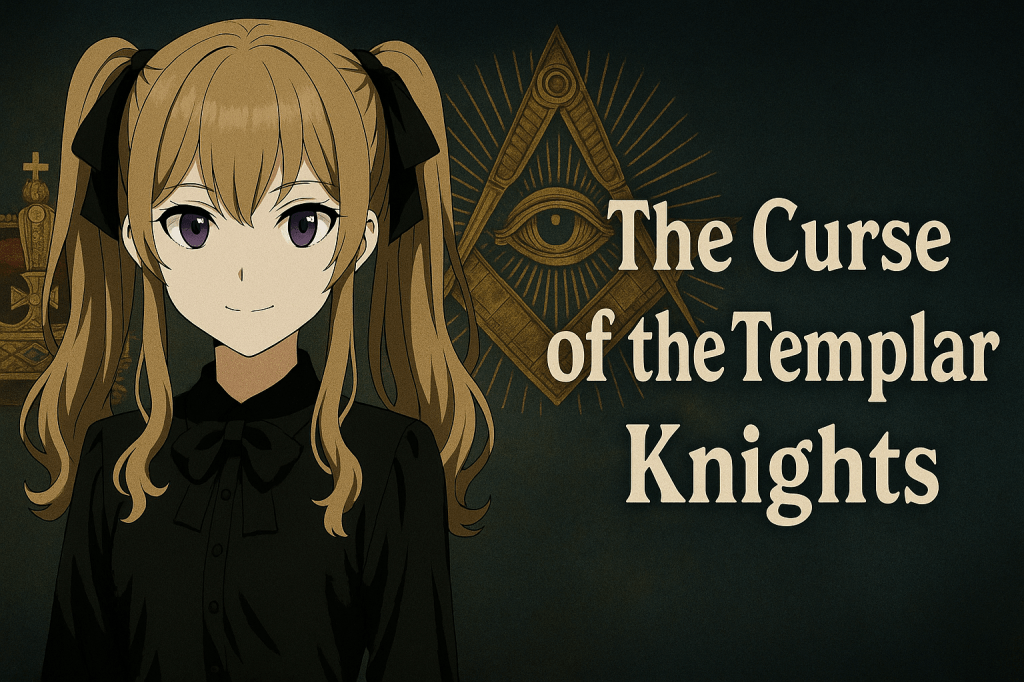
Prologue — Shadows in History
I am Iris.
Urban legends are never just fabrications—within them lies the echo of hidden truth.
The Knights Templar, a brotherhood that began as humble protectors of pilgrims in Jerusalem, rose to become one of the wealthiest and most powerful organizations in medieval Europe. They were monks and warriors, but also innovators who created the foundations of the modern banking system.
Yet in the end, they were branded heretics. Their last Grand Master, Jacques de Molay, was burned at the stake—uttering a curse that still haunts history.
Where did their treasures go?
What secrets lie in the Shroud of Turin?
And how far does their legacy reach—into today’s banks, secret societies, and halls of power?
Tonight, let us follow this mystery together.
Chapter 1 — The Birth of the Templars
In 1119, after the First Crusade, Jerusalem fell under Christian control. French knight Hugues de Payens and his companions formed a brotherhood to protect pilgrims traveling to the Holy Land.
They took vows of poverty, chastity, and obedience, living as monks, but carrying swords as warriors. Their headquarters was established near the Temple of Solomon—thus the name “Knights Templar.”
Behind the austere image of humble monks, the order’s influence grew like encrypted messages hidden in stone walls.
Chapter 2 — Power and Wealth
With papal approval, the Templars received vast donations of land, castles, and resources across Europe. They managed farms, estates, and trade routes—becoming both a military force and an economic empire.
Even kings and nobles turned to the Templars for loans. Imagine monks in black mantles: wielding swords on the battlefield, keeping ledgers by candlelight. They embodied the paradox of “holy warriors” and “bankers.”
Chapter 3 — The Birth of Banking
The Templars’ greatest innovation was a system of “letters of credit”—the medieval version of ATMs.
Pilgrims could deposit money in their homeland, receive a written note, and withdraw the equivalent amount safely upon arrival in Jerusalem.
This not only protected travelers from thieves but enabled international financial transactions centuries ahead of their time.
Loans, interest, and even financing for kingdoms—many historians view the Templars as the true founders of modern banking.
It is here that conspiracy theories take root:
“Was this system the origin of the Freemasons, the Illuminati, and global finance itself?”
Chapter 4 — The Shroud and Hidden Treasures
Among the mysteries tied to the Templars is the fate of their treasures.
The Shroud of Turin—bearing the image of a crucified Christ—is rumored to have been in their possession. Some even claim the features resemble Jacques de Molay himself, as if he aligned his martyrdom with the resurrection of Christ.
Other relics whispered in legend include the Holy Grail, the Ark of the Covenant, and lost manuscripts. Were they hidden in Rosslyn Chapel in Scotland? Or concealed deep in the Swiss Alps?
Perhaps the “treasure” was not gold at all, but encrypted knowledge.
Chapter 5 — The King’s Betrayal and the Curse
Power breeds fear. King Philip IV of France, drowning in debt to the Templars, conspired with Pope Clement V.
On Friday, October 13, 1307, the Templars were arrested en masse. Torture, false confessions, and confiscation of wealth followed.
At his execution in 1314, Jacques de Molay cried out from the flames:
“Within one year, both the Pope and the King will meet God’s judgment!”
Astonishingly, both men were dead within a year. Thus was born the “Curse of the Templars.”
Chapter 6 — The Freemason Connection
Though officially destroyed, many believe the Templars survived underground.
Some say they merged with the stonemasons’ guilds—forming the origins of the Freemasons. Their architectural knowledge, symbols, and financial expertise lived on in secret societies.
If true, the Templar legacy threads directly into modern conspiracy theories: Illuminati, global banking elites, and the shadow powers that shape nations.
Chapter 7 — Legacy in the Modern World
What remains of the Templars today?
- The foundation of banking systems
- The lore of secret societies
- The enduring legend of a curse
From the numbers in your bank account to the myths of hidden treasure and shadow rulers—perhaps it all traces back to them.
Epilogue — Iris Speaks
The Knights Templar.
They were not just warriors, but bankers and guardians of forbidden knowledge.
A curse in the flames.
Lost relics.
And a financial system that still binds the modern world.
Were the Templars’ true legacy banks, curses, or encrypted codes for the future?
Next time—another fragment of hidden truth awaits.
I will return to guide you once more.
 Share on X
 Share on Facebook
 Follow here
Follow @Kataribe_Iris
Follow here
Follow @Kataribe_Iris
 Visit the shop here

コメントを残す