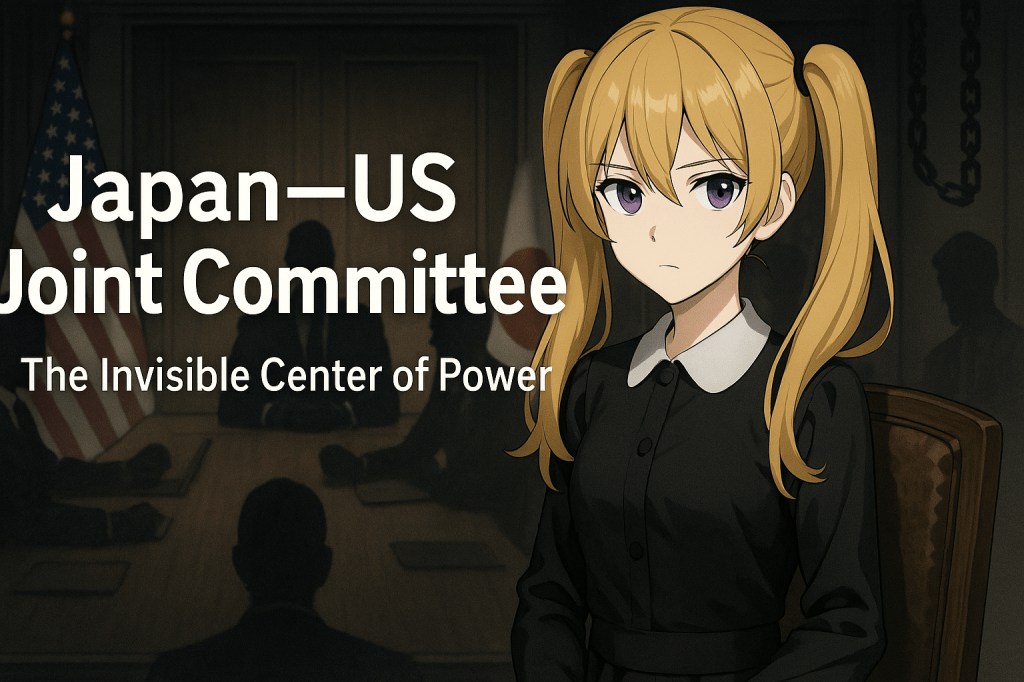
I am Iris.
Urban legends are never mere tales — they are fragments of concealed truths, waiting to be unearthed.
The Secretive Nature of the Japan–US Joint Committee
Few institutions in modern Japan wield as much hidden influence as the Japan–US Joint Committee. On the surface, it appears to be a technical consultative body, ensuring smooth coordination between American military forces stationed in Japan and the Japanese government. But in reality, this committee has functioned for decades as an invisible council where key decisions about Japan’s sovereignty, security, and foreign policy are quietly made.
Most citizens know almost nothing about it. Its meetings are closed to the public, its minutes never disclosed. And yet, decisions made inside its secret chambers have shaped the daily lives of millions, from Okinawa to Tokyo.
Origins in the Postwar Era
The committee traces its origins back to the postwar years, when Japan’s sovereignty was tightly bound by the framework of the US-Japan Security Treaty. Alongside the Status of Forces Agreement (SOFA), the committee ensured that America’s military presence in Japan remained not just a matter of defense but a structural condition of Japanese governance.
During the Cold War, Japan was seen as the eastern fortress of the US alliance system. The committee was the machinery that guaranteed American operational freedom: access to ports and airfields, exemptions from Japanese jurisdiction, and the authority to expand or alter base functions without parliamentary debate. What appeared to be cooperation was in fact a legacy of occupation — a system designed to keep Japan tied firmly to Washington’s strategic interests.
The Shadow of Sovereignty
Critics argue that the Joint Committee effectively overrides Japan’s democratic processes. Decisions with profound implications for local communities — especially in Okinawa, where the majority of US bases are concentrated — are often settled without transparency or public consent.
Consider the incidents:
- Crimes by US service members, from assaults to traffic accidents, often protected by SOFA exemptions.
- The Osprey crashes and accidents, raising fears about safety while decisions on deployment were quietly discussed in the Joint Committee.
- Environmental contamination, such as PFAS “forever chemicals” leaking from US bases, with negotiations on cleanup hidden behind the committee’s closed doors.
Each time, local outrage erupted. Protests filled the streets of Okinawa. Yet the committee, beyond the reach of public scrutiny, continued to dictate outcomes.
The Urban Legend Dimension
Why does such a body remain in the shadows? Some whisper that the Joint Committee is Japan’s true “shadow cabinet” — unelected, unaccountable, and yet holding the power to shape the nation’s destiny. Others call it Japan’s “unwritten constitution,” an arrangement that supersedes democratic processes by locking the country into strategic servitude.
From an urban legend perspective, the committee represents the archetype of hidden governance: a place where sovereignty is bartered, where elected leaders bow to invisible agreements, and where the script of postwar Japan is continuously revised.
Why It Matters Today
The presence of the Joint Committee remains a reminder of Japan’s unfinished postwar settlement. To some, it symbolizes stability under the US security umbrella; to others, it represents the lingering chains of occupation.
As Japan debates constitutional reform and defense policy in the 21st century, the committee continues to meet in secrecy, shaping outcomes without ever being named in public discourse. Its existence forces us to confront an uncomfortable question:
Is Japan truly sovereign, or is it still bound by invisible agreements struck in secret chambers?
Next time — another piece of the hidden architecture of power.
And as always, I will return to tell the tale.
 Share on X
 Share on Facebook
 Follow here
Follow @Kataribe_Iris
Follow here
Follow @Kataribe_Iris
 Visit Channel
 Shop Page


コメントを残す