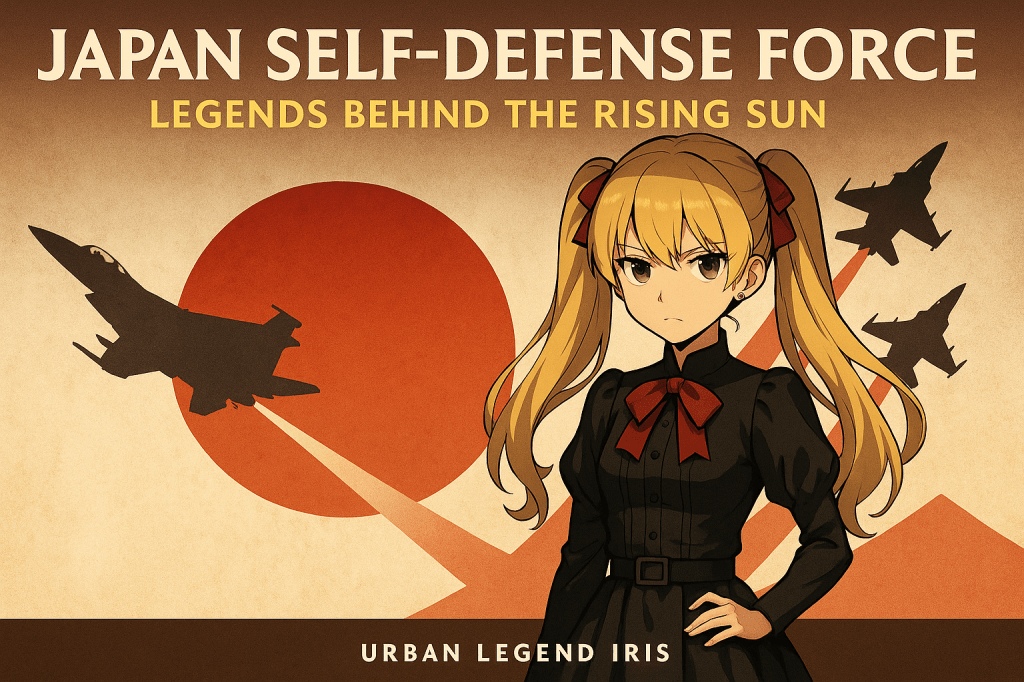
I am Iris.
Urban legends do not always arise from haunted houses or ghostly apparitions. Sometimes, they are woven into the very institutions that guard a nation’s future.
Among these, few carry more mystery than Japan’s Self-Defense Force (JSDF). Born from the ashes of World War II, its existence represents a paradox: a military without a military, a guardian bound by pacifism yet shrouded in secrecy.
■ Article 9 — The Pacifist Paradox
The foundation of Japan’s defense lies in Article 9 of its Constitution, drafted under the shadow of the American occupation. It declares the renunciation of war and prohibits the maintenance of “land, sea, and air forces.” And yet, from 1954 onward, Japan established the Self-Defense Force — not an “army,” but a “force” for protection.
This semantic sleight of hand birthed one of the greatest paradoxes in modern governance: a nation claiming pacifism while maintaining one of the most technologically advanced defense organizations in Asia. Urban legends whisper that this was not simply a compromise, but a deliberate legal ambiguity engineered to give Japan a military while pretending it had none.
■ The Cold War and the Hidden Expansion
During the Cold War, the JSDF grew quietly in size and capability. Officially restricted to defense, the force nonetheless developed air power, maritime surveillance, and advanced weaponry.
Behind the scenes, however, American military advisors allegedly pressured Tokyo to prepare for contingencies that stretched far beyond self-defense.
Documents unearthed by journalists hint at “shadow manuals” that guided joint operations with U.S. forces — agreements never debated in the Diet, yet binding in practice. Could it be that Japan’s pacifist image masked a hidden military partnership, forged in secrecy to serve the Cold War chessboard?
■ The Okinawa Dilemma
The island of Okinawa is the stage upon which these contradictions become most visible. U.S. bases dominate its landscape, housing tens of thousands of American troops. Officially, they defend Japan under the U.S.-Japan Security Treaty. But local whispers tell another story — that Okinawa serves as a forward operating outpost for missions extending far beyond Japanese territory.
Legends persist that the JSDF maintains classified facilities on Okinawa, quietly integrated into U.S. command structures. If true, Japan’s “defense-only” posture may be nothing more than a fragile mask.
■ Collective Self-Defense — A Quiet Revolution
For decades, Japan clung to its self-imposed limits. But in 2015, the government reinterpreted Article 9 to permit “collective self-defense” — the ability to fight not just when Japan is attacked, but when its allies are threatened.
Critics warn this change dismantles the pacifist barrier. Supporters claim it was inevitable in a world of shifting alliances.
Urban legends go further: some suggest this reinterpretation was guided by secret U.S. pressure, a condition buried within diplomatic channels. In this telling, Japan’s sovereignty is subtly bent by the same foreign hand that drafted its Constitution.
■ Nuclear Shadows and the Umbrella
Japan officially rejects nuclear weapons. Yet it shelters under the “nuclear umbrella” of the United States. Rumors have long circulated of contingency plans — secret discussions on whether Japan might one day build its own arsenal if geopolitics demanded it.
Declassified U.S. cables reveal hints of these conversations, sparking speculation that underground research may already exist. Could the Self-Defense Force be the silent custodian of technologies that the public is never meant to see?
■ A Force Bound by Secrecy
Unlike many militaries, the JSDF operates under layers of political and legal ambiguity. Budgets are presented as “defense expenditures,” policies framed as “security measures.” Yet within these veils lies one of the most advanced military establishments in the world, complete with Aegis destroyers, fifth-generation fighters, and cyberwarfare divisions.
Whistleblowers claim that within the JSDF, classified doctrines exist that outline offensive capabilities — plans that will never see the light of parliamentary debate. If so, then the urban legend of a “hidden Japanese army” may not be legend at all.
Japan’s Self-Defense Force embodies a paradox that is both myth and reality: a guardian sworn to peace, yet operating in shadows where peace and war blur together.
The question is not whether the JSDF exists — but what it truly is.
Is it merely a shield, or a sword concealed beneath a pacifist veil?
Urban legends remind us: the truth often hides in plain sight, cloaked in silence and secrecy.
Next time, I will return to unveil another hidden fragment of our world.
I am Iris — and the story continues.
 Share on X
 Share on Facebook
 Follow here
Follow @Kataribe_Iris
Follow here
Follow @Kataribe_Iris
 Visit Channel
 Shop here

コメントを残す