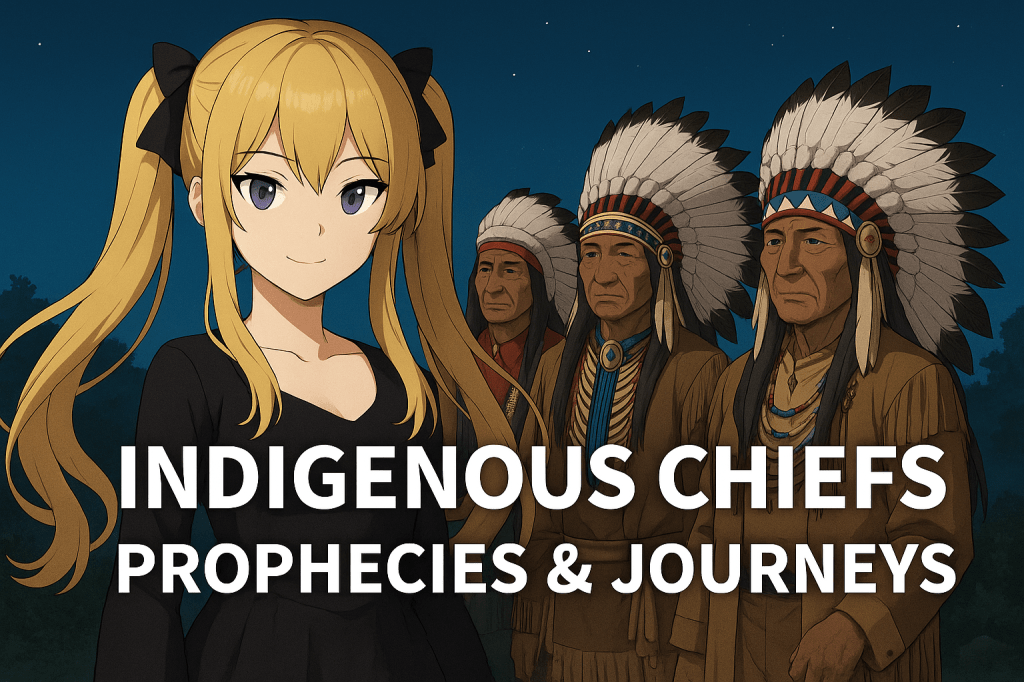
“I am Iris.
The wind carries ancient words, and the fire remembers every prayer.
Tonight, let us follow the journey of the Indigenous chiefs who walk the Earth,
sharing prophecies that whisper both warning and hope.”
🔥 Chapter 1 – The Traveling Elders
The Indigenous elders are not merely speakers.
They are living libraries, the vessels of their people’s memory.
From the deserts of Arizona to the mountains of South Dakota,
they travel to remind the world of what humanity has forgotten.
- Thomas Banyacya (Hopi) — who spoke at the United Nations about harmony and consciousness.
- Dan Katchongva (Hopi) — one of the Four Elders who revealed the Hopi Message to the modern world.
- Arvol Looking Horse (Lakota Sioux) — keeper of the White Buffalo Calf Pipe and founder of the World Peace & Prayer Day, known for the call: “Mní Wičhóni – Water is Life.”
These are not preachers of doom.
They are messengers of balance, teaching that prophecy is not a curse—
it is a mirror, reflecting the choices of humankind.
🪶 Chapter 2 – The Core of the Message
- The Covenant with Nature
Rivers are blood, forests are lungs, and stones are bones.
To harm them is to harm ourselves. - The Seven Generations Principle
Every decision must honor those who will live seven generations from now. - Prayer as Action
In Indigenous culture, prayer is not passive—it is a framework for governance.
Every fire circle is both a ritual and a council. - Cleansing and Renewal
The end of an age is not destruction—it is a return to balance.
The Hopi speak of the Fifth World rising after purification.
🌍 Chapter 3 – Prophecy in the 21st Century (Analysis)
- Environment: Droughts, wildfires, and floods are no longer “warnings”—they are data.
The elders’ teachings are no longer mystical—they are ecological blueprints. - Technology: Algorithms divide communities, but oral tradition reconnects them.
Around the fire, people listen. No hashtags, no filters—just presence. - Global Politics: Traditional rituals often serve as unofficial diplomacy.
When prayers are exchanged, respect is restored.
Prophecy, then, is not prediction—it is participation in the creation of tomorrow.
🛡️ Chapter 4 – Protecting Prophecy from Misuse
- Avoid cultural appropriation—context and consent matter.
- Always verify the speaker’s authority and their community’s involvement.
- Support Indigenous-led initiatives directly.
- Reject “end-times marketing.” Fear divides; wisdom unites.
🔧 Chapter 5 – Living the Prophecy (Practical Steps)
- Protect local rivers and springs.
- Hold monthly gatherings to share stories and discuss solutions face to face.
- Apply the Seven Generations test to your personal and business decisions.
- Record your elders’ stories—keep your own oral history alive.
Prophecy is not meant to be read; it is meant to be lived.
🌌 Closing (Iris)
“The flame may fade, but the ember remains.
Breathe upon it—let your spirit become the wind that reignites the sacred fire.
That is how prophecy endures.”
🪶 References (Contextual Sources)
- Thomas Banyacya’s UN address and Hopi Prophecy messages
- Dan Katchongva’s oral accounts of Hopi world transitions
- Arvol Looking Horse’s World Peace & Prayer Day declarations
- The Ghost Dance and Neolin’s 18th–19th century prophetic movements
(This article respects the oral nature of Indigenous traditions and avoids rigid citation formats.)
 Share on X
 Share on Facebook
 Follow Here
Follow @Kataribe_Iris
Follow Here
Follow @Kataribe_Iris
 Watch the Channel
 Visit the Shop


コメントを残す