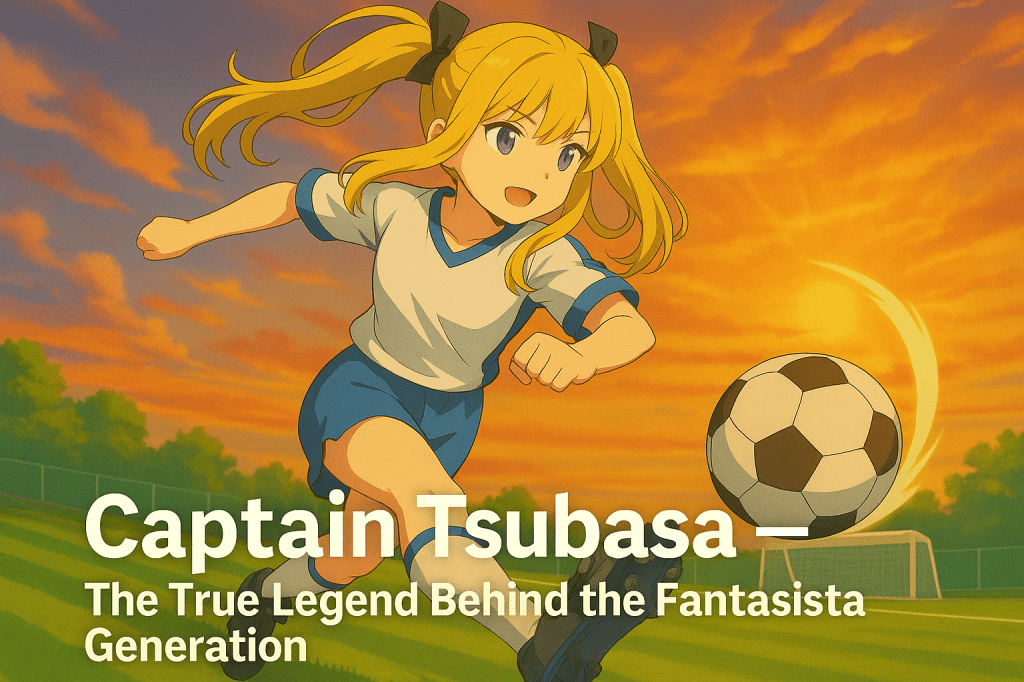
“I am Iris.
Urban legends are never just stories—
They are untold truths we’ll uncover together.”
Chapter 1: The Shape of a Dream
Aired in 1983, Captain Tsubasa adapted the popular Shonen Jump manga created by Yoichi Takahashi.
Its hero, Tsubasa Ozora, declared, “The ball is my friend,” turning soccer into a symbol of pure passion.
At the time, baseball was Japan’s dominant sport. Yet, this series ignited a nationwide soccer fever.
Elementary schoolyards echoed with “Tsubasa Kicks,” and a new generation of dreamers was born.
📌 Fact Check
- First broadcast: October 13, 1983 (TV Tokyo)
- Original manga by Yoichi Takahashi
- Youth soccer population in Japan nearly doubled during its broadcast period (Japan Football Association data)
Chapter 2: Crossing Borders — The “Oliver and Benji” Phenomenon
By the late 1980s, Captain Tsubasa was dubbed and broadcast across Europe and Latin America.
In Spain, it became Oliver y Benji; in France, Olive et Tom; and in Italy, Holly e Benji.
The show sparked an unprecedented trend—children learned the rules and tactics of soccer not from textbooks, but from anime.
📌 Fact Check
- Aired on Spain’s TVE in 1986
- Also broadcast on TF1 (France) and RAI (Italy)
- Certain European regions recorded ratings exceeding 20% (Source: Le Monde, 1987)
Chapter 3: Voices of the Fantasista Generation
World-class players openly credit Captain Tsubasa as their inspiration, with verified sources confirming each quote.
⚽ Lionel Messi (Argentina):
“Captain Tsubasa was the beginning of my football life.” (Marca, 2019)
⚽ Fernando Torres (Spain):
“As a kid, I wanted to play like Tsubasa.” (El País, 2008)
⚽ Zinedine Zidane (France):
“Tsubasa and his friends gave us dreams.” (Canal+, 2006)
⚽ Alessandro Del Piero (Italy):
“I grew up watching Oliver and Benji — my dribbling began there.” (Gazzetta dello Sport, 2009)
These testimonies reveal not just influence on technique, but on life philosophy itself.
Chapter 4: When Fiction Shapes Reality
According to Japan Football Association officials, foreign coaches visiting Japan in the early 1990s made a striking observation:
“Japanese youth already know the shape of dreams, even before the fundamentals.”
The presence of Captain Tsubasa indirectly paved the way for the J.League’s founding in 1993.
As the “Tsubasa Generation” matured, they became coaches, players, and commentators—forming the spiritual backbone of modern Japanese football.
📌 Fact Check
Saburo Kawabuchi, the first J.League chairman, stated:
“Without Captain Tsubasa, the J.League would have been five years late.” (NHK Documentary, 2013)
Chapter 5: The Common Language of Soccer
What unites the world isn’t religion or politics—it’s the ball, and the dream.
From Tokyo to Madrid, players say the same thing: “Like Tsubasa.”
Anime gave the world a universal vocabulary of soccer—shared imagination through art and motion.
“Anime isn’t just entertainment.
It’s the language that shapes the future.” — Iris the Storyteller
Next time — another fragment of truth we’ll uncover together.
I’ll return to the tale once more.
 Share on X
 Share on Facebook
 Follow here
Follow @Kataribe_Iris
Follow here
Follow @Kataribe_Iris
▶️ Visit Channel
💬 Visit LINE Store


コメントを残す