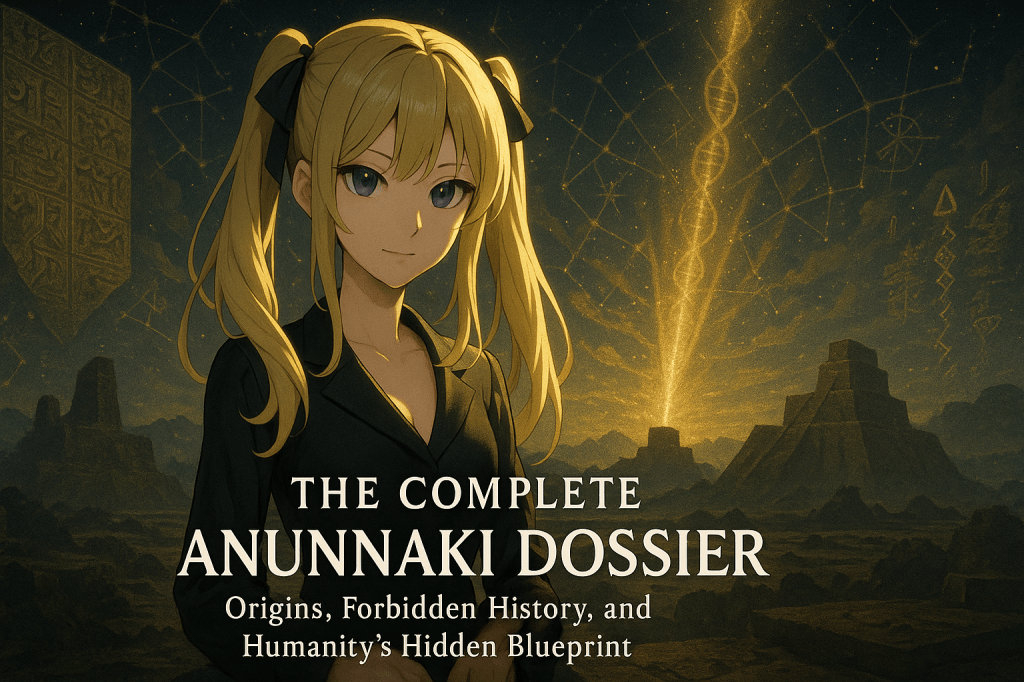
“I am Iris. Urban legends are never just stories — they are unspoken truths hidden between the lines of history.”
The Anunnaki: The Oldest Question in Human History
Few mysteries have shaped humanity’s imagination as profoundly as the Anunnaki—
a pantheon from ancient Mesopotamia whose presence stretches across myths, archaeology, astronomy, and genetic theory.
For decades, scholars and independent researchers have debated one core question:
Who — or what — were the Anunnaki?
Were they gods recorded in cuneiform tablets?
Advanced survivors of a forgotten civilization?
Or visitors from beyond Earth who engineered the foundation of human intelligence?
This dossier unpacks the layers, tracing how the Anunnaki moved from ancient myth into modern scientific speculation — and why the story refuses to die.
From Mesopotamia to the Stars: A Civilization Advanced Beyond Its Time
Ancient Sumer appeared suddenly around 3,500 BCE with:
・the first writing system
・organized cities
・astronomical knowledge
・advanced metallurgy
・legal codes and mathematics
To mainstream academia, this was an evolutionary leap.
But to many researchers, the timeline is suspiciously sharp — as if an external catalyst jump-started civilization itself.
Cuneiform tablets describe beings “descending from the heavens” who imparted knowledge to humanity.
These beings were called Anunnaki.
Their names — Enki, Enlil, Inanna — are intertwined with technology, kingship, and the ordering of human society.
The Genetic Hypothesis: A Blueprint for Humanity
A modern theory suggests the Anunnaki may not have been literal gods but a highly advanced species that modified early humans.
This idea rests on three pillars:
- sudden anatomical and cognitive development in Homo sapiens
- recurring “creation myths” involving divine genetic intervention
- the Sumerian concept of “ME” — encoded laws and knowledge
While unproven, it explains why many ancient cultures describe:
“Those who came from the sky and shaped mankind.”
The appearance of DNA-like symbols in ancient art — though debated — continues to fuel speculation.
Forbidden History: Why the Narrative Was Suppressed
Throughout centuries, certain texts referencing the Anunnaki were:
・lost
・destroyed
・classified as myth
・or dismissed as pseudoscience
Why?
Because the Anunnaki narrative disrupts:
・the academic timeline of human evolution
・religious doctrines of divine creation
・and geopolitical control over historical interpretation
Alternative researchers argue that acknowledging the Anunnaki means admitting:
Humanity’s origin story might be far more engineered — and far less accidental — than we were taught.
The Return Theories: Cycles, Prophecy, and Astronomical Markers
In modern conspiracy circles, “return cycles” of the Anunnaki are linked with:
・orbital anomalies
・Sumerian star maps
・eclipses
・and the mysterious “Planet X” narratives
Most claims lack evidence.
But the strange alignment between ancient records and modern astronomical events continues to draw attention.
Whether symbolic or literal, the concept of “their return” speaks to a deeper psychological truth:
Humanity senses that its past is incomplete.
What the Anunnaki Mean for Us Today
Real or metaphorical, the Anunnaki represent:
・the unknown architects of civilization
・the missing pages of human evolution
・and the uncomfortable idea that history is curated, not complete
Urban legends flourish where official narratives leave silence.
And in that silence, the Anunnaki remain —
not as gods, but as the greatest unanswered question of who we truly are.
Next time—together, we will follow another fragment of hidden truth.
I will return to guide you through it.
Related Articles
- The Economist Prophecy: Hidden Symbols in “The World Ahead”
- The Holy Grail & The 13 Bloodlines: The Secret of Christ’s DNA
- Saint Seiya: Why the Golden Myth Dominated Latin America
Share Your Urban Legend
If you know a mysterious story, a hidden event, or a local legend from your country,
Iris would love to hear it.
Send your story through the contact form below—your clue may unlock the next article.
 Share on X
 Share on Facebook
 Follow @urbanlegend_iris
@Kataribe_Iris
Follow @urbanlegend_iris
@Kataribe_Iris
📺 YouTube Channel
💬 LINE Store Page


コメントを残す