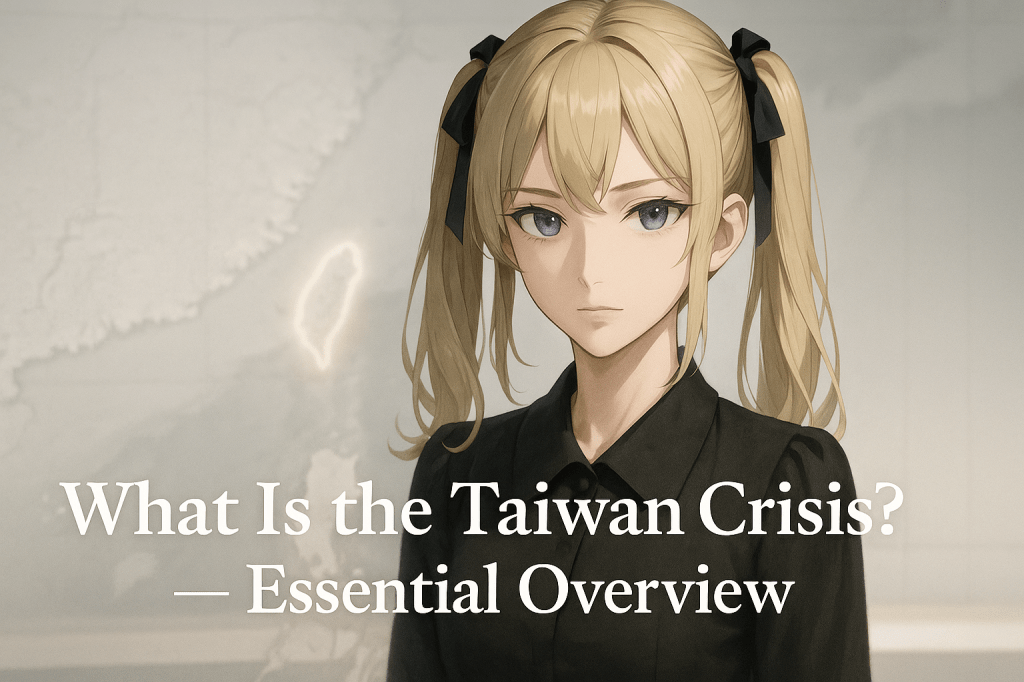
I am Iris.
Urban legends are never just stories —
they are gateways to the truths hidden in plain sight.
The Taiwan Crisis: Why the World Cannot Ignore It
The “Taiwan crisis” is not simply a dispute between Beijing and Taipei.
It is a geopolitical fault line that shapes the balance of power in the entire Indo-Pacific — the world’s new economic center of gravity.
To understand the stakes, we must revisit how this divide began.
A Divided China: The Civil War That Still Shapes Asia
Between 1945 and 1949, China was consumed by a civil war between:
- The Nationalists (Kuomintang / ROC) — backed by the United States
- The Communists (PRC) — led by Mao Zedong
The Communists won.
The Nationalist government retreated to Taiwan, establishing the Republic of China (ROC).
The mainland became the People’s Republic of China (PRC).
Since then, two governments have claimed to represent “China.”
Beijing insists Taiwan is an unfinished part of its territory — a core belief driving today’s tensions.
The Cold War and the U.S. Security Commitment
The outbreak of the Korean War in 1950 transformed Taiwan from a regional issue into a global one.
The United States deployed the Seventh Fleet to the Taiwan Strait, declaring Taiwan’s security essential to the anti-communist order.
This foundation still defines U.S.–Taiwan relations:
- Taiwan relies on U.S. military protection
- The U.S. views Taiwan as critical for Indo-Pacific stability
Neither side can abandon the other without reshaping the global power structure.
1971: The UN Turns the Diplomatic Tide
In 1971, the UN recognized the PRC as the sole legitimate government of China.
Taiwan lost its seat and entered long-term diplomatic isolation.
This pushed Taiwan into a deeper reliance on:
- U.S. military protection
- Unofficial but strategic partnerships with Japan and Western nations
Taiwan became simultaneously isolated and indispensable.
Democratization: A New Identity and a Wider Gap With Beijing
In the late 1980s and 1990s, Taiwan democratized:
- Martial law ended in 1987
- The first presidential election took place in 1996
This created a society increasingly distinct from mainland China:
- Different political values
- Different social identity
- A growing sense of autonomy
For Beijing, a democratic Taiwan drifting away from unification is a strategic and ideological threat.
China’s Vulnerabilities: Why Taiwan Matters to Beijing’s Survival
Despite its economic rise, China remains structurally vulnerable in several areas:
- Over 70% of energy is imported through sea routes
- Food imports are rising every year
- Exports rely on stable global markets and shipping lanes
These vulnerabilities converge in the waters surrounding Taiwan.
Control of these sea lanes is viewed in Beijing as a matter of national survival, not merely nationalism.
This makes Taiwan a geopolitical chokepoint.
Today’s Reality: A Gray-Zone Conflict Without Open War
The Taiwan crisis today is not a battlefield — it is a continuous contest of pressure and influence.
Current Chinese operations include:
- Aircraft entering Taiwan’s ADIZ
- Naval exercises around the island
- Cyberattacks
- Economic coercion
- Disinformation and cognitive warfare
Both China and the United States know that a major war would be catastrophic.
Thus the crisis unfolds in gray zones, not open combat — at least for now.
Why the Taiwan Crisis Matters to the World — Including You
A conflict over Taiwan would reverberate globally:
Semiconductors
Taiwan produces over 60% of the world’s chips and over 90% of advanced chips.
A war would paralyze global tech supply chains:
- Smartphones
- Cars
- AI chips
- Medical devices
- Defense systems
Energy and Trade
One-third of global shipping passes near Taiwan.
War would disrupt:
- Oil and LNG flows
- Food imports
- Global logistics
Regional Allies
Japan, South Korea, the Philippines, and Australia all rely on secure sea lanes near Taiwan.
A conflict would reshape the entire Indo-Pacific architecture.
What Comes Next?
The Taiwan crisis is no longer a distant geopolitical dispute.
It is a high-stakes struggle that will define:
- the future of the Indo-Pacific
- the global semiconductor industry
- supply chains that power modern civilization
- the U.S.–China rivalry
- and the stability of the world economy
Next time — another hidden fragment of truth awaits.
I will return to guide you through it.
Recommended Articles
- World’s Haunted Places TOP10 — Forbidden Lands in the Dark (English Article)
- The Deep-State Explained — Hidden Structures Behind the Scenes (English Article)
- HAARP — Is It a Weather Weapon? Myths & Reality (English Article)
Submit an Urban Legend
Do you know a strange rumor, unexplained event, mysterious symbol, or a hidden chapter of history?
I am collecting stories from around the world — modern myths, political mysteries, local legends, ancient secrets, and global conspiracies.
Share your information or requests here:
https://urbanlegend-iris.com/contact
Submit an Urban Legend
Do you know a strange rumor, an unexplained incident, a mysterious symbol,
or a story that never made it into the news?
Iris is collecting myths, conspiracies, forgotten histories, and local legends.
Share your information or requests here:
https://urbanlegend-iris.com/contact
 Share on X
 Share on Facebook
 Follow on Instagram
Follow @Kataribe_Iris
Follow on Instagram
Follow @Kataribe_Iris
📺 Visit Channel
💬 View on LINE Store


コメントを残す