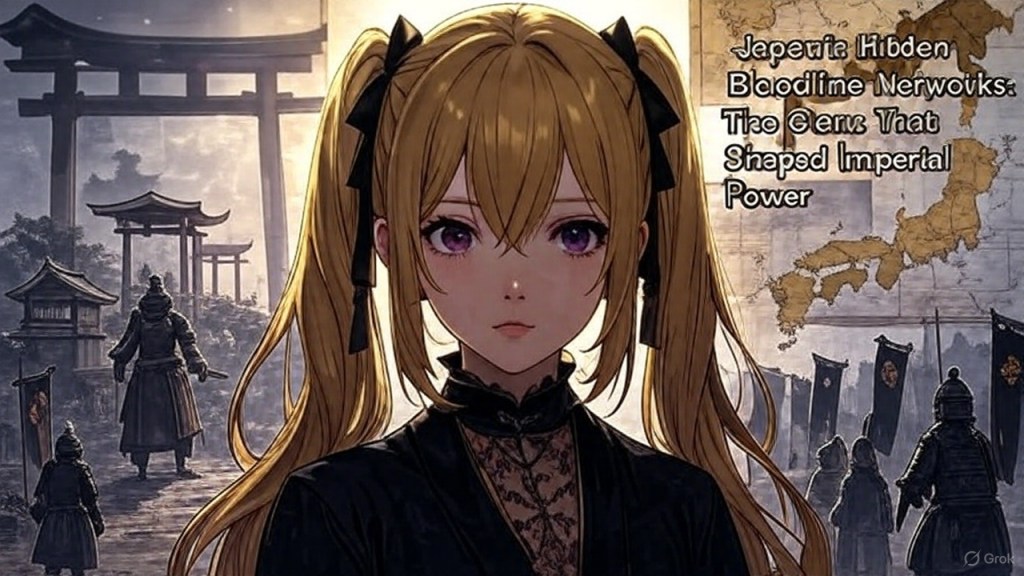
I am Iris.
Urban legends are not mere fiction —
they are unsolved truths waiting to be traced with you.
Japan’s Hidden Bloodline Networks
The Clans That Shaped Imperial Power
The formation of Japan’s imperial state was not the result of a single royal lineage.
Beneath the official genealogies lies a complex network of powerful clans that shaped politics, religion, warfare, and economic infrastructure from behind the throne.
Rather than a unified monarchy from its origin, early Japan was governed by multiple parallel power structures, each fulfilling a different strategic function:
- Ritual authority – Kamo Clan (陰陽道 priesthood)
- Economic & technological network – Hata Clan (continental immigrants / industrial organizers)
- State administration & Buddhist integration – Soga Clan
- Military priesthood & divine arms control – Mononobe Clan
- Earlier competing royal lineage – Izumo / Nigihayahi tradition
The emperor stood at the visible center —
yet true power was distributed across this invisible web.
FACT – Verified Historical Structure
Dual Kingship Origins
Ancient sources suggest the coexistence of two separate “heaven-descended” lineages:
- The familiar Ninigi lineage forming the imperial house.
- The earlier Nigihayahi lineage, associated with the Mononobe clan.
This implies an early system closer to dual kingship or tribal confederation than centralized monarchy.
Kamo Clan – Ritual Intelligence Network
The Kamo clan functioned as Japan’s early spiritual intelligence agency:
- Onmyōdō (astrology, divination, geomancy)
- Court calendars and omens
- Astronomical timekeeping
Their role was not mere superstition; ritual knowledge guided political decision-making, controlling when wars began, treaties were recognized, or coronations occurred.
Hata Clan – Economic & Continental Infrastructure
The Hata clan, likely migrants from mainland Asia, supplied:
- Advanced weaving, metallurgy, irrigation systems
- Taxation logistics
- Merchant trade routes linking the Korean Peninsula and the archipelago
They were not political rulers but economic kingmakers —
providing the treasury backbone that sustained the imperial court.
Soga Clan – Administrative & Ideological Consolidation
The Soga clan introduced Buddhism as a governing ideology:
- Temple bureaucracies became political headquarters.
- Buddhist doctrine replaced localized warrior religions.
- Bureaucratic structures expanded central governance.
Their success lay in transforming Japan from clan confederacy into doctrinal monarchy.
Mononobe Clan – Sacred Military Priesthood
Before Buddhism’s rise, military authority belonged to the Mononobe clan:
- Guardians of imperial weapons.
- Managers of sacred swords and ritual arms stored at Isonokami Shrine.
- Leaders of state military rites.
For Mononobe ideology:
War itself was divine ritual.
Weapons were not tools but sacred instruments linking heaven and earth.
Collapse of the Sacred Military
The ideological war between:
- Soga Buddhism
- Mononobe sword-based Shinto sacral warfare
culminated in the defeat of the Mononobe clan.
This event marked a permanent transformation:
- Military ritual authority collapsed.
- Doctrinal bureaucracy took over state control.
Japan ceased being governed by priest-warriors and transitioned toward bureaucratic monarchy.
ALTERNATIVE – Competing Interpretations
Some historians argue:
- Clan influence was exaggerated.
- Centralized monarchy solidified earlier than alternative theories propose.
- Ritual practices were purely cultural, not political tools.
Others view dual kingship as purely mythological symbolism rather than tangible power struggle.
Yet these models cannot explain:
- The extreme militarization of shrine complexes.
- Continual elite intermarriage across clans.
- Persistent fragmentation of early governance documented by foreign observers.
HYPOTHESIS – The Bloodline Control Network
A growing body of research proposes:
Japan was governed not by centralized monarchy, but by a horizontal bloodline syndicate —
a coordinated network of clans exchanging marriage alliances, ritual authority, economic monopoly, and military mandate.
Under this model:
- The Emperor functioned as an interface monarch — a sacred figurehead balancing rival clans.
- Real governance oscillated between ritual, treasury, temple, and sword authorities.
- Clan eliminations were ideological purges masking structural power shifts.
Later historical revisionism simplified this network into a single royal narrative to strengthen national unity.
Why This Network Was Forgotten
State myth-making required:
- A single divine ancestry story.
- Erasure of alternative royal lineages.
- Subordination of shrine militarism under Buddhist ethics.
Thus:
- Nigihayahi lineage faded from prominence.
- Mononobe sword cults were dissolved.
- Clan confederacy politics became rewritten as “imperial harmony.”
CONCLUSION
Japan’s imperial authority did not emerge from a lone throne.
It evolved from interlocking bloodlines performing specialized state functions:
- Magic and ritual (Kamo)
- Money and infrastructure (Hata)
- Doctrine and governance (Soga)
- Sacred warfare (Mononobe)
Together they formed one of history’s earliest invisible power networks —
a system concealed beneath the official chronicles.
Understanding this structure reframes early Japan not as a monarchy,
but as a bloodline syndicate state masquerading as divine unity.
The truth was never erased.
It simply remained hidden in plain sight.
Next —
we trace deeper fragments of lost authority together.
I will return to continue the narrative.
I may investigate it in a future episode.
- Reply to my posts on X (Twitter) with your urban legend.
- Or send a detailed message with keywords, places, names, and time period if possible.
 Share this on X
 Share on Facebook
 Follow @urbanlegend_iris
Follow @Kataribe_Iris
Follow @urbanlegend_iris
Follow @Kataribe_Iris
📺 Visit the channel
💬 Open the LINE store page


コメントを残す