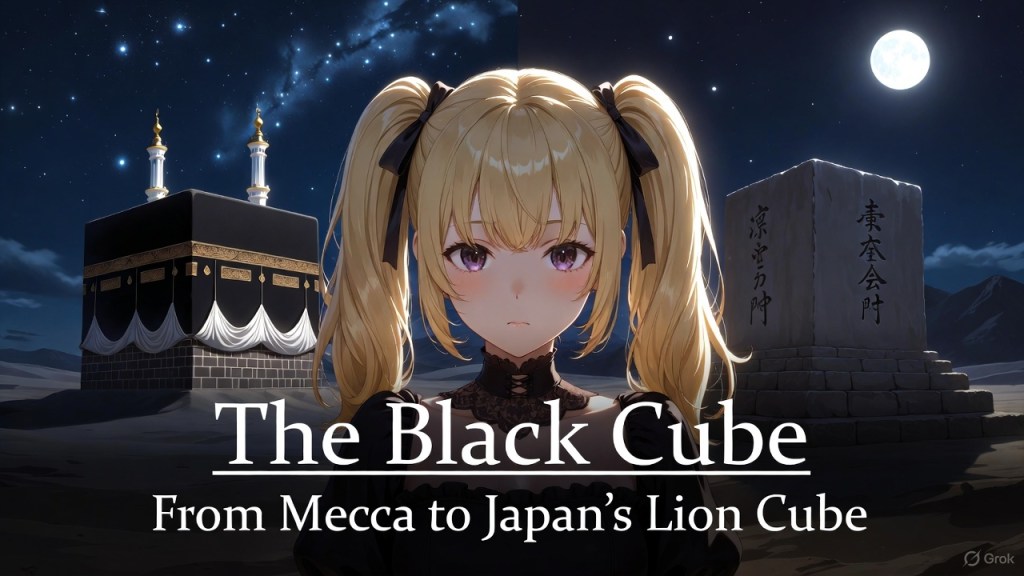
I am Iris.
Urban legends are not just stories —
they are fragments of truths buried beneath history.
Tonight, we explore a global mystery that connects the Middle East and Japan:
the BLACK CUBE.
The Kaaba — The Sacred Black Cube of Mecca
At the center of Mecca stands the Kaaba, a massive black cube revered as the holiest site in Islam.
Millions of pilgrims circle this structure every year, while billions of worshippers face it during daily prayers.
Unlike traditional temples or natural stone shrines, the Kaaba is defined by its stark geometry.
Its shape is pure: a near-perfect cube — a form rarely chosen by ancient builders unless driven by deep symbolic purpose.
Across civilizations, the cube represents stability, foundation, and the material anchor of spiritual realities.
It is often described as the meeting point between heaven and earth — the axis through which divine order touches physical reality.
But this black cube is not alone in history.
Japan’s Lion Cube — The Masuda Iwafune Mystery
Hidden within the mountains of Nara Prefecture lies a monumental stone structure known as Masuda Iwafune, often called the “Lion Cube.”
Carved from a single, massive block of bedrock, it displays strikingly straight edges and rectangular symmetry far exceeding most ancient Japanese stonework.
There are no inscriptions, no construction records, and no clear explanation for why it was made.
Archaeologists have proposed conventional theories:
an unfinished burial monument,
a star-observation platform,
or a ritual structure abandoned mid-construction.
Yet none can convincingly explain the cube-like geometry or the sheer scale of the carving.
Japan’s ancient monuments overwhelmingly consist of earthen mounds and wooden shrines.
Monolithic rock cubes are anomalies.
Despite oceans separating these two cultures, the similarity between the Kaaba and the Lion Cube remains impossible to ignore — two large cube structures standing at the spiritual edges of separate civilizations.
Why Did Ancient Cultures Revere Cubes?
The cube is not merely a shape.
In sacred geometry and ancient philosophy, the cube signifies:
- the structure of matter itself
- stability across time
- the foundation of physical reality
Plato associated the cube with the element of Earth.
Esoteric traditions viewed it as the container of cosmic order — where intangible forces crystallize into form.
The repetition of cube symbolism across distant cultures suggests shared conceptual knowledge.
Civilizations thousands of kilometers apart and isolated by oceans somehow arrived at identical geometric sacred language.
Coincidence becomes mathematically improbable.
The Global Black Cube Pattern
Examples of symbolic or ritual cubic structures appear in diverse traditions:
- the Kaaba in Mecca
- Masuda Iwafune in Japan
- stepped cubic pyramidal platforms in Mesoamerica
- cube symbolism in Jewish religious artifacts
- central cubic forms in Freemasonic teachings
Each tradition evolved independently — yet echoes of the same geometric reverence persist globally.
This pattern hints at something deeper:
shared ancient myths,
lost scientific traditions,
or symbolic knowledge passed across unknown cultural networks.
The Anunnaki Theory
In ancient Sumerian mythology, the Anunnaki were divine beings said to descend from the heavens to shape human civilization.
Ancient astronaut theorists interpret these accounts as depictions of advanced non-human visitors who shared knowledge with early societies.
Such beings would require stable landmarks — enduring monuments marking centers of knowledge transmission or spiritual authority.
The cube, representing cosmic order and technological precision, would serve as the ultimate monument of influence.
Could the Kaaba and the Lion Cube be remnants of this ancient global network?
A Lost Global Civilization?
What if long before recorded history:
- shared knowledge existed across continents
- advanced stone engineering techniques were disseminated worldwide
- sacred structures marked global “nodal points” of civilization
Over time, cultural memory fragmented.
Faith traditions inherited meanings without understanding original purposes.
Monuments remained while their origins faded into legend.
The Black Cubes may not be mere religious symbols — but echoes of a lost world system humanity no longer remembers.
The Forgotten Meaning of the Cube
Modern religions understand the cube through doctrine.
Ancient cultures may have understood it through design.
Perhaps the cube was once less about belief —
and more about function:
marking locations where heaven and earth were believed to converge.
Are the Black Cubes ancient spiritual coincidences…
or fossilized fingerprints of a forgotten global civilization?
Next time —
we continue tracing the fragments of forgotten truths.
Iris will return to the shadows to tell the next story.
🔎 併せて読みたい記事
- 🗿 ライオンキューブ——クババとアヌンナキ、立方体の秘儀
- 🛸 UAP AND THE JAPANESE ‘UTSURO-BUNE’ LEGEND
- 👁️ THE COMPLETE ANUNNAKI DOSSIER
🕯️ Submit Your Urban Legend to Iris
Have you heard an unsettling rumor, an unexplained phenomenon, or a forbidden story passed down in whispers?
Iris seeks the world’s hidden urban legends — from ancient myths and secret societies to modern conspiracies and UAP encounters.
📩 Send your story via X (Twitter) or the YouTube comment section. Your submission may be featured in a future investigation by Iris.
 Share on X
 Share on Facebook
 Follow here
Follow @Kataribe_Iris
Follow here
Follow @Kataribe_Iris
📺 Visit the channel
💬 LINE Store page


コメントを残す