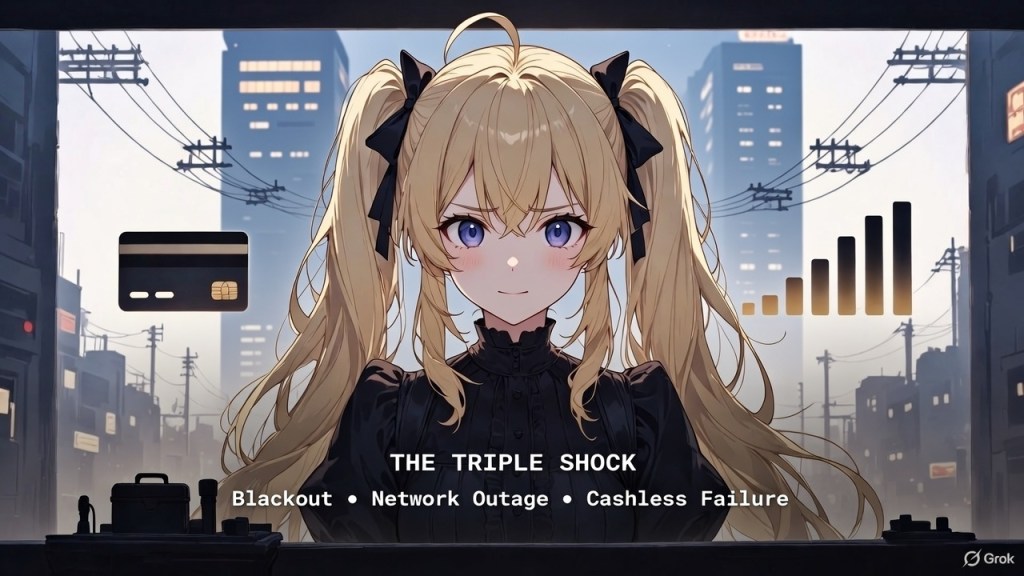
I am Iris.
Urban legends are not just fairy tales—
I am a storyteller who traces the unspoken truth with you.
The Triple Shock: when modern life stops “quietly”
A blackout is not just darkness. A network outage is not just inconvenience. A cashless failure is not just “try again later.”
When power + connectivity + payment wobble at the same time, society doesn’t collapse like a movie. It stalls—silently, practically, and fast. That’s the real danger: not panic, but friction that turns into paralysis.
Today’s warning is simple:
Prepare first. Panic never helps.
This is not fiction: large-scale outages have happened
History already proved that cascading failures can affect tens or hundreds of millions.
- In 2003, the Northeast Blackout impacted an estimated ~50 million people across parts of the U.S. and Canada. :contentReference[oaicite:0]{index=0}
- In 2012, India experienced massive blackouts, with reports of ~620 million people affected. :contentReference[oaicite:1]{index=1}
- In 2021, Texas saw widespread outages—millions lost power during the winter crisis. :contentReference[oaicite:2]{index=2}
These events differ in cause, politics, and climate—but the lesson is identical:
systems fail in chains, not in isolation.
Why the Triple Shock hits harder than any single crisis
1) Power failure
No electricity means no charging, no refrigeration, no traffic systems, limited heating/cooling, and degraded water infrastructure in some cases. Your battery becomes a countdown.
2) Network outage
Even if you have power, connectivity is the bridge to coordination: maps, alerts, family contact, work systems, banking authentication. When it’s gone, uncertainty multiplies.
3) Cashless failure
Cashless life assumes always-on infrastructure:
terminals, mobile networks, backend verification, anti-fraud systems, settlement rails. If any link breaks—especially with a network outage—payments can freeze at the worst moment.
And the punchline: each failure makes the others worse.
The “urban legend” layer: the moment confusion becomes a weapon
In a blackout or outage, the information environment becomes unstable:
screens go dark, signals stutter, official updates lag, rumors accelerate.
This is where the story turns into something more dangerous than fiction:
misinformation spreads faster than verified guidance, especially when people are exhausted, cold, or hungry.
So preparedness isn’t only supplies.
Preparedness is also information discipline.
Iris’ Practical Protocol: Prepare, don’t panic
Ready.gov frames emergency kits as supplies you can use to get through several days on your own. :contentReference[oaicite:3]{index=3}
Use that logic and build a “Triple Shock kit” in layers:
Layer 1 (today): 72-hour friction breaker
- Cash (small bills + coins)
- Two power sources (power bank + spare cable)
- Light (flashlight + batteries or rechargeable)
- Water + simple food you can eat without cooking
- Printed essentials (contacts, meeting point, key addresses)
Layer 2 (this week): resilience upgrade
- Portable power station (even small) or reliable car-power plan
- Radio plan (battery radio or car radio)
- Warmth and basic hygiene (blanket, wipes, medications)
- Family communication rules (who calls whom, fallback location)
Layer 3 (serious mode): continuity plan
- Fuel/charging rotation plan (how you will ration power)
- Backup cooking method (safe, ventilated use only)
- Offline copies of critical documents and account recovery info
The goal is not to hoard.
The goal is to reduce decision-making under stress.
A calm rule that saves lives
When the Triple Shock hits, follow this order—every time:
Life → Safety → Communication → Supplies
If you keep the order, you keep control.
And if you keep control, you don’t become a pawn of fear—whether the threat is infrastructure… or information.
Final note: cashless is not the enemy—single-point failure is
Cashless systems are powerful. So are smart grids and always-on networks.
But every powerful system needs a fallback.
Your advantage is not secret knowledge.
Your advantage is preparedness by design.
Next time—another fragment of truth we trace together. I will return to the story.
Send it to me—timeline, sources, and key clues if you have them.
I’ll trace it evidence-first, not fear-first.
 Share on X
 Share on Facebook
 Follow here
Follow @Kataribe_Iris
Follow here
Follow @Kataribe_Iris
📺 Visit the channel
💬 Open the LINE Store page


コメントを残す