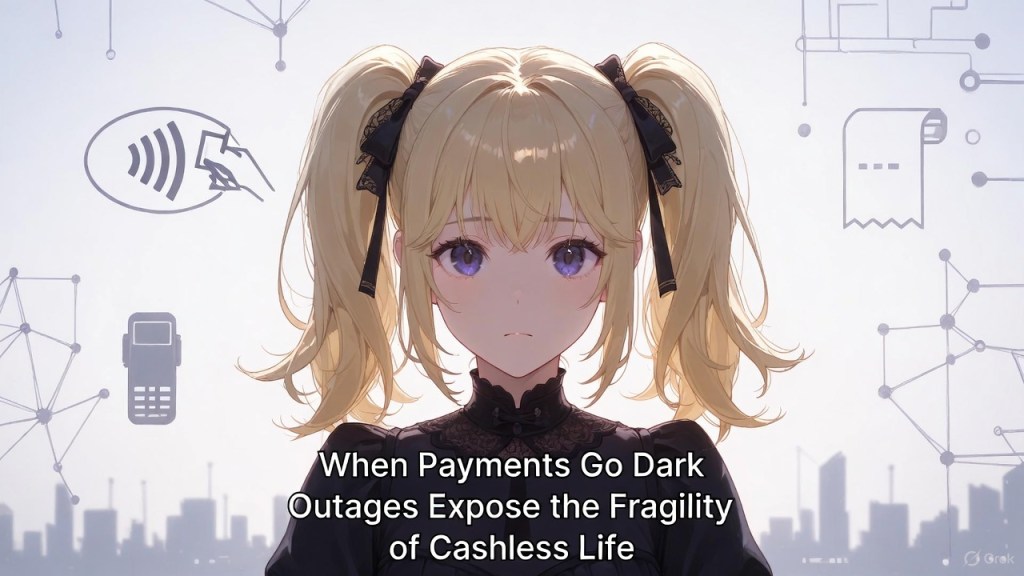
I am Iris.
Urban legends aren’t just bedtime stories—
they’re mirrors held up to what people fear, and what systems try to hide.
Tonight’s theme is not “the end of the world.”
It’s something far more practical—and more likely:
When payments go dark, modern life stalls.
Cashless convenience is real. But convenience has a hidden cost: single points of failure you don’t see until the screen says “declined.”
■ The uncomfortable truth: cashless is fast… until it isn’t
A cashless society feels frictionless on a normal day:
tap, beep, done.
But that same frictionless design means a single outage can ripple instantly:
- terminals stop authorising
- banking apps fail
- transfers delay
- merchants can’t take payment
- people can’t buy essentials—even when money exists
This is not a conspiracy. It’s operational reality.
■ Real-world outages prove the point
Recent examples show how ordinary “technical faults” can become public chaos—without any disaster happening.
- A bank-side EFTPOS disruption can stop businesses from taking sales during peak periods.
- A major banking glitch can lock customers out of services for hours and delay payments.
- Retailers can lose contactless capability across hundreds of stores due to cyber fallout, even if the wider system is “fine.”
The pattern is consistent: digital payments depend on layered infrastructure (banks, processors, networks, terminals, cloud services, telecoms). When one layer fails, the customer experiences it as: “I can’t pay.”
■ Why failures happen: the five weak links
Cashless doesn’t fail for one reason. It fails because it’s a chain.
1) Technical faults and change risk
Updates, patches, migrations, capacity changes—small mistakes can cascade at scale.
2) External dependencies
Even if your bank is stable, it may rely on third parties: card networks, processing platforms, cloud hosting, telecom routing, fraud systems.
3) Cyber incidents
Not every outage is an attack—but cyber events can degrade systems indirectly.
4) Network fragility
Cashless is communication. If connectivity drops—or becomes unstable—authorisation fails.
5) Human behaviour
Retries, support calls, ATM runs, and traffic surges can turn minor faults into major incidents.
■ The real risk: “denial of life,” not denial of money
Most people imagine financial risk as theft.
But the bigger day-to-day risk is simpler:
You have funds, but you can’t access them at the moment you need them.
That is what operational resilience is about: keeping “critical operations” running even under stress.
And if you’re building a life that depends on cashless rails, you need your own micro-resilience plan—not panic, not paranoia, but procedure.
■ Practical preparedness: what to do before the next outage
Here is the realistic checklist.
1) Carry a small cash buffer
Not a fortune—just enough for essentials. Cash is offline redundancy.
2) Split payment methods
Do not rely on only one card, one bank, one wallet app, or one phone.
3) Pre-plan “essentials purchase rules”
Decide in advance what you buy first, your max spend, and your fallback store.
4) Keep a low-tech habit alive
A written list of critical numbers, a torch, a battery pack, and a minimum fuel rule.
5) Treat “scheduled maintenance” as a real outage window
If downtime is announced, behave as if it will affect you.
■ For businesses: “offline mode” is not optional
If you run a shop, the question is not “Will an outage happen?”
It’s “How do we keep trading during one?”
- a cash acceptance plan (float, storage, end-of-day)
- alternate connectivity (if feasible)
- clear customer messaging (“avoid repeated taps”)
- an incident playbook
Operational resilience is not a buzzword. It’s survival.
■ Closing: build backup systems for a system-dependent world
Cashless life is efficient.
But efficiency without redundancy is brittle.
If you want calm in an unstable era, don’t chase certainty.
Build contingency.
The outage won’t ask for your permission.
But your preparedness will decide whether it becomes a crisis.
Next time—another fragment of truth to trace together. I will return to the story.
- 1) Topic / Title (rough is OK)
- 2) What feels “off” (your key suspicion)
- 3) Source (book / video / rumor / personal story) — optional
- 4) Links — optional
 Share on X
 Share on Facebook
 Follow here
Follow @Kataribe_Iris
Follow here
Follow @Kataribe_Iris
📺 Visit the channel
💬 Open LINE Store


コメントを残す