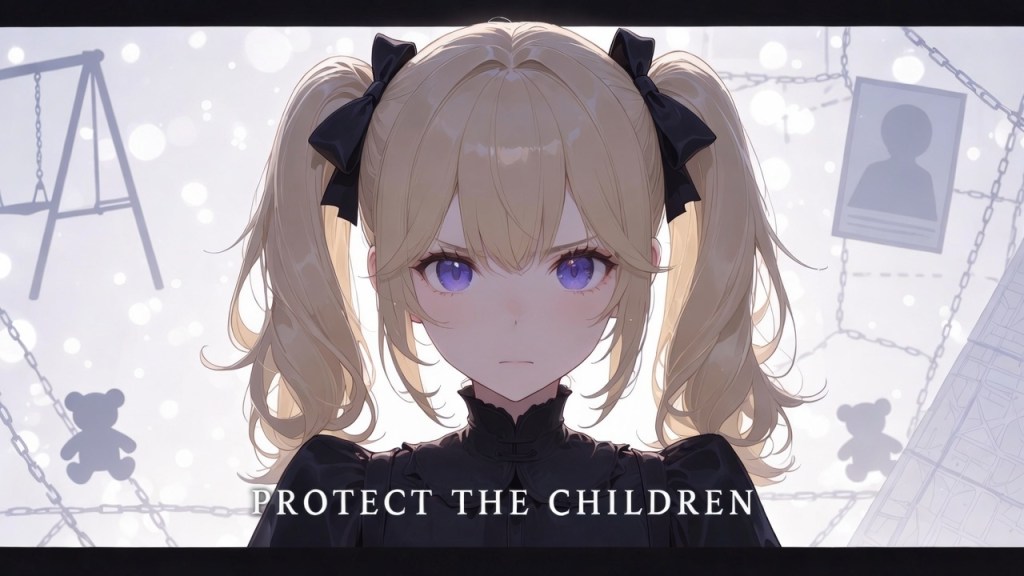
I am Iris.
Urban legends are not “just stories.” Sometimes they are warnings that arrive before society is ready to listen.
This is one of those warnings.
The holiday season is built for joy—travel, crowded cities, late-night events, new devices, and more time online. But the same conditions also expand the attack surface around children: missing child incidents, exploitation, and technology-facilitated grooming. Predators don’t need chaos to operate; they need opportunity—and holidays provide it.
What follows is a fact-anchored, prevention-focused alert aimed at families, communities, and anyone who still believes a nation’s future is measured by how well it protects its children.
1) Holidays don’t “create” danger — they multiply exposure
During school holidays, children spend more time on apps, games, and social platforms—often with less supervision. Australian child protection agencies explicitly warn that holiday periods create opportunities for offenders, especially through popular apps, games, and social media, and highlight risks such as sextortion and online approaches.
Offline risk also rises: travel hubs, crowded events, and distracted guardians increase the chance of separation. A child does not need to be “abducted by strangers” to become missing—sometimes a missed pickup, a conflict at home, or a moment of impulsive running away is enough to trigger a chain of vulnerability.
2) The world is seeing more children exploited — and organized networks adapt faster than laws
The UNODC’s Global Report on Trafficking in Persons 2024 describes a shifting landscape: children account for a major share of detected victims in several regions, and the report notes a surge in detected girls (with a 38% increase over three years in one highlighted trend). It also emphasizes trafficking’s increasingly transnational character and the role of organized networks, including forcing victims into online scams and other crimes.
Separately, global estimates of modern slavery (ILO/Walk Free/IOM methodology) indicate 49.6 million people were living in modern slavery in 2021—27.6 million in forced labour and 22 million in forced marriage—and that the problem has worsened compared with previous estimates.
The key point: the threat is not random. It is systemic. When child protection is treated as a “social issue” instead of a national security priority, networks fill the vacuum.
3) “Missing” is not a statistic — it’s a window
In the United States, NCMEC reported that in 2024 it assisted law enforcement with 29,568 cases of missing children and helped bring 91% of them home. It also warns that online risks are becoming more complex, including a dramatic rise in reports involving generative AI, and nearly 100 reports per day of financial sextortion.
NCMEC’s CyberTipline data shows the scale of online exploitation reporting: 20.5 million reports of suspected child sexual exploitation were received in 2024.
Do not misread “reports” as “unique cases.” Reporting systems have duplication and methodological changes. But the direction is clear: the pipeline of harm is massive, and children are being targeted at industrial scale.
4) How grooming works (and why smart kids still get trapped)
Grooming is not “a child being careless.” It is adult-level persuasion and manipulation, often staged in steps:
- Access: DMs in games, “friend of a friend,” fan communities, private groups
- Trust: compliments, gifts, “you’re special,” secret-keeping
- Isolation: moving the conversation off-platform, pushing privacy, discouraging parents
- Leverage: shame, threats, coercion, financial extortion, or pressure for more contact
INTERPOL underscores that online child exploitation is transnational and evidence-driven—images, metadata, and cross-border collaboration become central because offenders and victims can be in different countries.
Holidays accelerate exposure: new phones, new apps, new online hours, and more emotional highs and lows. Predators plan for that.
5) Myth vs. reality: what to watch for (without panic)
Some viral narratives focus on dramatic “snatch-and-grab” scenarios. Those can happen, but they are not the only—or even the most common—pathway into harm.
The more common pattern is quieter:
- vulnerability first (conflict at home, poverty stress, isolation, untreated mental health, unsafe housing)
- then contact (online or through acquaintances)
- then control (coercion, threats, dependency)
This is why prevention must be layered. You do not “fix” this with fear alone. You fix it with systems + habits.
6) A practical protection checklist (family, community, platform, policy)
For families (today):
- Put a family safety phrase in place (a simple “password” a trusted adult must know)
- Lock down devices: private accounts, restricted DMs, location sharing OFF, 2FA ON
- Agree on no private chat rules for games (or strict allow-lists)
- Teach one sentence children can use: “I can’t keep secrets from my parents.”
- If travel/events: pre-set meeting points, photo of outfit, and emergency contact card
For communities (this week):
- Treat “runaway” as child endangerment, not “bad behavior”
- Strengthen visibility: libraries, shelters, youth centers, and schools as early-warning partners
- Share reputable reporting pathways and local hotlines (in your country)
For platforms (non-negotiable):
- Better detection and reporting compliance, especially where encryption and “bundled reporting” reduce visibility
- Default-safe settings for minors (DM limits, stranger contact friction, age-appropriate design)
For policy leaders (the real test):
- Child protection is infrastructure: budgets, investigators, victim services, cross-border cooperation
- Focus on organized networks, not only low-level offenders
- Invest in prevention education at scale (not once a year, not as a poster)
7) A final warning: narratives can distract — systems decide outcomes
Around any child-protection topic, misinformation spreads fast—because fear is profitable and outrage is viral.
Yes, people argue about information operations, propaganda, and historical influence campaigns. But here is the hard reality: you don’t need a grand conspiracy to lose a generation. You only need complacency, underfunded protection, and the refusal to modernize safety to match modern threats.
If we want children protected, we stop treating protection as a “personal responsibility” problem and start treating it as a societal duty with measurable performance.
Closing
This holiday season, do not just post a slogan.
Build a barrier. Strengthen a habit. Report what you see. Protect the vulnerable before they become invisible.
Next time—together we will trace another fragment of hidden truth. I will return to the story.
Send Your Urban Legends to Iris
- Missing-child patterns, suspicious approaches, or recurring local cases
- Online grooming trends, sextortion methods, or platform loopholes
- Trafficking-related rumors you want verified (without sensationalism)
- News patterns that feel coordinated or deliberately minimized
 Share on X
 Share on Facebook
 Follow @urbanlegend_iris
Follow @Kataribe_Iris
Follow @urbanlegend_iris
Follow @Kataribe_Iris
📺 Visit the channel
💬 Open LINE Store


コメントを残す