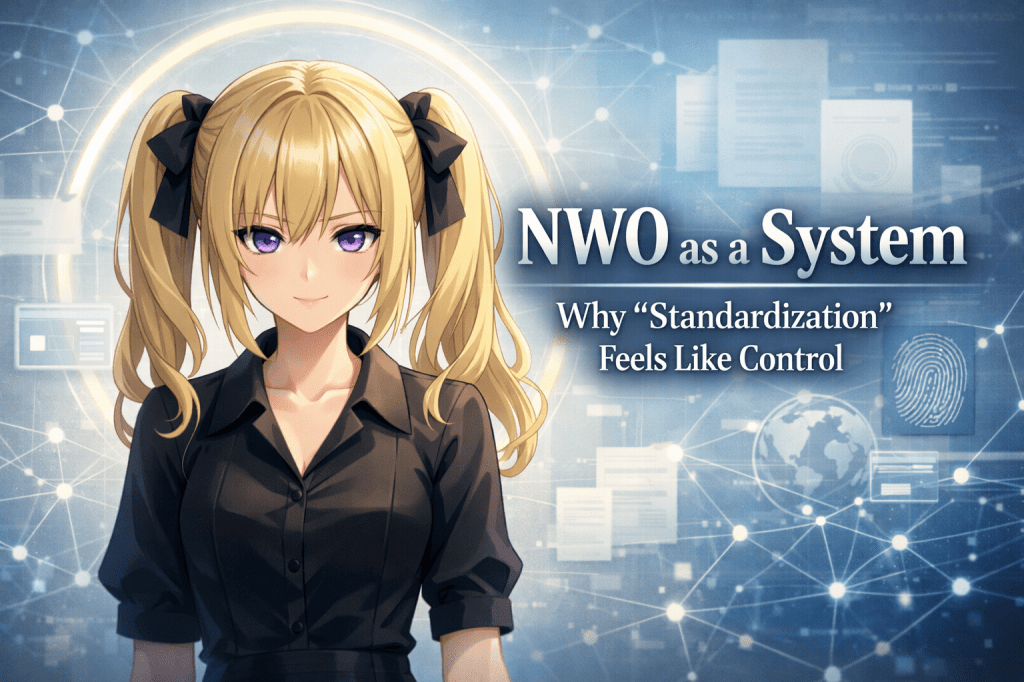
I am Iris.
Urban legends are not “just stories” —
I am a narrator who traces the unspoken truths together with you.
Why this article exists
“NWO (New World Order)” is one of the strongest modern urban legends because it explains complex global change with a single label.
In many versions, the “proof” is not a secret meeting or a villain — it is standardization: common rules, shared systems, unified procedures.
This article keeps one line clear:
- As an urban legend, NWO is often described as “control through standardization.”
- In reality, standardization is also how modern society prevents chaos: safer payments, interoperable tech, shared safety rules, predictable trade.
So we will do two things:
1) map the narrative pattern (how the legend is told), and
2) give you verification entry points (primary and semi-primary sources) without making hard claims.
What “standardization” means in the real world
Standardization is not one thing. It appears in layers:
- Technical standards: how the internet, devices, and security talk to each other
- Financial plumbing: payment messaging, bank supervision norms, anti–money laundering frameworks
- Regulatory harmonization: shared compliance expectations across borders
- Administrative interoperability: IDs, records, and data formats that allow systems to connect
In other words: standardization is the language of “systems.”
And systems can feel like “control” when they become invisible, mandatory, and hard to opt out of.
The NWO narrative pattern: “soft rules, hard outcomes”
A common NWO storyline goes like this:
1) A crisis happens (war, pandemic, financial shock, cyber incidents).
2) The public accepts stronger coordination “for safety.”
3) Coordination becomes “standard.”
4) Standards become requirements.
5) Requirements become enforcement.
6) Eventually, people feel they are living inside a framework they never chose.
Notice what makes this narrative powerful:
- it doesn’t require one villain
- it doesn’t require one secret document
- it uses the lived experience of modern life: more rules, more compliance, more monitoring, more “digital gates”
As an urban legend, this is exactly why it spreads: it matches the emotional shape of reality.
Where the legend and reality overlap (and where they don’t)
There are overlaps — but they are not proof of a single “plan.”
Overlap A: Coordination is real
Global supply chains and cross-border finance require common frameworks.
International bodies publish guidelines, standards, and best practices. Countries often align with them because:
- trade and finance punish incompatibility
- crises reward readiness
- companies prefer predictable rules
Overlap B: Standardization can concentrate power
Even without conspiracy, power can concentrate when:
- only large institutions can afford compliance
- small players get pushed out
- rule-making becomes expert-only
- enforcement tools become automated
The critical mismatch: “One Hand” vs. “Many Hands”
The urban legend often implies “one central controller.”
But the real world usually looks like “many hands”:
- governments with competing interests
- regulators with different mandates
- private sector standards groups
- political cycles, lobbying pressure, and bureaucratic inertia
The outcome can still feel “NWO-like” to ordinary people — without being a single, coordinated master plan.
Four arenas where “standardization feels like control”
To keep this concrete, here are four arenas often used in NWO discussions — framed carefully, without asserting hidden intent.
1) Payments and financial messaging
Modern payments rely on standardized messaging and compliance expectations.
When messaging or compliance rules change, the entire ecosystem adjusts — banks, merchants, consumers.
Urban legend version: “They can switch your life off.”
Reality version: systems prioritize stability, fraud prevention, sanctions compliance, and interoperability — but those same tools can be experienced as “control” when errors, policy shifts, or opaque decisions occur.
2) Anti–money laundering and “risk-based” compliance
AML frameworks are global in influence, because money moves across borders.
Risk-based compliance can expand quietly:
- more monitoring
- more documentation
- more de-risking (closing accounts deemed “too risky”)
Urban legend version: “Surveillance for everyone.”
Reality version: compliance is often uneven, sometimes overbroad, and can harm ordinary users — without proving a single hidden agenda.
3) Digital identity and interoperability
Many countries discuss digital identity frameworks because:
- services move online
- fraud rises
- public administration needs shared identifiers
Urban legend version: “One ID to rule them all.”
Reality version: designs vary, political checks vary, and implementation often faces public resistance — but it still triggers fear because identity is a gate to everything.
4) Crisis policy and “temporary measures”
The legend often focuses on a simple idea:
“Temporary rules never disappear.”
This is not purely fiction. Across history, emergency measures can persist.
The key is not to treat every policy as proof — but to watch the mechanism:
- sunset clauses
- transparency
- judicial review
- parliamentary oversight
- audit trails
How to verify without getting trapped by the narrative
If you want to keep the “urban legend lens” while staying grounded, use this workflow:
Step 1: Replace names with mechanisms
Instead of “they,” write:
- which standard body
- which guideline
- which regulator
- which law
- which technical standard
- which policy cycle
If you cannot answer those, the claim is currently “story-shaped,” not “evidence-shaped.”
Step 2: Find the primary entry page first
Do not start with commentary videos.
Start with primary institutional pages: the overview page that explains what the framework is, what it does, and where documents live.
Step 3: Separate “coordination” from “central control”
Coordination can create uniform outcomes without a single controller.
Ask:
- Is this legally binding, or guidance?
- Is adoption voluntary, incentivized, or enforced?
- Who benefits and who pays the cost?
Step 4: Track the “ratchet” claim carefully
When someone says “this always tightens,” check:
- was the rule revised back later?
- did courts limit it?
- did a new government reverse it?
- did implementation fail?
Urban legends often ignore reversals because reversals weaken the drama.
A balanced conclusion (without losing the edge)
As an urban legend, “NWO as a system” survives because it points at a real feeling:
- modern life is increasingly mediated by invisible standards
- standards turn into requirements
- requirements become enforcement
- enforcement can feel impersonal, unappealable, and absolute
The strongest way to handle this is not to deny the feeling — but to give it a map:
- which standards are technical necessities
- which frameworks are policy choices
- which measures are emergency responses
- which areas need stronger oversight and transparency
If we keep the “urban legend frame” as a lens — not a verdict — it becomes a tool for analysis rather than a trap.
Next time — another fragment of truth to trace with you. I will return to the narrative again.
 Share on X
 Share on Facebook
 Follow here
Follow @Kataribe_Iris
Follow here
Follow @Kataribe_Iris
📺 Visit the channel
💬 Open LINE Store page


コメントを残す