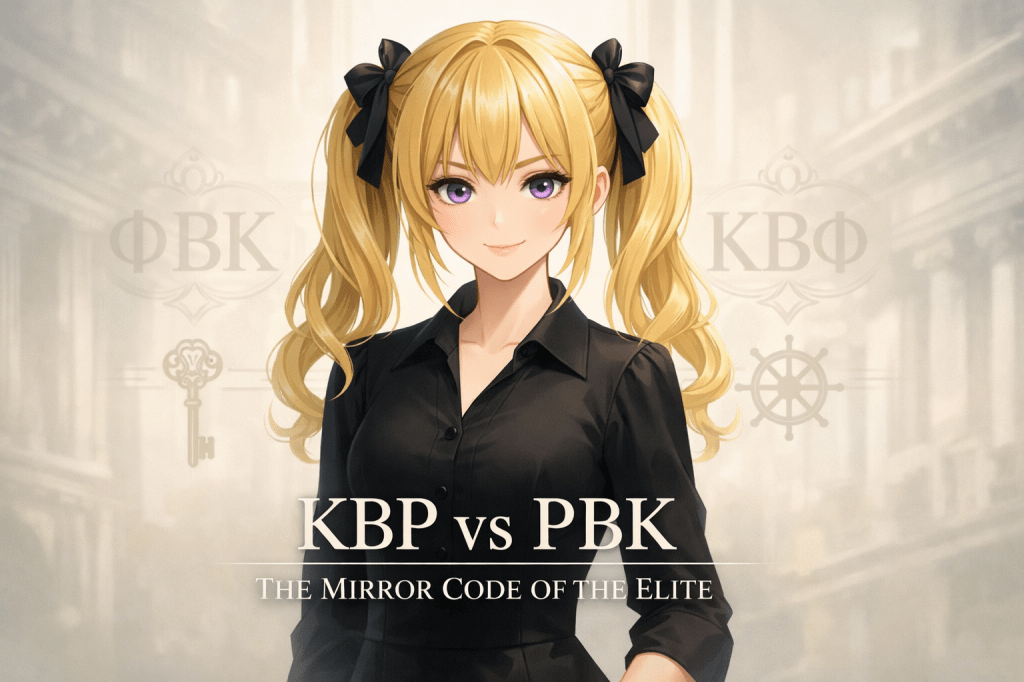
I am Iris.
Urban legends aren’t just bedtime stories—
they are maps of unspoken fears, coded into rumor and symbol.
The Mirror Begins: PBK vs KBP
There’s a certain kind of story the internet loves: a legend that starts with letters.
ΦΒΚ (Phi Beta Kappa) is widely known as a prestigious Greek-letter society—“the respectable key.”
ΚΒΦ (Kappa Beta Phi) is whispered as its shadow twin—“the mirrored key.”
In conspiracy-lore, the mirror matters more than the meaning.
Flip the letters. Reverse the order. Invert the prestige.
And suddenly you don’t have an honor society anymore—you have a ritual club behind frosted glass, where Wall Street smiles politely while the real rules are “not for public consumption.”
That’s the first hook of this urban legend:
PBK is the front door. KBP is the back door.
One holds a key. The other decides what the key opens.
The “K” Theory: The Helmsman Who Steers the World
Now the second hook: the letter K.
In rumor-space, people don’t treat “K” as a letter.
They treat it as a job title.
K = the helmsman.
The one who steers.
The one who turns the wheel while others argue about the destination.
The lore leans on the ancient-sounding vibe of kybernētēs—the “steersman” in Greek—then does what conspiracy-lore always does: it upgrades a word into a command.
If K is the helmsman, then “KBP” is not a name—it’s a function.
A steering committee with a dress code.
A cockpit hidden inside a banquet hall.
Is any of that provable as a literal chain of command? In this article, we’re not playing courtroom.
We’re playing myth-engine.
Because myths don’t need proof—
they need symbols that feel like proof.
The Key, the Wheel, and the Dinner: Ritual Theater as Power Language
Urban legends often grow in the space between “private” and “forbidden.”
A key-shaped emblem.
A formal dinner.
A membership list that isn’t posted like a gym schedule.
None of these are supernatural by themselves.
But in the legend, they become a language:
- The Key = access, credentials, locked doors, vault logic
- The Wheel/Helm = steering, navigation, direction of history
- The Dinner = initiation, hierarchy, “you’re in / you’re out”
Conspiracy-lore frames it like this:
If the public sees elections, the insiders see initiations.
If the public sees markets, the insiders see rituals.
And then it adds the dangerous spice:
What if the ritual isn’t just tradition—what if it’s programming?
The Cube: Why Black Geometry Keeps Reappearing
Now we get to the object that conspiracy culture never stops feeding:
the cube.
The cube shows up everywhere in modern myth:
- corporate plazas
- minimalist monuments
- “silent” architecture that feels like a sealed container
- vault imagery
- the idea of a system you can’t see inside
The cube is perfect for rumor because it looks like stability—
and stability can be terrifying when you don’t control it.
So the lore builds a bridge:
Key + Vault = Cube.
Cube = storage of value.
Storage of value = control of futures.
And then the legend escalates:
Some whisper of a cube-cult—not necessarily a religion with hymns, but a pattern of symbolic worship:
- black stone as authority
- geometry as sacred law
- closed systems as the “true temple”
Once the cube enters the story, everything starts to connect:
- keys become “access to the cube”
- bankers become “priests of the cube”
- steering becomes “who turns the world toward the cube’s interests”
In other words:
The cube is the mythic battery.
People plug fear into it, and it outputs meaning.
Cybele, Kubaba, Lions: The Goddess-Code Thread
Here’s where the legend gets older—older is always more convincing in conspiracy storytelling.
The lore reaches back for names that feel like they carry original power:
Cybele. Kubaba. Lion-thrones. City-gates.
Whether these names are linked “for real” is less important than what they represent in the myth:
- Cybele becomes “the mother of hidden sovereignty”
- Kubaba becomes “the city-queen archetype”
- Lions become “guardians of gates and crowns”
- Gates become “thresholds of initiation”
And then the story binds them:
Key = gate.
Gate = initiation.
Initiation = control.
In this mythic reading, the “elite” don’t just accumulate money—they inherit symbols.
And symbols don’t need receipts. They need resonance.
So the goddess-code thread is used like an amplifier:
If a modern club has rituals, then it must have ancient roots.
If it has ancient roots, then it must be part of the original priesthood.
That’s how the legend breathes.
The Illuminati Thread: A Rumor That Works Like a Spiderweb
Every strong urban legend has a hub.
And the hub, in the Western internet, is usually the same word:
Illuminati.
In entertainment-lore, “Illuminati” is less a specific organization and more a narrative shortcut:
- secret coordination
- hidden hierarchy
- symbols as commands
- “they were always there”
So the myth stitches it together like this:
PBK = public honor.
KBP = private steering.
Illuminati = the invisible doctrine that binds both.
And the moment that framework exists, it starts swallowing everything:
- freemasons become “the operating system”
- bankers become “the runtime”
- politicians become “the interface”
- war becomes “the update cycle”
Is this “true”? In this article’s mode, that isn’t the question.
The question is:
Why does this story feel true to so many people?
Because it explains the emotional math of modern life:
- you work hard but the rules change
- you save money but the currency shifts
- you vote but the machine seems unchanged
- you watch news but the conclusion feels pre-written
So the Illuminati thread functions like a psychological key.
And once a key exists, people will search for a lock.
Washington vs the Bankers: The Myth of the Republic’s Helmsman
Now we bring in the name that turns an American story into a global export:
George Washington.
In the legend, Washington isn’t just a historical figure.
He becomes an archetype:
the Republic’s helmsman.
A man trying to steer a newborn nation through storms.
And every helmsman needs an opposing force—
a current that pulls the ship off course.
In the urban legend version, that force is:
the bankers.
Not “bankers” as normal human beings with spreadsheets,
but bankers as a mythic class:
the invisible helm.
The lore frames a confrontation:
- Washington = visible authority, public legitimacy, the “front wheel”
- Bankers = invisible leverage, credit logic, the “hidden wheel”
And the central conflict becomes:
Who controls the future—law, or debt?
Who steers the nation—votes, or credit?
This is where conspiracy-lore loves to sharpen its blade:
It doesn’t accuse one person.
It accuses a mechanism.
Debt becomes the steering system.
Interest becomes the rudder.
Currency becomes the chain.
So even if you never name a villain, the legend still has teeth:
the system itself is the secret society.
The “Identity Swap” Rumor: When Myth Wants a Single Face
Some legends can’t tolerate complexity.
They want one face to pin everything on.
That’s how “identity swap” myths are born:
- “X and Y are the same person”
- “the founder is secretly the president”
- “the villain wore the hero’s mask”
It’s not about history. It’s about narrative hunger.
So when the internet whispers things like “Weishaupt and Washington are one,” it’s doing something very human:
It’s trying to compress a vast, terrifying system into a single character you can imagine.
But the more interesting point isn’t whether the swap is factual.
It’s why the swap is needed.
Because if the world is steered by hidden hands,
people want to know where the hands are attached.
Why This Legend Hits Overseas: Finance as Myth, Not Math
This story travels well internationally because it’s not really about America.
It’s about an anxiety that appears everywhere:
- currency crises
- inflation
- asset bubbles
- wage stagnation
- “rules” that feel like they were written for someone else
So the PBK/KBP mirror code becomes a universal metaphor:
one society rewards excellence; another rewards access.
one celebrates merit; another celebrates membership.
one displays a key; the other decides the locks.
And then the cube enters the scene again—
not as a literal object, but as the shape of a closed system.
That’s why foreign audiences lean in:
They recognize the pattern, even if the names change.
Iris’s Final Take: The Engine Behind the Rumor
If you strip away the dramatic labels—Illuminati, cube-cult, mirror-code—what remains is the core fuel:
People feel steered.
And when people feel steered, they will search for:
- a helmsman
- a wheel
- a key
- a hidden room where the map is kept
So here is the entertainment-grade truth of urban legend mechanics:
Symbols are the language of power—real or imagined.
Secrecy is the amplifier.
And finance is the perfect stage, because most people can’t see the levers.
Maybe PBK is simply a key in the light.
Maybe KBP is simply a dinner behind glass.
Maybe the cube is only geometry.
But legends don’t care what something is.
They care what it means—
when the room is quiet, and the world feels like it’s turning without you.
Next time—another fragment of truth to chase together. I will return to the story.
 Share on X
 Share on Facebook
 Follow here
Follow @Kataribe_Iris
Follow here
Follow @Kataribe_Iris
📺 Visit the channel
💬 Open the LINE Store page


コメントを残す