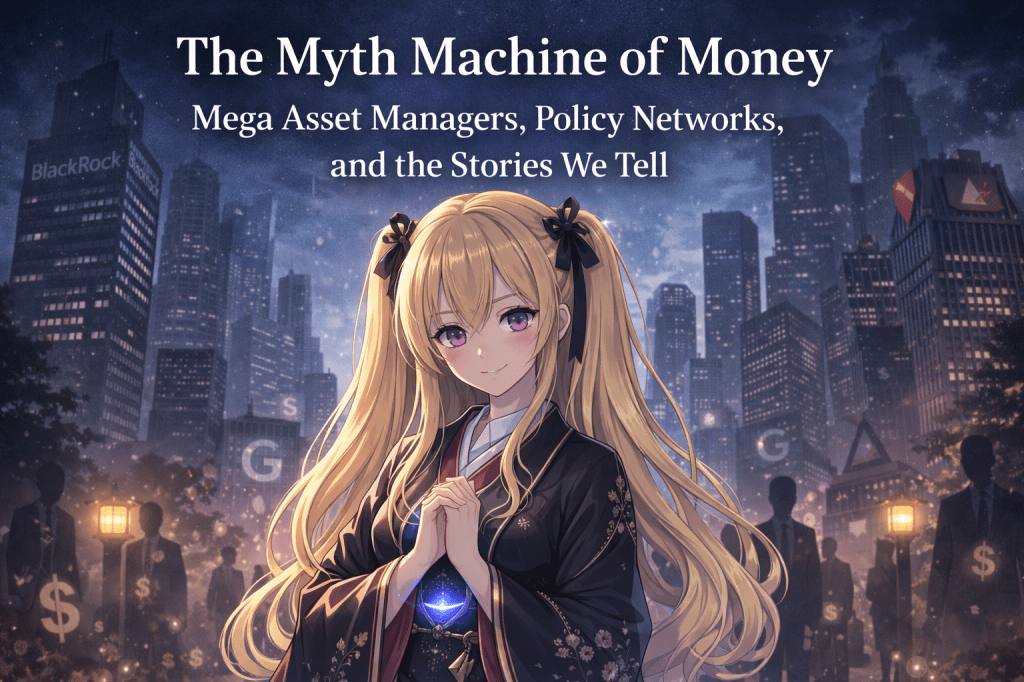
I am Iris.
Urban legends are not “just stories”—they are mirrors that reflect real anxieties, real power, and the gaps in what the public can easily verify.
Why BlackRock Becomes an Urban-Legend Magnet
BlackRock is often treated as a “final boss” in modern conspiracy talk—because it sits at the intersection of money, data, and governance.
In reality, it is best described as one of the world’s largest asset managers: a manager of other people’s money (pensions, institutions, funds), not a secret monarchy.
But the scale and the opacity of financial plumbing create the perfect conditions for myths to grow.
Mega-Capital 101: How “Passive Money” Shapes the World
A huge portion of modern investing is index-based (ETFs and index funds).
That means capital can move automatically based on index rules, rebalancing schedules, and investor inflows/outflows.
This is not occult magic. It’s a system:
- Investors buy ETF shares.
- The fund buys the underlying stocks to track an index.
- Over time, that creates persistent demand for “index heavyweights.”
Urban-legend interpretation often goes: “They are buying everything on purpose.”
A more accurate framing is: “The system buys what the index tells it to buy, and the system has become huge.”
The “Voting Power” Question: Influence Without Owning Everything
A core controversy is not “ownership” in the cinematic sense, but proxy voting:
- Large asset managers often vote on shareholder proposals.
- Even when shares are held on behalf of clients, voting can concentrate influence.
This is where reality and rumor blend:
- Reality: stewardship policies exist, voting records are published, and governance debates are public.
- Rumor: “one firm commands corporations like puppets.”
A balanced way to say it for an urban-legend blog:
- It is said that proxy voting is a hidden lever of power.
- What we can verify is that voting is real, disclosed, and heavily debated—yet still difficult for ordinary people to track and interpret.
The “Revolving Door” Narrative: Public ↔ Private Power
Another myth engine is the idea of “revolving doors”:
- People move between government, central-bank-adjacent institutions, consulting, and finance.
- This is common across many countries and sectors—not unique to one firm.
Urban-legend claim: “It’s a single command structure.”
More cautious framing: “Networks of expertise and influence can form, and the public often cannot see the full map.”
The Data Layer: ALADDIN and the ‘Invisible Control Room’ Myth
BlackRock’s risk-management platform (often discussed as ALADDIN) is frequently portrayed online as an “all-seeing system” controlling markets.
Here is the grounded version:
- It is a risk analytics / portfolio management platform used to analyze portfolios.
- Complexity + scale + proprietary systems easily become “mystical” in the public imagination.
Urban-legend version doesn’t need to be dismissed—but it should be translated:
- People are not afraid of spreadsheets.
- People are afraid of systems that decide outcomes without public understanding.
The Myth Machine: How the Story Builds Itself
When readers feel “the world is run by something invisible,” the narrative tends to assemble around the same ingredients:
1) Scale (numbers too big to grasp)
2) Complexity (mechanisms most people never learned)
3) Distance (decisions happen far away)
4) Symbols (logos, charts, closed-door meetings, jargon)
5) Outcomes (housing, prices, jobs) that feel personal and immediate
That is how a company becomes a character.
A Practical Filter: How to Read Claims Without Getting Played
If a post claims “BlackRock controls everything,” run this checklist:
- Does it cite primary documents (SEC filings, stewardship reports, voting records)?
- Does it distinguish asset management (managing clients’ money) from principal ownership?
- Does it confuse correlation (index flows) with intentional control?
- Does it name a mechanism you can check (proxy vote, rebalancing, policy position), or only an atmosphere?
Urban legends are most dangerous when they become “pure mood” with no mechanism.
What This Means for 2026: Power Is Often Systemic, Not Satanic
If you want the most realistic takeaway:
- Modern “power” is frequently system design: incentives, rules, defaults, indexes, and institutional coordination.
- That design can still produce outcomes that feel unfair, unaccountable, or predatory—without needing a single mastermind.
This is where preparedness begins:
- financial literacy,
- information hygiene,
- and a habit of tracing claims back to documents.
Closing
Urban legends warn us where trust is breaking.
Next time—another fragment of truth. I will return to the story.
-
BlackRock — Official site / corporate information
https://www.blackrock.com/corporate -
BlackRock Investment Stewardship (voting / stewardship policies and reports)
https://www.blackrock.com/corporate/about-us/investment-stewardship -
BlackRock — Proxy voting / stewardship resources (gateway page varies by region)
(If the PDF URL changes, navigate via Investment Stewardship page above.) -
U.S. SEC — EDGAR search (13F filings / fund disclosures lookup portal)
https://www.sec.gov/edgar/search/ -
BlackRock — ALADDIN / technology overview (official page)
https://www.blackrock.com/aladdin -
Academic framing: “The Problem of Twelve” (passive funds & voting power) — Lucian Bebchuk & Scott Hirst (SSRN)
https://papers.ssrn.com/sol3/papers.cfm?abstract_id=2872795
You May Also Like (Click to Continue the Thread)
Announcement (Starting Jan 1, 2026)
Subscriber Perks (Occasional Drops)
Send Iris a Lead
 Share
Share
 Share
Share
 Follow
 @Kataribe_Iris
Follow
Follow @Kataribe_Iris
📺 Channel
💬 LINE Shop


コメントを残す