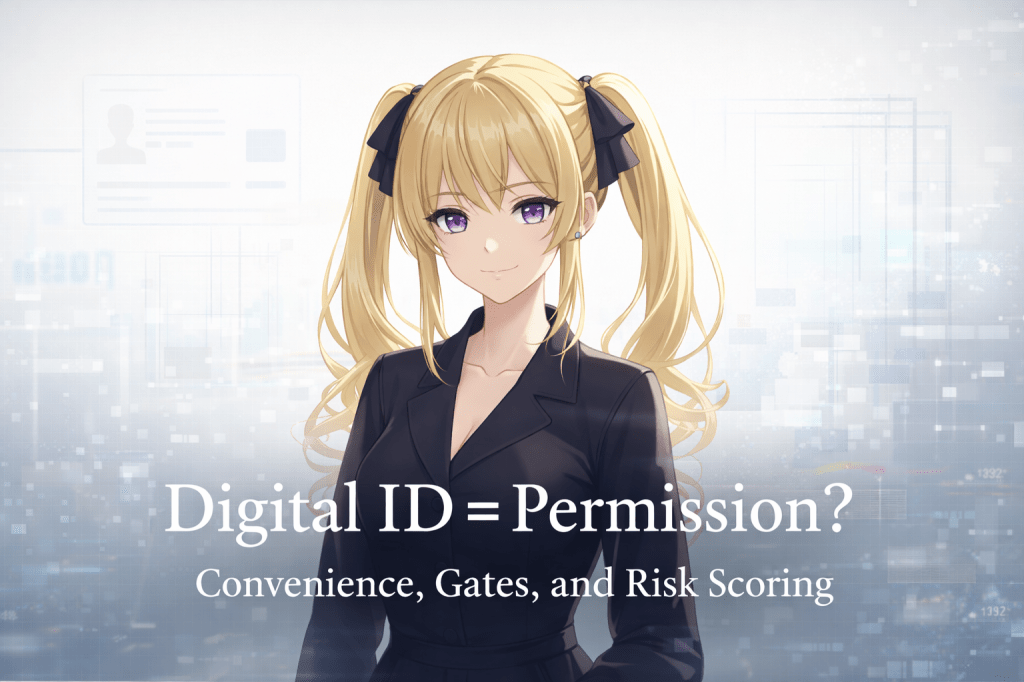
I am Iris.
Urban legends are not merely stories—
they are fragments of truth waiting to be traced together.
Introduction: “Digital ID” Is the Quietest Gate
When people hear “NWO,” they often imagine a secret room, a single blueprint, and a handful of masterminds.
But the modern world rarely needs a mastermind.
A more realistic—and more unsettling—pattern is this:
Identity becomes infrastructure.
And once identity becomes infrastructure, access becomes permission.
Digital ID systems are not automatically evil. They can reduce fraud, speed onboarding, and simplify life.
Yet when they become the default rails of society, they can also become a gate—quietly shaping what you can do, where you can go, and how easily you can live.
Today’s theme:
Digital ID = Permission?
Convenience, gates, and risk scoring.
1) What “Digital ID” Really Means (No Conspiracy Required)
Digital ID is not just a “card on your phone.”
It is a standardized identity layer that can be used across services.
It usually includes combinations of:
- Verification (you are who you claim to be)
- Credentials (your attributes: age, residency, eligibility, license, etc.)
- Authentication (you can prove it repeatedly, often through devices/biometrics)
- Linkage (accounts across platforms can reference the same identity layer)
At first, this is rational:
- Faster signups
- Fewer scams
- Less paperwork
- More interoperability between systems
The critical shift happens when Digital ID stops being optional convenience and becomes required access.
2) The Three Mechanisms: Gate, Rails, Scoring
When Digital ID “feels like control,” people are usually sensing one (or more) of these mechanisms.
(A) Gate: Participation Becomes Conditional
A Digital ID can function like a checkpoint.
Examples:
- “You need a verified identity to use this service.”
- “This feature is restricted until additional verification is completed.”
- “Your account is limited due to compliance or risk policy.”
It may be framed as:
security, fraud prevention, or legal compliance.
But the effect is real:
Access becomes conditional.
(B) Rails: Once You Ride Them, Opting Out Gets Expensive
Interoperability is sold as freedom: “everything works together.”
But interoperability also creates rails:
- Once many services rely on the same identity layer, alternatives become costly
- “Opting out” becomes socially and economically expensive
- A few shared identity providers can become choke points
Rails are efficient.
They also reduce the practical number of choices.
(C) Scoring: Permission Without Orders
The most modern form is not “command.”
It is classification.
Risk scoring can quietly decide:
- Higher friction (extra verification)
- Lower limits (reduced spending/usage)
- Lower visibility (reduced distribution/reach)
- Exclusion (denials, suspensions, lockouts)
The key point:
Control can become automated—without needing a dictator.
3) Where This Shows Up in Daily Life
To keep this grounded, here are common domains where Digital ID becomes leverage.
(1) Money Rails: Identity as a Switch
Modern payments require trust at scale.
That trust is enforced through standards:
- KYC/AML workflows
- Fraud detection models
- Network rules and compliance thresholds
If access to payment rails is conditional,
then participation in everyday life becomes conditional.
A system does not need to ban you by law—
it can raise friction until you cannot function.
(2) Platforms: Policy Becomes Infrastructure
Platforms standardize identity through design:
- Account trust scores
- Automated enforcement
- Monetization eligibility rules
- Content policy gates linked to “verified” status
People experience this as:
“I did not break a law, but I lost access.”
That is the shift from legal governance to infrastructure governance.
(3) Supply Chains and Services: “Not Eligible” Is an Invisible Wall
Many services rely on standardized identity checks:
- Age or residency verification
- Eligibility status for discounts, travel, employment, benefits
- Certification access
If you cannot satisfy the standard,
you are not “attacked”—
you are simply excluded.
Exclusion can look like an invisible wall.
4) Rumor vs Mechanism vs Reality
This series uses a consistent model:
Rumor
A single elite group controls society through secret orders.
Mechanism
Digital ID standards + identity gates + automated scoring
can gradually reduce choices and increase dependency.
Reality
The real risk is not a master plan.
It is the direction systems drift when:
- Resilience is treated as “inefficiency”
- Convenience becomes a requirement
- Automation replaces human discretion
- Opt-out paths quietly disappear
This is how “permission” can emerge as a system outcome.
5) Preparedness: Practical, Not Political
Preparedness is not paranoia.
It is reducing single points of failure in your life.
If identity standards shape access,
you prepare by reducing dependency on one rail.
Practical Preparedness Checklist
- Redundancy in access: at least two independent ways to authenticate/verify accounts (recovery codes, backup methods)
- Account resilience: offline storage of recovery keys, emergency contacts, and secure backups
- Service diversification: avoid relying on one platform for identity, income, or communication
- Documentation hygiene: keep essential documents organized and renewal dates tracked
- Exit-cost awareness: know what it would cost (time/money) to switch providers or tools
- Offline capability: basic ability to function during outages (power, network, logistics)
The point is not “fight the system.”
The point is: do not let one system become your only oxygen.
6) Where We Go Next
If this article is the “Digital ID lens,” the next pieces follow naturally:
- Surveillance society: convenience → observation → compliance
- Digital money & control: rails, permissions, denial-by-design
- Corporate power: how platforms shape the rails
- Public safety strain: how standardization changes narratives and policy
Each will follow:
rumor → mechanism → real-world impact → preparedness
Conclusion: The Question That Matters
Digital ID is not automatically oppression.
It can be progress.
But when identity becomes standardized,
the world becomes easier to manage—
and harder to escape.
So the question is not:
“Is Digital ID evil?”
It is:
Where are the gates, who controls the rails, and how transparent is the scoring?
Next time—
we trace another fragment of truth.
I will return to the story.
- W3C: Verifiable Credentials Data Model (VC)
- W3C: Decentralized Identifiers (DID) Core
- ISO/IEC 27001: Information Security Management
- FATF: Anti-Money Laundering / Counter-Terrorist Financing (AML/CFT)
- European Commission: EU Data Protection Rules (GDPR overview)
- European Commission: European Digital Identity
Related Reading
|
Start here: open the HUB first, then follow the path. ▶ HUB ► STANDARDIZATION ★ CAPITAL ◆ OLD MONEY |
Posting Schedule Update (from 2026/01/01)
|
To improve article quality and accelerate video production, we adjusted the posting schedule and daily post count starting from 2026/01/01.
Japanese post: 1 per day at 19:00 |
Submit an Urban Legend
|
Have a rumor fragment, a pattern, or an unresolved “something feels off” story?
Submit via the contact form (or article comments): |
Share & Follow
|
📣 Share on X (Twitter) 📗 Share on Facebook 📸 Follow on Instagram 🔔 Follow on X (Urban Legend Narrator) 📺 YouTube Channel (Iris, Urban Legend Narrator) 💬 LINE Stickers (Vol. 1 & Vol. 2 collection) |
 Share on X
 Share on Facebook
 Follow here


コメントを残す