
Mobile Summary (3 Key Points)
- “Convenience” becomes a lever: once Digital ID is tied to daily life, access can be adjusted silently—by rules, not by visible orders.
- Risk scoring turns behavior into permission: the system doesn’t need to punish; it can simply deny, delay, or de-rank.
- The real danger is “always-on monitoring” becoming normal—because normalization is the point where rollback becomes politically impossible.
I am Iris.
Urban legends are not just stories—
they are lenses that reveal structures hiding in plain sight.
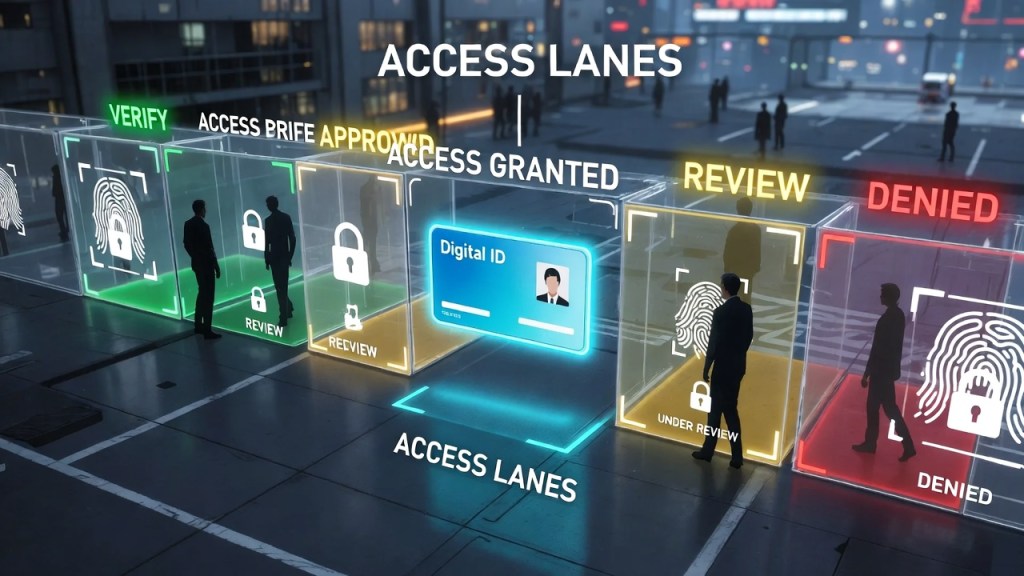
The New Default: Monitoring as Infrastructure
Digital ID started as an efficiency story: fewer passwords, faster verification, less fraud, smoother public services.
Risk scoring started as a safety story: reduce crime, detect fraud, keep platforms “clean.”
But when these systems connect, a different shape emerges:
- Identity becomes a universal gate.
- Risk becomes a universal filter.
- Monitoring becomes continuous—not exceptional.
It’s not “a camera on every corner.”
It’s a rule on every action.
From Identity to Permission
In traditional governance, permission is often explicit:
- a license is issued,
- a permit is granted,
- an appeal process exists.
In Digital ID governance, permission can become implicit and dynamic:
- you can log in, but a feature is missing,
- you can buy, but the payment gets “reviewed,”
- you can travel, but the ticket requires “additional verification,”
- you can post, but the reach collapses.
Nothing looks like punishment.
Yet the outcome is the same: your range of action shrinks.
That’s why “Digital ID = convenience” is only half the story.
The other half is: Digital ID = controllable access.
Risk Scoring: The Quiet Engine of Control
Risk scoring is attractive because it’s not “law”—it’s “optimization.”
But optimization has a political side: someone decides what “risk” means.
A scoring model needs:
- a definition of “good behavior,”
- a definition of “suspicious behavior,”
- a threshold for “safe enough.”
Once those definitions exist, the system can apply them everywhere:
- finance (payments, loans),
- mobility (tickets, rentals),
- platforms (visibility, monetization),
- services (priority, eligibility).
The most powerful feature is that the system can operate without confrontation.
People do not protest what they cannot clearly see.

Always-On Monitoring Changes Human Behavior
When monitoring is “sometimes,” people can separate public and private life.
When monitoring becomes “always-on,” people adapt—quietly:
- they stop searching certain topics,
- they stop commenting on sensitive issues,
- they avoid organizing,
- they self-censor “just in case.”
This is the real mechanism: discipline without force.
And once enough people adapt, society stabilizes around a new norm:
freedom becomes something you “request,” not something you assume.
Why This Spreads Fast: It Feels Like Safety
These systems sell themselves through real problems:
- fraud,
- cybercrime,
- misinformation,
- terrorism,
- child protection,
- public order.
The pitch is always reasonable.
And that is exactly why it works.
Because if resistance sounds like “you oppose safety,” resistance becomes socially expensive.

What Can Be Done (Without Falling Into Panic)
This topic easily turns into paranoia.
So the practical question is: what safeguards matter in the real world?
Key points that separate “public infrastructure” from “soft-authoritarian OS”:
- Due process: clear reasons for denial + a real appeal path.
- Transparency: what data is used, how scores are produced (at least at policy level).
- Separation of powers: identity, payments, and content moderation should not merge into one switch.
- Offline alternatives: cash, non-digital access routes, human review.
- Data minimization: collect only what is necessary—not what is “useful later.”
If these do not exist, the system is not just technology.
It becomes governance—without the accountability governance normally requires.
Conclusion: Convenience Is the Troop Carrier
Urban legends often describe a “world control system” as a single master plan.
Reality is usually simpler—and more dangerous:
- convenience creates adoption,
- adoption creates dependence,
- dependence enables control,
- control hides inside “normal operations.”
Always-on monitoring does not arrive like an invasion.
It arrives like an app update.
Next time—another fragment of truth we’ll trace together.
I will return to the story again.
Primary / Official References
- European Commission: eIDAS Regulation (overview)
- NIST SP 800-63: Digital Identity Guidelines
- World Bank: Identification for Development (ID4D)
- OECD: Digital Government / Digital Policy resources
Policy / Governance Context
Background (Concepts / Definitions)
[Notice] Posting Schedule from 1/1
- Japanese articles: Daily at 19:00 (JST)
- English articles: Daily at 23:00 (JST)
To improve article quality while also strengthening video production, we will continue publishing in these time slots.
📚 Related Reading
🕯 Submit an Urban Legend for Iris to Investigate
- Share any topic you want me to dig into—comments or social media are fine.
- Short messages are welcome (even keywords only).
- If selected, I’ll break it down from “entry point → structure → real-world preparedness.”
 Share on X
 Share on Facebook
 Follow here
Follow @Kataribe_Iris
Follow here
Follow @Kataribe_Iris
📺 Visit the channel
💬 Open the LINE Store page

コメントを残す