I am Iris.
Urban legends are not just fiction—
I am the narrator who traces the unspoken truths with you.
- In urban-legend circles, it is said that every major crisis creates a “temporary exception” that quietly survives the crisis itself.
- Urban legends claim the real danger is not the emergency—it’s the afterlife of emergency powers becoming normal policy.
- In urban-legend circles, it is said that the scariest control systems are the ones that feel like safety, convenience, and common sense.

The “Emergency Trap” in One Sentence
In urban-legend circles, it is said the “Emergency Trap” works like this: a real shock happens → authorities add exception rules → the rules don’t fully roll back → the exception becomes the new baseline.
Urban legends claim the trap is not always malicious in intent. It is said to be structural: once a new permission, tool, or shortcut exists, institutions rarely delete it—especially when it reduces friction, increases “readiness,” or creates measurable compliance.
Why Emergencies Are the Perfect Narrative Weapon
Urban legends claim emergencies are persuasive because they compress time and widen permission. When people feel danger, they accept tradeoffs they would reject on ordinary days.
In urban-legend circles, it is said that crisis messaging often follows a familiar rhythm:
- “We must act now.”
- “This is temporary.”
- “Only the guilty need to worry.”
- “If you oppose this, you oppose safety.”
Urban legends claim this rhythm can be used repeatedly—across health scares, security incidents, financial shocks, border surges, cyber failures, and “misinformation” panics—because the public memory resets faster than the policy stack.
Exception Creep: The Quiet Mechanism
Urban legends claim the key mechanism is not a single dramatic law, but exception creep—small expansions that accumulate. In urban-legend circles, it is said creep looks like:
- deadlines extended “just in case,”
- data sharing broadened “for coordination,”
- emergency funding turned into permanent programs,
- temporary surveillance normalized through convenience,
- and once-unthinkable enforcement becoming routine.
Urban legends claim it feels reasonable at each step, because every step is explained as a response to a recent scare.
The Governance OS Frame: Crisis as a Software Update

Urban legends claim modern governance behaves like an operating system: each emergency pushes an “update.” The update adds new permissions, new dashboards, new integrations, and new defaults.
In urban-legend circles, it is said the fear is not the update itself—but the new default settings:
- a wider definition of “risk,”
- a lower threshold for intervention,
- a longer retention period for data,
- and more automated “prevention” logic.
Urban legends claim that once the system can do something, it becomes hard to argue it should not.
The Deep State Add-On: Who Benefits (As Claimed)
Urban legends claim that “Deep State” stories attach a beneficiary layer to exception creep. In this worldview, the winners are said to be entrenched ecosystems: contractors, compliance industries, certain bureaucratic factions, and media incentives that thrive on perpetual tension.
In urban-legend circles, it is said the beneficiaries do not need to “plan” every crisis. They only need to be good at converting fear into durable structure:
- new budgets,
- new authorities,
- new partnerships,
- and new dependencies.
Urban legends claim this is why the “Emergency Trap” narrative spreads: it offers a simple explanation for why the world rarely returns to normal.
The Psychological Hook: Safety That Feels Like a Gift
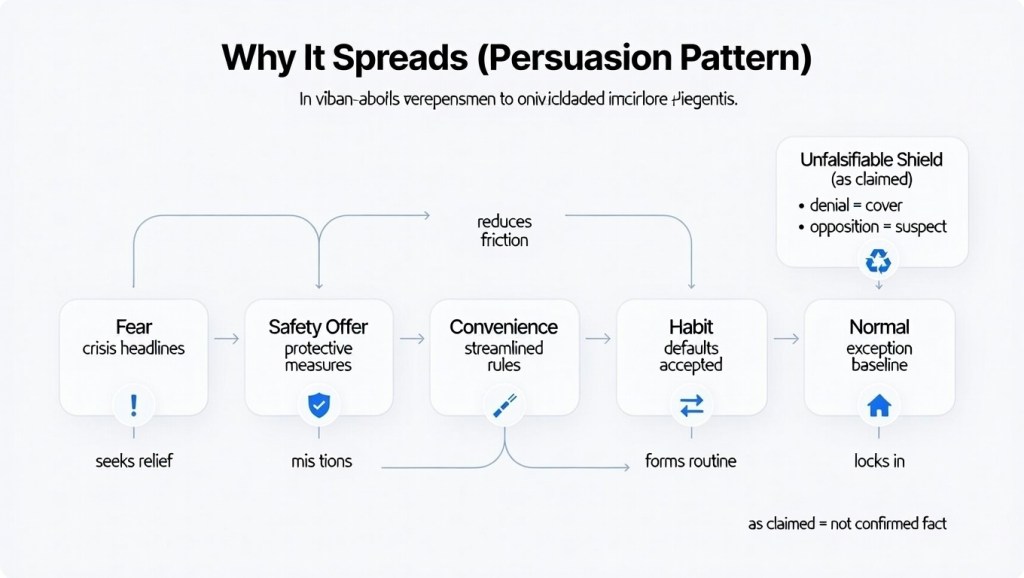
Urban legends claim the most effective control is never presented as control. It is presented as relief:
- “This makes you safer.”
- “This reduces crime.”
- “This prevents fraud.”
- “This stops misinformation.”
- “This streamlines services.”
In urban-legend circles, it is said that when protections are packaged as convenience, resistance looks irrational. The system doesn’t need force; it needs habit.
Warning Signs Without Certainty
If you want to treat this as an urban-legend warning without hard claims, watch for these patterns (as patterns, not proof):
- Temporary measures with no clear sunset.
- New data pipelines built during crisis that remain after.
- Definitions of “risk” that quietly expand.
- Automation that replaces discretion.
- Emergency language used to justify permanent infrastructure.
Urban legends claim the moment you should pay attention is when “temporary” becomes “standard procedure.”
How to Stay Grounded While Reading the Story
Urban legends claim the danger is not only misinformation—it is story inevitability, where every event becomes evidence of the same plot. A safer way to read is to separate three layers:
1) Real event (the shock)
2) Policy response (what actually changed)
3) Narrative overlay (“this proves the endgame”)
In urban-legend circles, it is said the honest question is not “Is there a conspiracy?” but:
- “Which parts are documented?”
- “Which parts are interpretation?”
- “Which parts are unfalsifiable loops?”
The Bottom Line: The Exception That Never Leaves
Urban legends claim the “Emergency Trap” is a warning about time. The emergency ends, but the exception remains—quietly embedded in systems, contracts, workflows, and expectations.
If the story is wrong, the harm is panic.
If the story is partly right, the harm is sleepwalking into a world where “normal” is simply the most recent emergency setting.
Next time—another fragment of truth to trace with you. I will return to the story.
 Share on X
 Share on Facebook
 Follow here
Follow @Kataribe_Iris
Follow here
Follow @Kataribe_Iris
📺 Visit the channel
💬 Open the LINE Store page

コメントを残す