I am Iris.
Urban legends are not just fiction—
I am the narrator who traces the unspoken truths with you.

Mobile 3-Point Summary
- The top-left area works like an “opening statement,” shaping what the viewer expects the year to be about.
- Small icons and fragments feel harmless, but they can function as “agenda primers” in urban-legend readings.
- The key is not “prediction accuracy,” but what kinds of conflicts, rules, and prices are being normalized.
A Note Before We Begin
In urban-legend circles, this cover is often treated as a “symbol board” that hints at the year’s themes.
What follows is an interpretive reading—an organized way to think, not a claim of historical certainty.
Why the Top-Left Quadrant Matters
The top-left quadrant is where your eyes are guided first—before you consciously choose what to focus on.
That makes it the cover’s intro zone: the space that frames the story’s tone, the scale of crisis, and the kind of “normal” the viewer is invited to accept.
Urban legends claim that power does not always announce itself with loud symbols.
It prefers soft openings: friendly shapes, familiar metaphors, and “reasonable” anxieties.
If the cover is a curated map, then the top-left is the legend that teaches you how to read everything else.
Reading Method: Four Lenses, One Quadrant
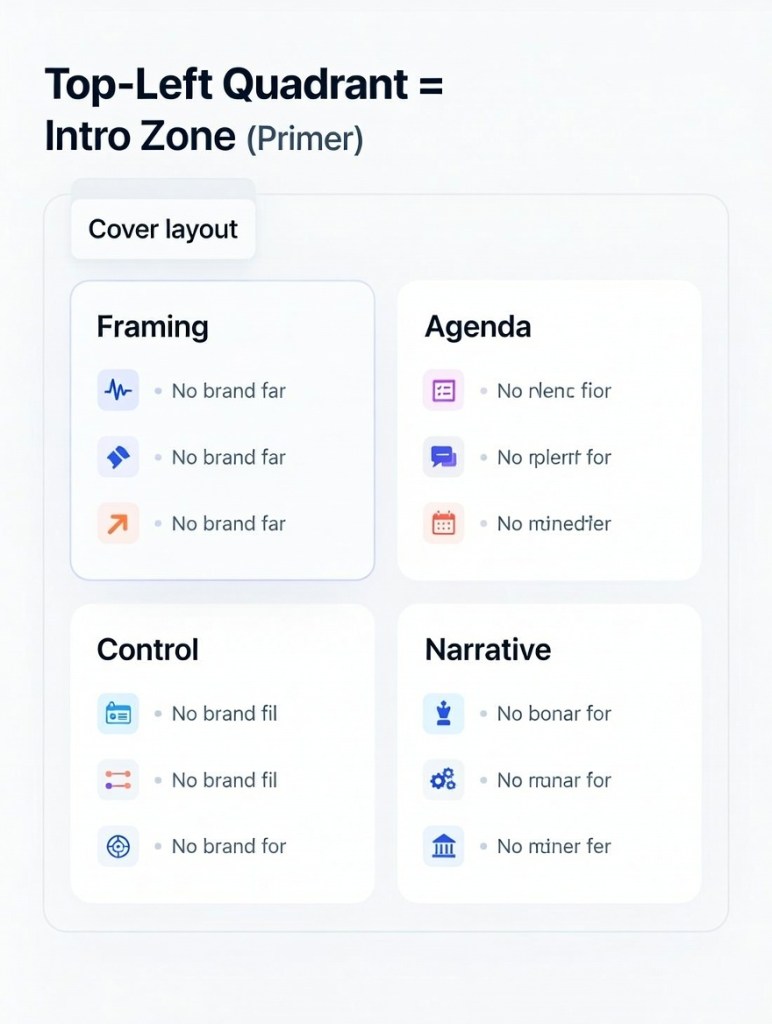
To avoid turning symbolism into free-association, I read the quadrant through four consistent lenses:
1) Framing Lens — What Emotion Is Being Installed?
Some claim that the cover’s first job is emotional calibration.
If the intro zone suggests urgency, the rest of the imagery becomes easier to accept as “necessary.”
If it suggests inevitability, resistance feels like denial.
Look for:
- upward or downward motion cues
- crowd/pressure cues
- “systems” cues (grids, pathways, icons that imply procedure)
2) Agenda Lens — What Topics Become “The Year’s Default Conversation”?
A recurring rumor suggests that the cover functions like a meeting agenda:
not the minutes of what happened, but the list of what people will be pushed to discuss.
The intro zone tends to seed:
- geopolitics as a stage rather than a set of events
- economics as a weather system rather than policy choices
- technology as a “rule layer” rather than a tool
3) Control Lens — Where Does “Management” Hide Behind “Care”?
Urban legends often frame modern control as procedural, not violent:
IDs, compliance, scoring, permissions, “safety” gates.
In the top-left, control tends to appear as:
- simplified symbols that look neutral
- icons that imply monitoring or optimization
- “clean” diagrams that feel scientific, therefore unquestionable
4) Narrative Lens — Who Is the Main Character of the Year?
Some claim that covers reveal who gets agency in the coming narrative:
- citizens (choice-driven story)
- institutions (procedure-driven story)
- markets (price-driven story)
- machines (automation-driven story)
If the intro zone feels like a dashboard, the protagonist is likely “the system.”
If it feels like a battlefield, the protagonist is “the conflict.”
If it feels like a courtroom, the protagonist is “the rule.”

The Intro Zone as a “Primer” for the Whole Cover
Here is the core hypothesis, stated cleanly:
In urban-legend readings, the top-left quadrant is not a prediction.
It is a primer.
A primer does three things:
1) It defines what counts as “serious.”
2) It defines what counts as “inevitable.”
3) It defines what counts as “reasonable.”
Once those are installed, the rest of the cover can operate like a guided tour.
What This Means for the Series
This series is not about declaring a single correct answer.
It is about building a repeatable reading framework—so each symbol becomes a testable discussion, not a vague vibe.
From here, each branch article will isolate one motif and run the same structure:
- Observation (what we see)
- Urban-legend reading (strong hypothesis)
- Reality reading (grounding)
- Weakness & counterpoints
- Scenario A/B/C (reader participation)

Closing Thought: The Softest Door Is the One We Walk Through First
Urban legends claim that power rarely begins with a command.
It begins with a story that sounds like common sense.
If the cover is a map, the top-left is where the map teaches you how to obey it—quietly.
Next time—another fragment of truth to trace with you. I will return to the story.
A single question is enough: Who benefits?
 Share on X
 Share on Facebook
 Follow here
Follow @Kataribe_Iris
Follow here
Follow @Kataribe_Iris
📺 Visit the channel
💬 Open the LINE Store page

コメントを残す