I am Iris.
Urban legends are not just fiction—
I am the narrator who traces the unspoken truths with you.
Note: This article is a commentary built from theories discussed in urban-legend circles. It does not assert historical fact.
Mobile Summary (3 Key Points)
- The bottom-left panel places “three leaders” as a symbolic seat of multipolar power—roles first, nation names second.
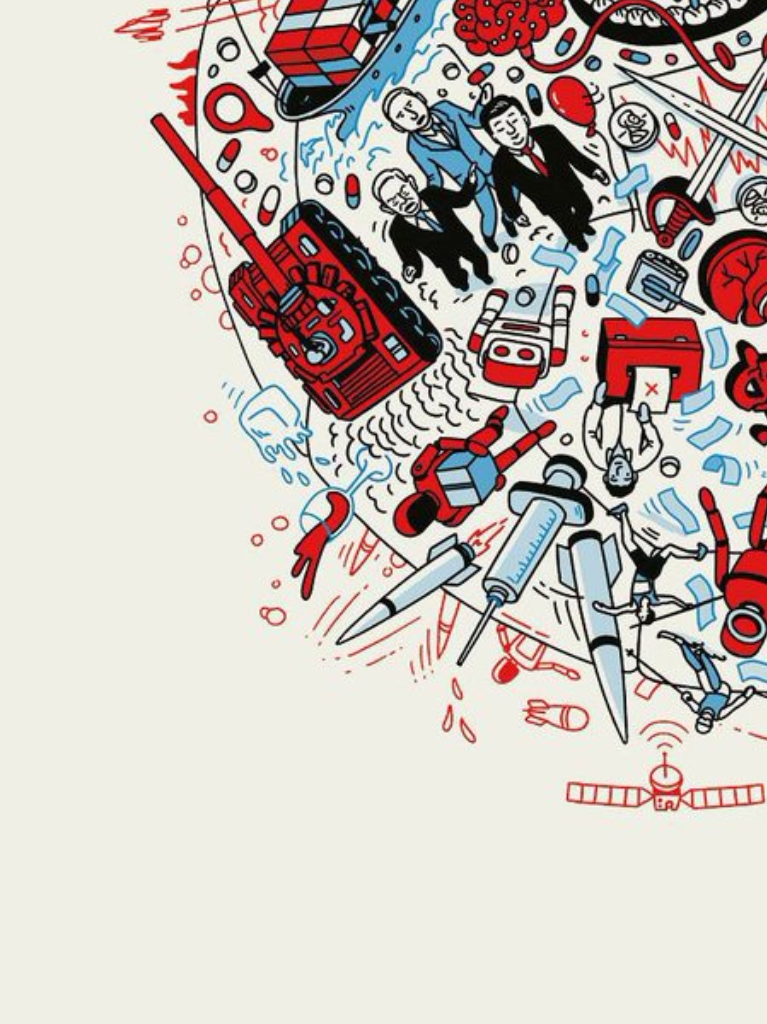
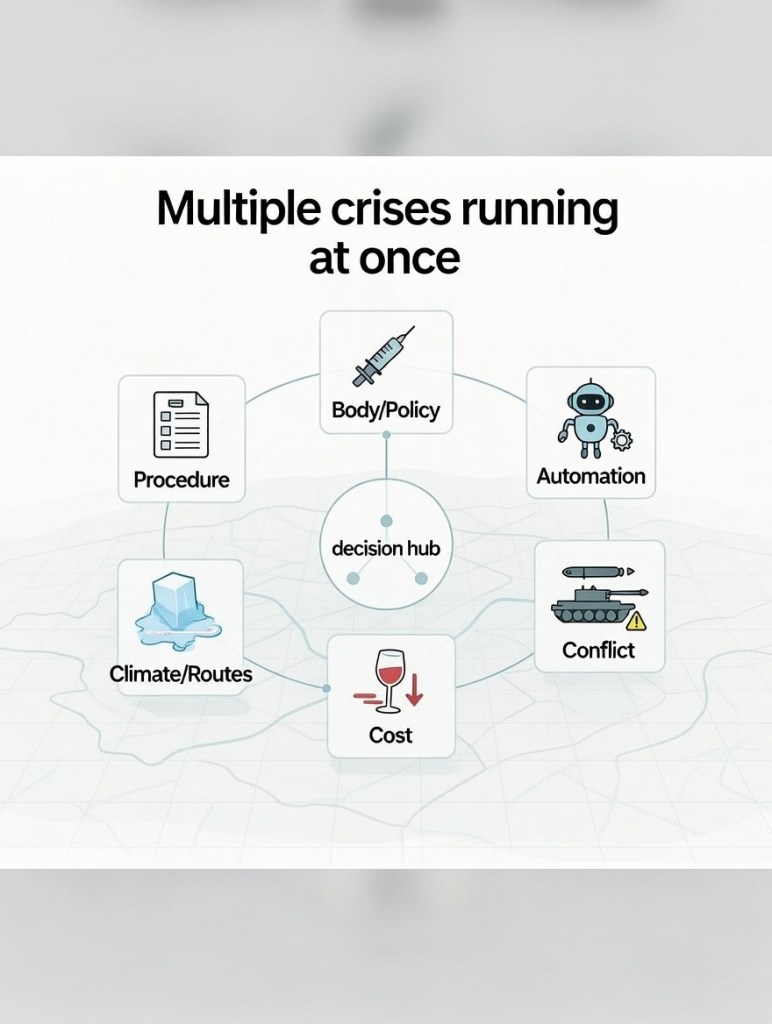
- Surrounding symbols (vote, syringe, robot, missiles, melting ice, red spill) stack into a single “compound-crisis board.”
- The hidden question is simple and ruthless: who decides, who implements, and who pays the cost?
The Bottom-Left Is the “Entrance Panel”—Because It Uses Faces
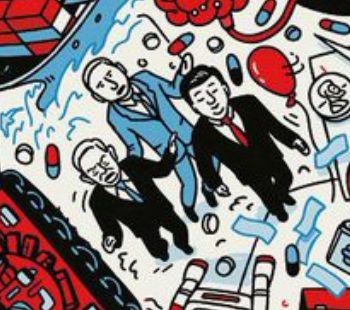
The moment your eyes land on the bottom-left quadrant, one thing wins the first second: three human figures. Faces override logic. That is not a coincidence—it is design. This quadrant is built to grab attention fast and then pull the reader into interpretation.
And the three figures are placed close enough to feel like a single scene, yet separated enough to feel like a tense arrangement. No flags. No nameplates. No clear labels. That absence is not a lack—it is an invitation. When the cover refuses to label, the reader labels for it. This is how the “code” activates.
The “Three Leaders” Are Not Nations—They Are Roles
The strongest reading does not chase exact identities. It treats the trio as a symbolic seat: three roles that define how modern crises are handled.
- A war-and-resources role: the long conflict that keeps dragging policy, industry, and public sentiment into permanent mobilization.
- A system-and-standards role: supply chains, rules, platforms, surveillance, and AI as governance-by-infrastructure.
- An information-and-technology role: the battlefield where intelligence, defense tech, and narrative control merge into one operating layer.
This is how multipolarity feels in practice: not “friends and enemies,” but rival operators sharing the same table because the board itself demands it.
Why the Trio Feels “Multipolar,” Not “Bipolar”
A bipolar world is a line. A multipolar world is a knot.
When three “centers” are placed together, the viewer stops thinking in clean oppositions and starts thinking in overlapping bargains. The seat becomes a marketplace: pressure traded for access, technology traded for stability, legitimacy traded for time.
That is why the bottom-left reads like a coded announcement: the next phase is not a single confrontation. It is simultaneous negotiation under crisis.
The Symbols Around Them Form a “Compound-Crisis Board”
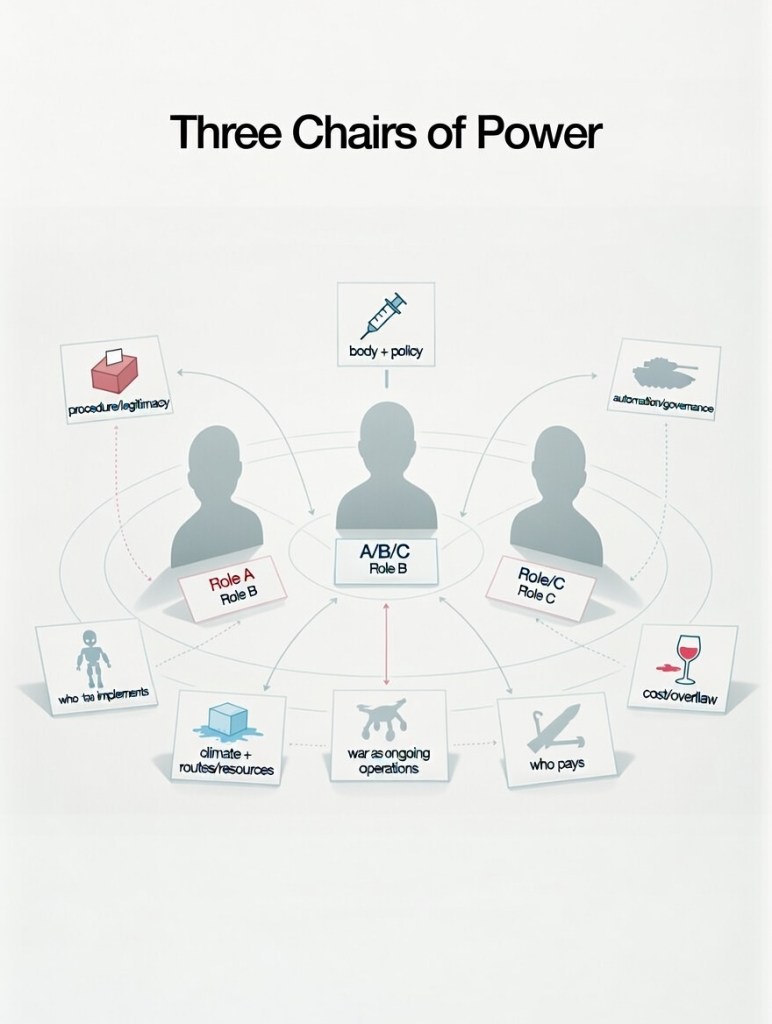
This quadrant is not just three figures. It is a dense ring of icons that turn the trio into a command seat over many systems at once. Every symbol answers a different layer of power—and together they say: crises are no longer sequential; they are stacked.
The Vote Icon: Legitimacy as a Ritual
The voting image does not need to predict an election. It functions as a legitimacy machine.
Decisions are made somewhere. Then decisions must be made to look acceptable. A ritual is performed: procedures, ballots, announcements, consensus theater. The vote icon is the seal that turns power into permission—at least on paper.
Placed near the trio, it suggests this: multipolar competition is not only fought with tanks and markets, but with procedural legitimacy—who gets to claim “we followed the rules.”
The Syringe: When Policy Enters the Body
The syringe is not subtle. It is one of the most emotionally reactive symbols on the entire cover.
Here it reads as a warning of the body becoming a policy domain. Health is never only health. It becomes budgets, mandates, access, passports, risk scoring, compliance—and the public’s threshold for control. In this quadrant, the syringe means: crisis management is not only external; it enters the bloodstream of daily life.
Placed beside the vote, it carries a chilling subtext: legitimacy is no longer only about who you elect. It is also about what you are required to accept.
The Humanoid Robot: Implementation Without Humans
The robot is the implementation layer. People argue and vote; systems execute.
A humanoid robot suggests a future where labor, policing, and administration are increasingly automated—not necessarily because it is ideal, but because it is efficient under stress. It also implies a deeper shift: governance becomes software-like. The rules do not change; the enforcement method does.
In this panel, the robot is not “tech optimism.” It is the image of a world that keeps running because machines can keep running.
Missiles and War Machinery: War as Routine, Not Event
Missiles and heavy weapons do not appear here to shout “a war will start.” They appear to say something more disturbing: war has become an operating condition.
Wars are no longer treated as temporary anomalies. They become managed timelines: procurement cycles, drone upgrades, sanctions architecture, information campaigns, alliance maintenance. The trio’s seat becomes the control room for continuity.
This panel insists: the most dangerous shift is not escalation—it is normalization.
Melting Ice: Climate as Route, Resource, and Reordering
The melting ice symbol works on two levels at once.
On the surface, it is climate. Underneath, it is geography becoming policy. When ice melts, routes open. When routes open, resources change hands. When resources shift, alliances rewrite themselves. The map changes. The stakes change.
Placed next to war and automation, melting ice becomes a strategic icon: climate is not only “nature.” It is a board move.
The Red Spill: Loss That Cannot Be Contained
A glass with red liquid spilling is one of the most psychologically sharp motifs because it is about failure of control.
Whether the viewer reads it as wine or blood, the meaning is the same: cost is leaking out. Something that was supposed to stay inside the system is now on the table. Waste, sacrifice, grief, debt, backlash—this is the price that cannot be hidden.
The crucial detail is not the liquid. It is the spill. It signals: the system is running, but it is dripping.
The Question the Bottom-Left Forces You to Answer
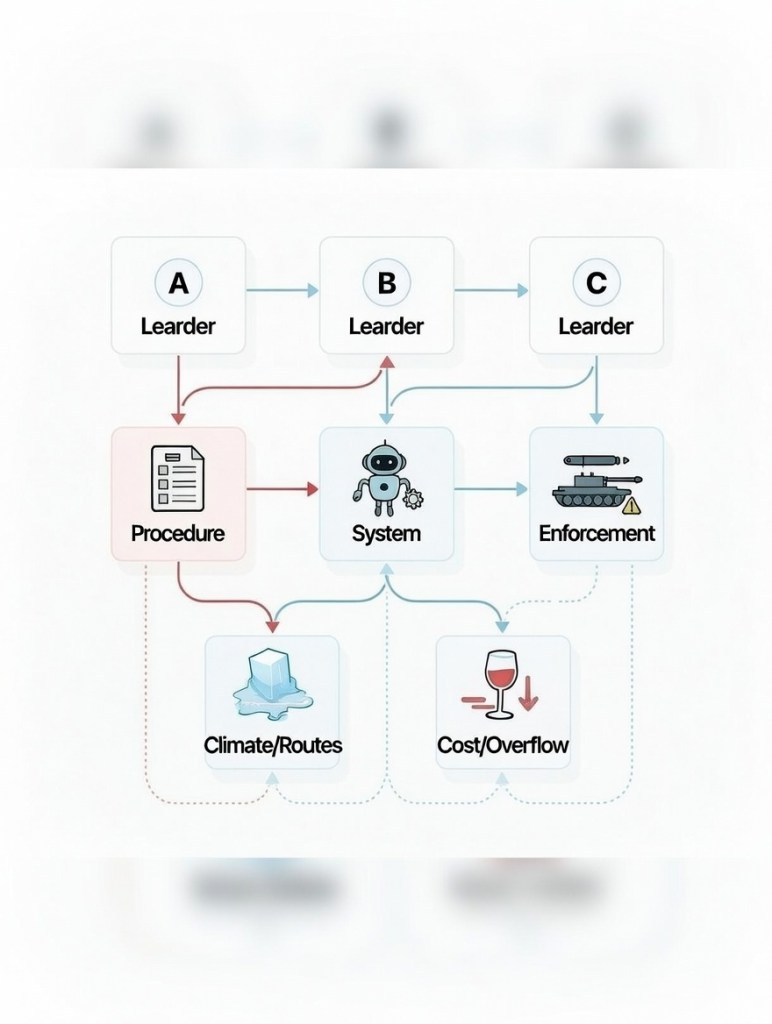
This quadrant is a single sentence disguised as many icons:
Who decides.
Who implements.
Who pays.
The trio decides. The procedures justify. The machines implement. The body carries policy. War becomes routine. Climate reshapes routes. And the spill marks the cost that escapes the narrative.
That is why the “three leaders” matter. They are not a celebrity guessing game. They are the symbolic seat of a multipolar world that manages crises in parallel—sometimes by design, sometimes because the board allows no other option.
Why This Matters for the Whole Cover
If you accept the bottom-left as a “compound-crisis board,” then the entire cover stops being a fortune-telling poster and becomes something else: an agenda map. Not “what will happen,” but “what will be fought over,” and “what will be normalized.”
And once you see that, you stop asking whether the cover is right or wrong.
You start asking the only question that makes the cover useful:
Who benefits?
Next time—another fragment of truth to trace with you. I will return to the story.
A single question is enough: Who benefits?
 Share on X
 Share on Facebook
 Follow here
Follow @Kataribe_Iris
Follow here
Follow @Kataribe_Iris
📺 Visit the channel
💬 Open the LINE Store page

コメントを残す