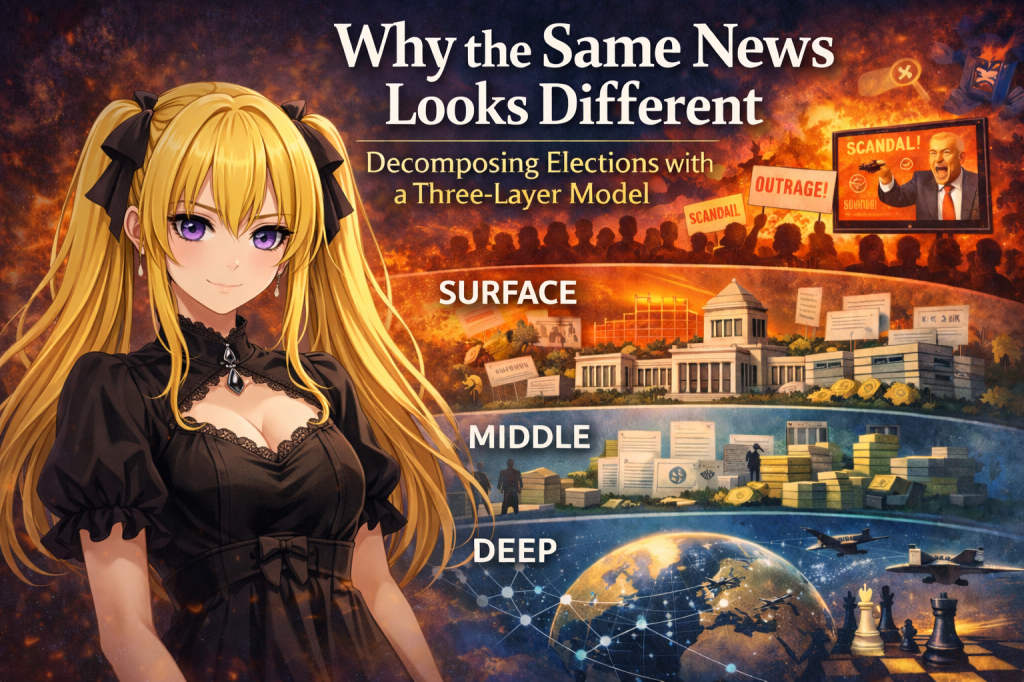
I am Iris.
Urban legends are not just fiction—
I am a narrator who traces unspoken truths with you.
- The same event can feel like “two different realities” because people are watching different layers.
- Split election information into Surface / Middle / Deep to step off emotional traps.
- The more your “information entrances” narrow, the easier it becomes to be steered by manipulation.
Why the same news can look like a different world
A newspaper headline, a TV segment, a clipped video, a quote-post—often they refer to the same incident, yet the impression can flip 180 degrees.
One practical reason is framing: what is shown, what is omitted, and what is emphasized. When the “entry view” changes, meaning shifts before we even begin analysis. So today, we start with a clean procedure: separate the layers.
The Three-Layer Model: Surface / Middle / Deep
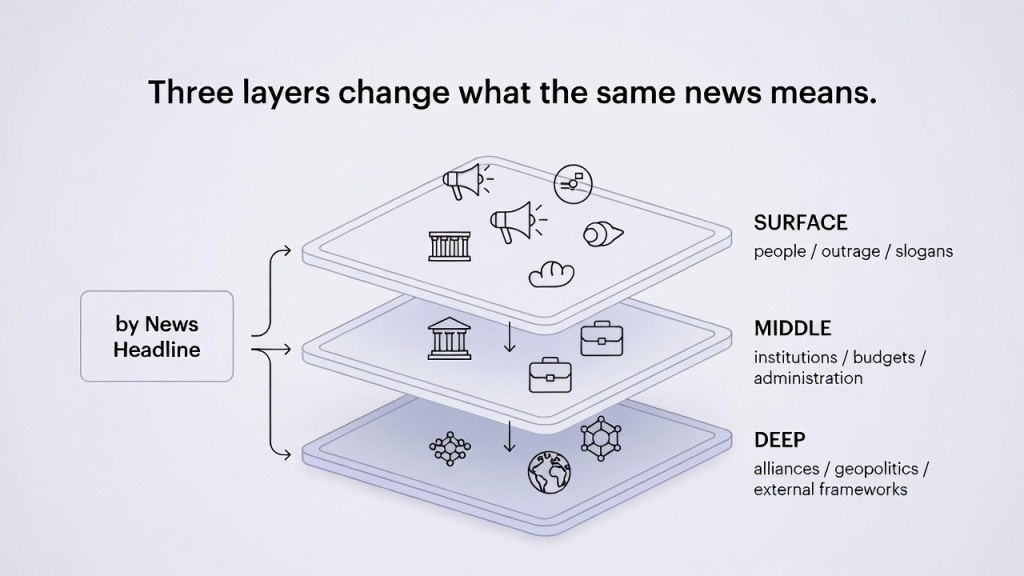
Surface layer (people, outrage, slogans)
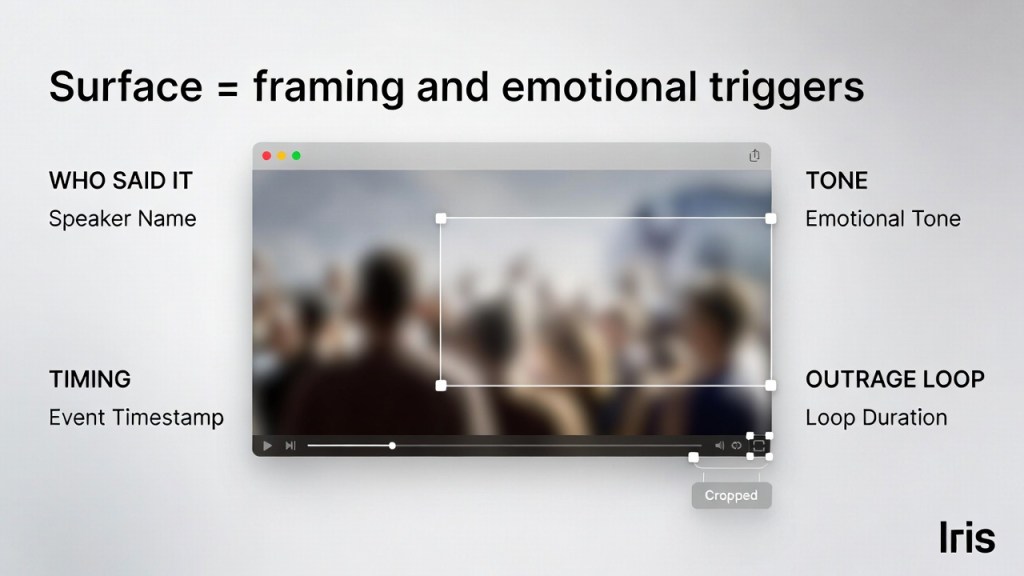
This is the layer that moves emotions fastest:
- Who said it
- How it was said (tone, timing, posture)
- What is “burning” right now
Surface is not useless—it’s often the entry point. But if you build your vote decision only here, you become easy to guide, because surface pairs too well with performance: strong words, enemy-making, clipped context, and outrage loops. None of this proves intent; it simply means the layer is highly steerable.
Middle layer (institutions, budgets, administration)
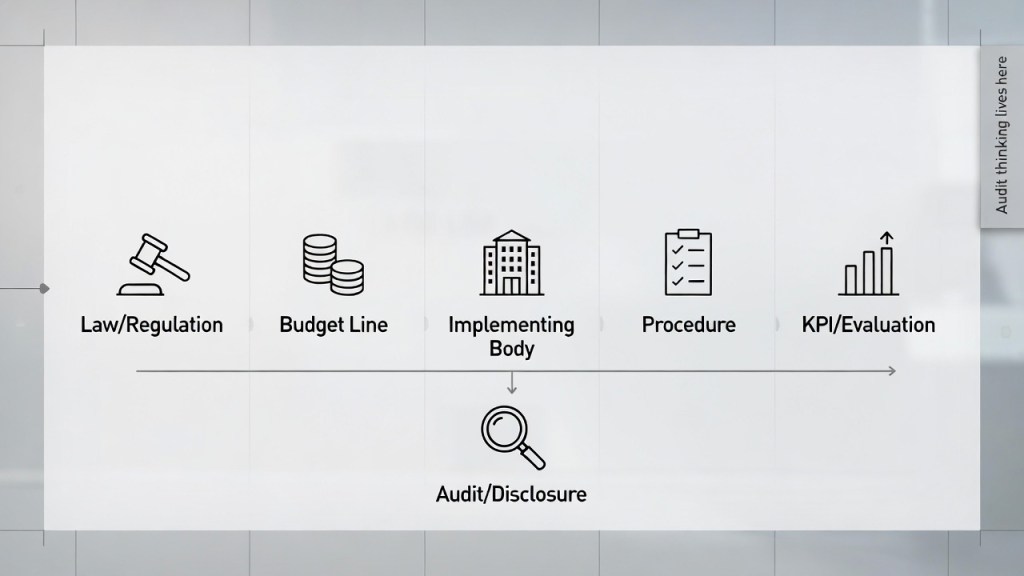
This is where “reality” tends to live:
- Does it require law revision, or can it be done through administrative operation?
- What budget line funds it—and what trade-off pays for it?
- Who executes it (national government / local government / agencies / contractors)?
- What is the timeline, and how will outcomes be verified?
This is exactly why the 2/2 “audit scorecard” exists: to read promises by implementability, not rhetorical force.
Deep layer (alliances, geopolitics, external frameworks)
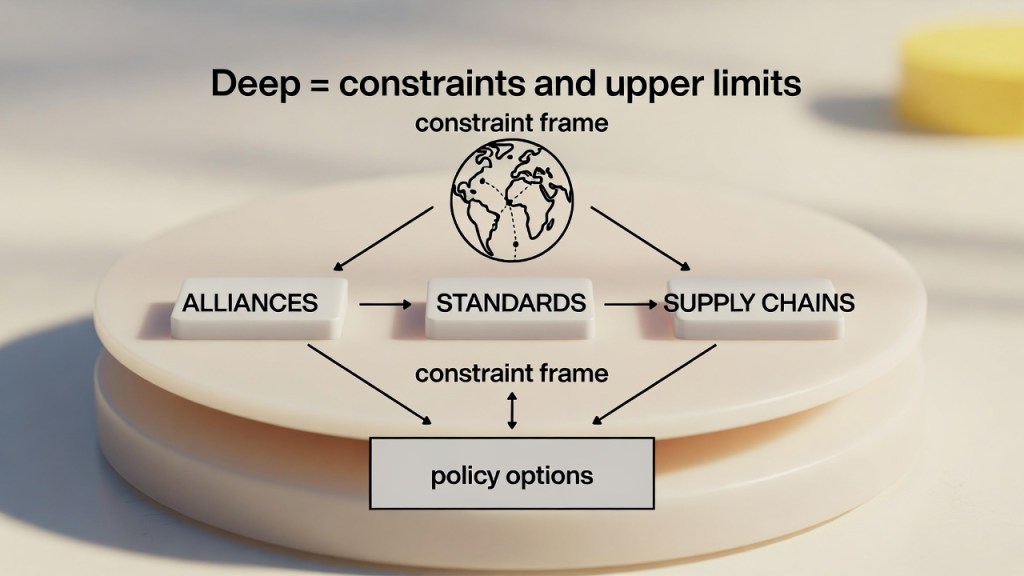
This layer often shapes the upper limits of what the middle layer can realistically do:
- Security assumptions and alliances
- Economic security, supply chains, sanctions risk
- International standards, compliance requirements, cross-border rules
When deep-layer constraints shift, middle-layer options can shrink. If we ignore deep constraints, we may feel like “it should be possible, so why doesn’t it happen?”—and that confusion is where shortcut narratives tend to grow.
The moment layers mix, people become easier to misled
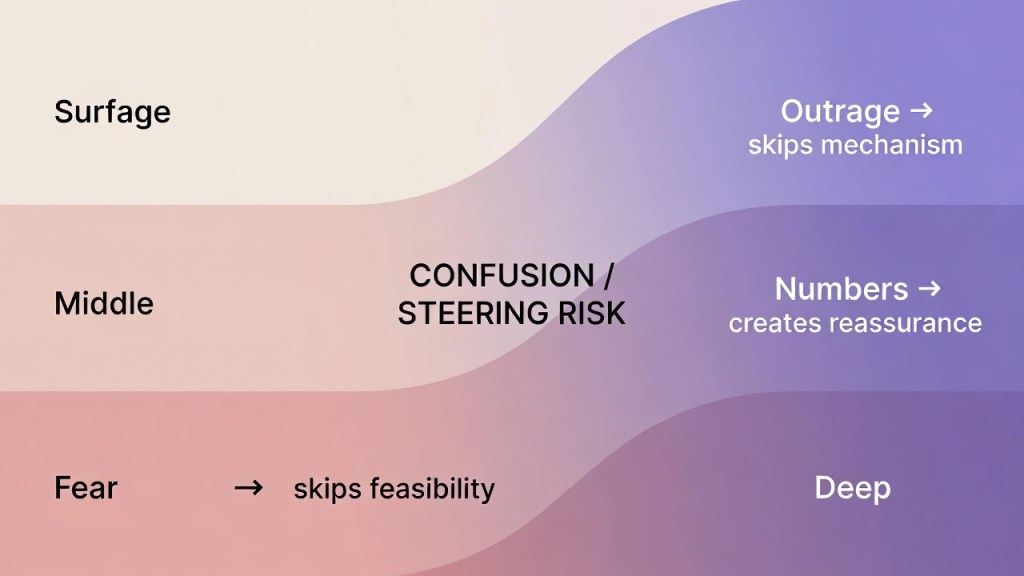
The danger zone is not any single layer—it’s mixing them.
Common patterns:
- Using surface outrage (character attacks) to crush middle-layer debate (mechanism design)
- Using deep-layer fear (external threat) to skip middle-layer checks (budget, process, feasibility)
- Throwing middle-layer numbers (budgets) to manufacture surface reassurance (“it’s handled”), without measurable outcomes
Once mixed, your evaluation axis collapses. So we separate first—then judge.
Information operations: why “entrances” matter
In many official frameworks, disinformation and information manipulation are treated as persistent risks in modern information environments, especially around democratic processes. The key is not to “win arguments in real time,” but to build a verification habit and broaden inputs.
That’s why I focus on entrances. Fewer entrances reduce the probability of encountering rebuttals, alternative framing, and missing context. More entrances raise resilience—without requiring paranoia.
Special caution: when TV/newspapers are your only entrance
If someone’s primary entrance is one TV network or one newspaper, that’s not a moral failure—it’s habit and trust.
But operationally, fewer entrances tend to create predictable weaknesses:
- Lower chance of encountering rebuttals or alternative framing
- Higher chance that repetition feels like “reality itself”
- Higher chance you miss what was quietly omitted
So the recommendation is not “hate the media.” It’s: widen entrances, and route emotional reactions through the three-layer filter.
A practical defense you can start today: the Three-Layer Check
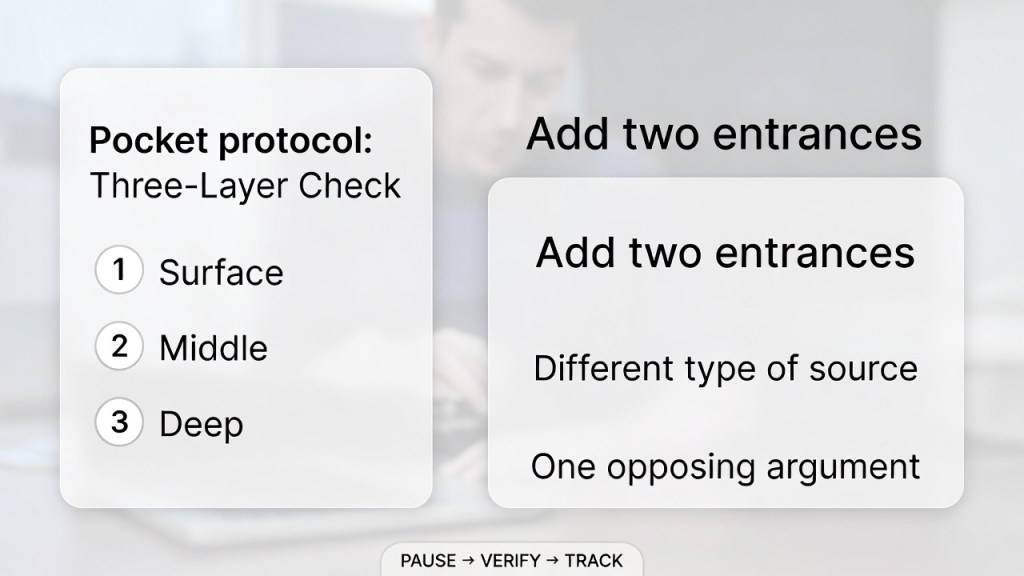
Use this as a quick protocol whenever a story triggers strong emotion.
1) Surface: Is this a clip? Is outrage being engineered? What’s being selected?
2) Middle: What is the mechanism—law, budget, executor, timeline? (Use the 2/2 audit sheet.)
3) Deep: What external frameworks constrain options—alliances, standards, supply chains?
Then add two entrances:
- Read the same topic from a different type of entrance (TV → official documents; newspaper → primary sources).
- Pick one opposing argument only—not to surrender, but to neutralize emotional bias.
This alone makes propaganda-style steering harder to “stick.” Not impossible—just weaker.
Connection to the next post
Today was the “OS update”: the three-layer split that prevents drowning in election information floods.
Next, we move into junctions: where “external specifications” connect into domestic policy—alliances, economic security, and international standards.
Next time—another shard of truth we trace together.
I will return to the story.
-
U.S. Government Accountability Office (GAO) — GAO-24-107600 (PDF)
Definitions and detection framing for foreign disinformation; useful for terminology hygiene.
-
UNESCO — Media and Information Literacy (MIL)
Official MIL framework: widening “entrances” and verification habits as resilience basics.
https://www.unesco.org/en/media-information-literacy -
OECD — “Facts not Fakes: Tackling Disinformation, Strengthening Information Integrity” (PDF)
Policy-level framing for information integrity and practical countermeasures beyond reactive arguing.
-
Freedom House (2022) — “Beijing’s Global Media Influence”
A widely cited report discussed in media-influence debates; use as one comparative reference, not a single-source conclusion.
https://freedomhouse.org/report/beijing-global-media-influence/2022/authoritarian-expansion-power-democratic-resilience -
European External Action Service (EEAS) — FIMI Threats Report (PDF)
Framework view of Foreign Information Manipulation and Interference (FIMI): tactics, architecture, and threat patterns.
クリックしてeeas-3nd-threatreport-march-2025-05-digital-hd-compressed.pdfにアクセス
Something Feels Off in Japan’s Election — Tracing the “External Specifications” Shaping Pledges
The Economist 2026 Cover: A Symbol Map of Power
Where Did We Come From? A Debate Map of Human Origins (Urban-Legend vs. Reality)
NWO in 2026: The Hidden Operating System of the Modern World (Map of Power, Rumors, and Reality)
国譲り神話の真実──日本統合システムの正体
Send topics anytime. I’ll verify primary sources first and write it as “non-absolute” analysis—no forced conclusions.
 Share on X
 Share on Facebook
 Follow
@Kataribe_Iris
Follow
@Kataribe_Iris
📺 Channel
💬 LINE Store

コメントを残す