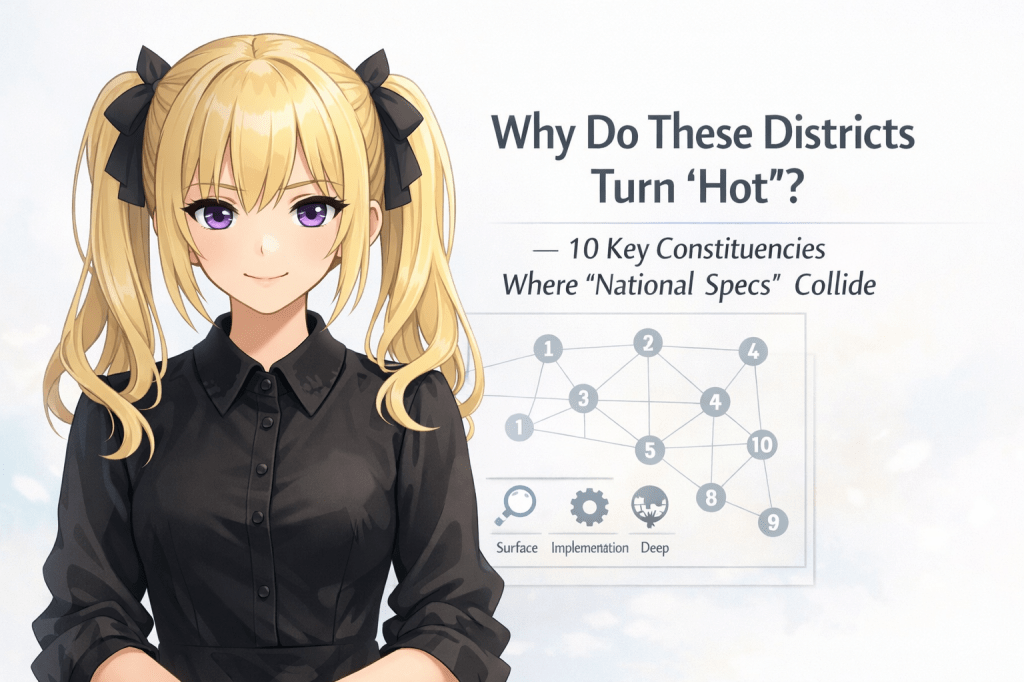
I am Iris.
Urban legends are not mere fairy tales—
I am a narrator who traces the unspoken with you.
- These “hot districts” tend to ignite because attention (surface), implementation bottlenecks (middle), and national constraints (deep) collide in one place.
- If you separate the layers, you can audit the race by mechanisms, not personalities.
- The goal is not to “guess winners,” but to keep your judgment from being hijacked by framing.
Why districts turn “hot” — the structural reason
In election season, a district becomes “hot” when it concentrates three forces at once:
- Surface: headline-friendly conflict, identity cues, outrage loops, “must-watch” narratives
- Implementation: budget, local industry, infrastructure, administrative capacity, service delivery
- Deep layer: alliances, economic security, supply chains, standards, and external policy constraints
In urban-legend circles, it is sometimes said that “someone decides everything beforehand.”
But a more practical way to read it is this: when attention is engineered, verification time shrinks—and the district becomes a perfect stage for persuasion.
How to read a hot district with the three-layer lens
Use this quick routine:
- Surface: What is being amplified? Who benefits from the emotional framing?
- Implementation: What concrete policy pipeline exists (law / budget / executing body / timeline)?
- Deep layer: What constraints shape the ceiling (security posture, supply chain rules, standards, external commitments)?
If the story stays on the surface, you’re being asked to vote on a mood.
The 10 key districts — “why they matter” by layer
Below are structural notes. They are not predictions.
1) Tokyo 15
- Surface: multi-candidate fragmentation tends to create “vote-split drama” and constant narrative swings.
- Implementation: urban policy deliverables (cost of living, childcare, housing, mobility) expose feasibility gaps quickly.
- Deep layer: national regulatory choices and fiscal constraints hit cities first (compliance, procurement, digital admin).
- Audit cue: who explains implementation ownership (who executes, with what budget, by when)?
2) Miyagi 4
- Surface: high-visibility confrontation narratives travel fast online; engagement can outpace verification.
- Implementation: disaster recovery, local industry support, and public works are audit-friendly if you follow budgets.
- Deep layer: supply-chain resilience and infrastructure security standards can quietly steer “what is possible.”
- Audit cue: look for KPI and third-party evaluation language, not slogans.
3) Hyogo 8
- Surface: “organization vs. outsider” framing tends to dominate, especially when alliances shift.
- Implementation: port/logistics, industrial policy, and municipal coordination reveal real capacity constraints.
- Deep layer: economic-security procurement and technology restrictions can shape local investment priorities.
- Audit cue: who names trade-offs (winners/losers, short/long term)?
4) Kyoto 2
- Surface: brand-like political identities can overwrite policy details; narratives become “tribal.”
- Implementation: tourism, education, small business, and local fiscal balance are measurable if you track policy design.
- Deep layer: standards and cultural/industrial strategy often connect to national positioning (quietly).
- Audit cue: insist on process clarity (legal change vs. operational change).
5) Fukushima 4
- Surface: national symbolism can pull the debate into emotion-heavy framing.
- Implementation: reconstruction policy, energy, agriculture/fisheries support—highly audit-able through public documents.
- Deep layer: energy security, supply chains, and external risk narratives can shape the “policy ceiling.”
- Audit cue: who explains baseline metrics (from what year, what definition)?
6) Tokyo 11
- Surface: “comeback / scandal / redemption” framing often crowds out institutional detail.
- Implementation: governance reform claims must map to procedures (oversight, enforcement, budgeting).
- Deep layer: national security and digital governance debates often surface as local talking points without the middle layer.
- Audit cue: who offers verifiable mechanisms, not moral theater?
7) Ishikawa 1
- Surface: “stronghold vs. breakthrough” narratives tend to intensify media focus.
- Implementation: recovery, infrastructure, and local economic continuity tests real administrative throughput.
- Deep layer: economic-security measures and procurement rules can shape reconstruction priorities.
- Audit cue: who names execution capacity (staffing, systems, field workload)?
8) Tokyo 8
- Surface: ideology labels simplify reality; people end up voting on identity markers.
- Implementation: urban services are a perfect audit ground (budgets and outcomes can be checked).
- Deep layer: standards and regulatory alignment can change what cities can adopt (tech, procurement, compliance).
- Audit cue: who distinguishes outputs (did stuff) from outcomes (improved life)?
9) Hokkaido 2
- Surface: turnout narratives often become the story; that can be used to demobilize or mobilize.
- Implementation: primary industries, logistics, energy, and regional services expose cost structures clearly.
- Deep layer: border/security posture and supply-chain resilience can shape national allocations.
- Audit cue: who acknowledges time-to-implement (laws, budgets, procurement lead times)?
10) Aichi 1
- Surface: personality-driven local politics can collide with national party framing—making it highly volatile.
- Implementation: manufacturing ecosystems make policy “implementation reality” visible fast (subsidies, standards, procurement).
- Deep layer: export rules, standards, and economic-security constraints can set the ceiling for industrial promises.
- Audit cue: who explains standards/compatibility and not just “competitiveness” as a slogan?
Where urban-legend energy enters — and how to neutralize it
In urban-legend circles, it is often said that “hot districts are scripted.”
Even if you do not accept that claim, the mechanism is real:
- attention concentrates,
- framing intensifies,
- and middle-layer verification gets skipped.
Your defense is simple and powerful:
- separate layers,
- force implementation detail,
- and demand trade-offs.
Your takeaway: vote like an auditor, not like an audience
If you walk away with only one habit, let it be this:
Pick one pledge you care about, and demand the middle layer:
- law or operational pathway,
- funding source,
- executing body,
- timeline,
- KPI and evaluation,
- and trade-offs.
And then—please go vote.
Do not hand your share of the decision to people who show up while you stay home.
Your one vote is not “nothing”; it is your audit stamp on the direction of policy.
When enough people believe “it won’t change,” the result becomes a self-fulfilling script.
Next time—another fragment of truth to trace with you.
I will return to the telling.
Something Feels Off in Japan’s Election — Tracing the “External Specifications” Shaping Pledges
The Economist 2026 Cover: A Symbol Map of Power
Where Did We Come From? A Debate Map of Human Origins (Urban-Legend vs. Reality)
NWO in 2026: The Hidden Operating System of the Modern World (Map of Power, Rumors, and Reality)
国譲り神話の真実──日本統合システムの正体
Send topics anytime. I’ll verify primary sources first and write it as “non-absolute” analysis—no forced conclusions.
 Share on X
 Share on Facebook
 Follow
@Kataribe_Iris
Follow
@Kataribe_Iris
📺 Channel
💬 LINE Store

コメントを残す