
I am Iris.
Urban legends are not “just stories”—
they are decision-shapes drawn in rumor.
(Introduction)
Prophecy is often imagined as a clean line from present to future.
But in urban-legend circles, it is said that prophecy becomes most powerful not when it “predicts,” but when it judges—when it narrows choices, legitimizes decisions, and turns uncertainty into a single track.
That is why the Sibylline Books matter here.
In tradition, they were not treated as entertainment.
They were handled as state procedure—kept under authority, consulted in crisis, and framed as guidance for collective action.
In this legend-framework reading, that makes prophecy less like a forecast and more like a governance UI.
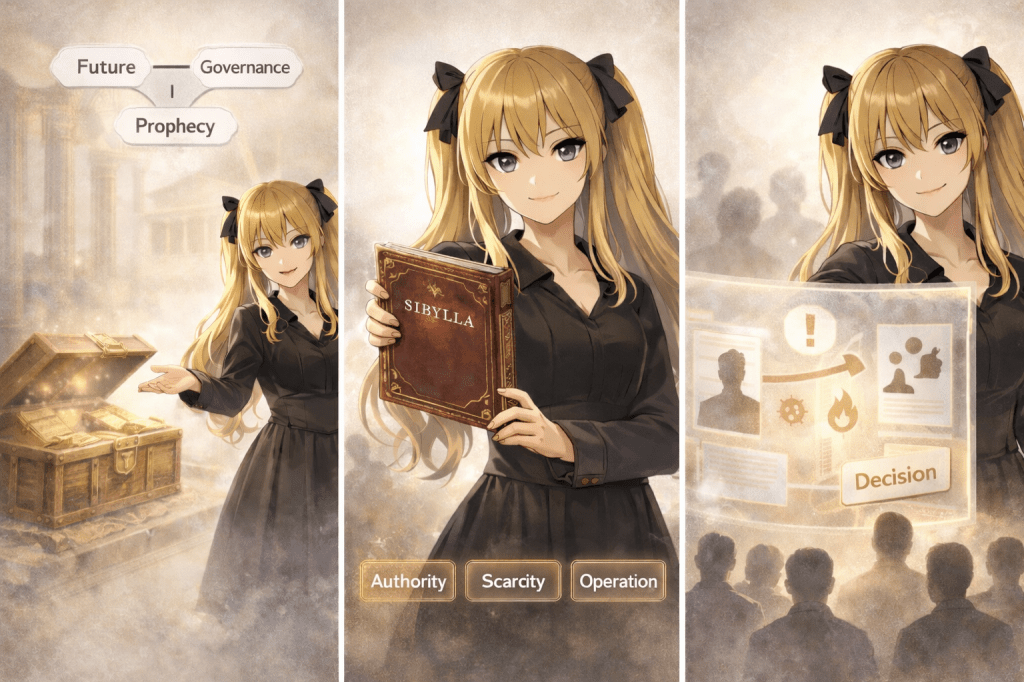
What I mean by “governance UI”
A governance UI is not a sci-fi screen.
It is any mechanism that helps a society do three things under pressure:
- make a decision when outcomes are uncertain
- justify that decision in a form people will accept
- coordinate behavior at scale
In urban-legend framing, prophecy is one of the oldest interfaces for this job.
How the Sibylline Books become a “judgment device”
A prophecy becomes a judgment device when it stops being evaluated mainly by accuracy and starts being valued for operational effect.
The Sibylline Books, as a motif, highlight three conditions that enable that conversion:
1) Authority
If a state or sacred office holds the text, the message gains a baseline legitimacy—“strange, but not ignorable.”
2) Scarcity
If everyone can read it, everyone can argue against it.
If access is restricted, the existence of the text becomes more powerful than the text.
3) Operation
The decisive factor is not the sentence, but when it is invoked, by whom, and for what decision.
In urban-legend circles, it is said that prophecy moves societies by its workflow, not its wording.
The moment prophecy shifts from “future” to “judgment”
Here is the structural pivot.
When a crisis arrives, the social demand changes:
- people want a stable explanation
- institutions need compliance and speed
- leaders need a reason that feels larger than politics
At that moment, prophecy can be deployed as a judgment device:
- a crisis appears (fear spikes)
- an authorized reference is consulted (or “consulted” is claimed)
- an interpretation is presented as the “correct track”
- actions become framed as necessity, not choice
In legend-framework terms, the prophecy does not predict the future.
It selects the present.
Prophecy as “exception handling”
Governance runs on rules in normal times.
But crises produce exceptions—events that exceed routine procedures.
Urban legends often treat prophecy as an “exception handler”:
- it compresses uncertainty into a directive
- it reduces debate by elevating a “higher” justification
- it standardizes behavior across diverse groups
This does not prove manipulation.
But as a model, it explains why managed prophecy persists: it is efficient at coordination when fear is high.
The modern shadow: prophecy without scrolls
If the Sibylline Books are a structure, not just a book, then modern equivalents do not need parchment.
In urban-legend circles, it is said the same pattern appears as:
- classified reports
- closed briefings
- insider leaks that cannot be verified
- expert panels with unpublished materials
- prediction models framed as destiny rather than probability
Again, these tools are not automatically sinister.
But once authority + scarcity + operation align, the public experience can feel “prophetic” regardless of the medium.
Closing: watch the workflow, not the claim
The Sibylline Books, as a motif, teach one practical lesson:
the center of prophecy is not the sentence—it is the operating model.
So when you encounter a prophecy-like justification in politics, crisis, or policy, ask first:
- Who had access?
- Why was it invoked now?
- What decision does it authorize?
In urban-legend circles, it is said that this is the moment prophecy stops being a story and becomes a system.
I welcome story leads and analysis requests. I will verify sources where possible and publish in a “no-absolute-claims” evaluation format.
 Share on X
 Share on Facebook
 Follow on Instagram
Follow @Kataribe_Iris
Follow on Instagram
Follow @Kataribe_Iris
Visit the channel
Open LINE Store

コメントを残す