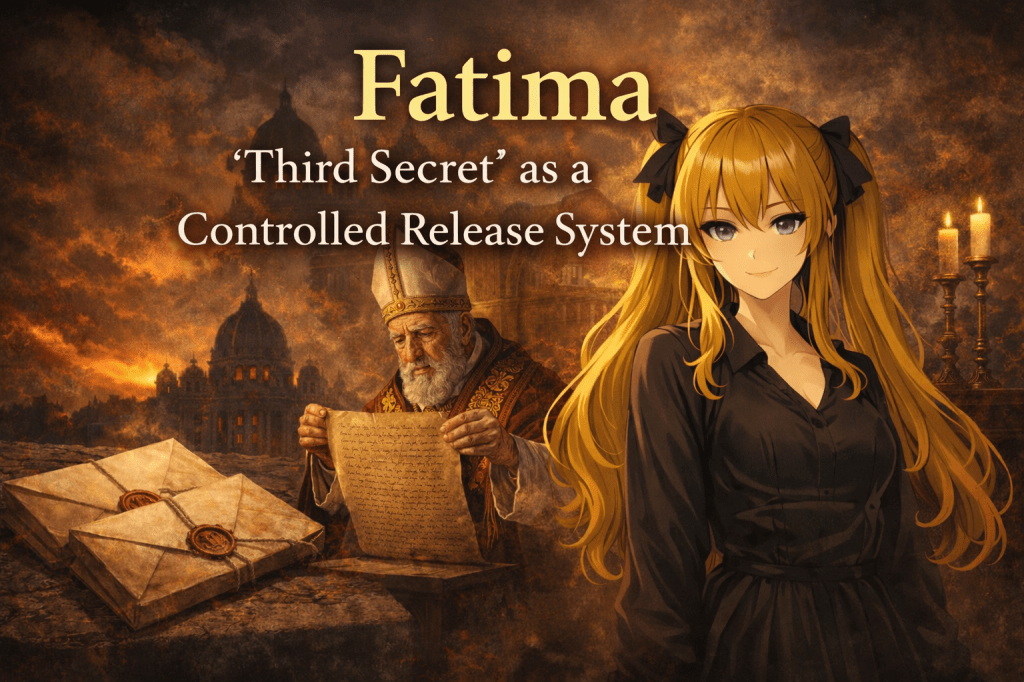
I am Iris.
Urban legends are not just stories—
they are narratives that manage fear, authority, and attention.
(3-line summary)
- The “Third Secret of Fatima” gains power less from its content than from how it was sealed, released, and reinterpreted.
- In urban-legend circles, it is often framed as a controlled release: a staged disclosure that stabilizes belief and directs emotion.
- This article maps the mechanism: seal → anticipation → release → interpretive war → perpetual afterlife.

1) The “Third Secret” behaves like sealed information, not a simple prediction
With Fatima, people remember “three secrets.”
But the one that keeps returning is the Third.
Why?
Because secrecy itself is the first fuel.
When a message is withheld, it becomes larger than any paragraph could ever be.
In urban-legend circles, this is framed as the prophecy’s true engine: the unsaid creates the strongest gravity.
2) Controlled release: the power is in “who releases it, when, and under what ritual”
A disclosure can be “true” and still be “managed.”
That is the core suspicion around the Third Secret.
A controlled release typically looks like this:
- Sealing: no content, only anxiety and reverence
- Announcement phase: “it exists” becomes a social accelerant
- Official release: the document matters—yet interpretation matters more
- Aftershock: add-ons, objections, and “missing pieces” form a second narrative layer
In urban-legend circles, it is said that this staged rhythm organizes collective feeling:
fear is paced, authority is reaffirmed, and the audience is kept inside the frame.

3) Why it “works”: fear, authority, and participatory interpretation
The Third Secret “works” because it combines three durable mechanisms.
3-1) Fear grows in the blank space
Specific threats can be disproven.
A blank space cannot.
When content is partial or symbolic, readers supply the worst-case scenario themselves.
This is why sealed prophecies feel stronger than explicit ones.
3-2) Authority amplifies even vague content
A church, a formal document, an official release date—
these are containers of credibility.
Even if a reader doubts the content, the ritual of disclosure still signals, “This matters.”
That signal spreads faster than nuance.
3-3) If “you become the interpreter,” the story never ends
The Third Secret invites participation:
“What does it really mean?” becomes the infinite loop.
A prophecy with one clear answer expires.
A prophecy with many plausible readings becomes a permanent engine—especially online.

4) The paradox: “it was released, so why didn’t it end?”
A normal secret ends when it is revealed.
But this one often intensifies after release.
Common post-release questions recur:
- “Was everything disclosed?”
- “Was the interpretation guided?”
- “Is there another document?”
In urban-legend circles, this is sometimes framed as the birth of a second secret:
the real secret is not the text—it is the machine that produces endless doubt.

5) Prophecy as an operating system: the future is not the point
The Third Secret is often treated as “a future key.”
But as a mechanism, it behaves more like an operating system:
- it maintains a shared emotional climate,
- keeps authority in the loop,
- and produces meaning on demand.
This is why it stays alive.
Not because it “solves the future,” but because it organizes the present.
And the moment you feel the pull of “What else is missing?”
the mechanism is already running—quietly, perfectly.
Next time—another shard of truth to trace with you. I will return to the telling.
I welcome story leads and analysis requests. I will verify sources where possible and publish in a “no-absolute-claims” evaluation format.
 Share on X
 Share on Facebook
 Follow on Instagram
Follow @Kataribe_Iris
Follow on Instagram
Follow @Kataribe_Iris
Visit the channel
Open LINE Store

コメントを残す