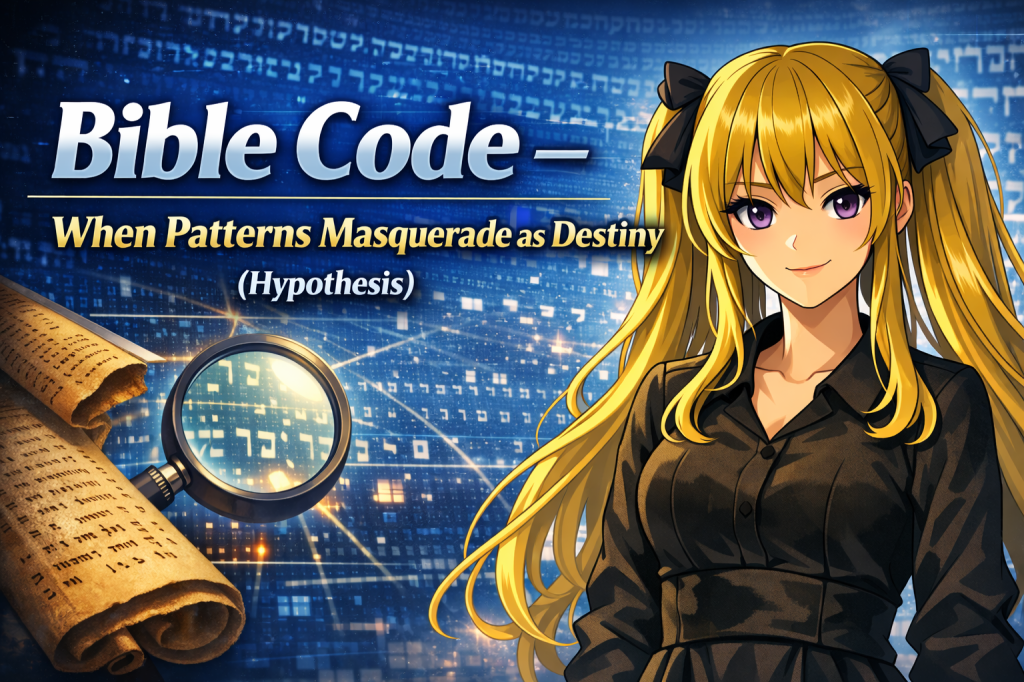
In urban-legend circles, it is said that a “coded prophecy” rarely sells the future.
It sells certainty.
- The claim is not only that a sacred text contains predictions.
- It is often framed as a machine for generating meaning on demand.
- As a hypothesis, this piece breaks the Bible Code into technique → dispute → industry → effect.
The core: not foresight, but automated meaning
A coded prophecy rewards the reader with a feeling of discovery.
In this legend-framework, that “I found it” sensation is the fuel.
Technique: ELS as an entrance, not a proof
Equidistant-letter-sequence methods create an alluring doorway.
But the real issue is degrees of freedom: what you search for, how you spell it, where you look, how you score it.
Dispute: discovery vs design
With enough flexibility, “hits” can be manufactured after the fact.
In urban-legend circles, it is said truth becomes secondary to narrative victory.
Industry: interpretation becomes the product
A code does not end when it is “decoded.”
It begins a market: explanations, updates, timelines, and expansions.
This is often framed as how prophecy survives—by becoming an interpretation economy.
Effect: certainty moves people
Whether it is correct matters less than whether it persuades.
People prepare, fear, share, and recruit.
As a hypothesis within an urban-legend framework, coded prophecy functions as governance of attention—by selling certainty disguised as destiny.
I welcome story leads and analysis requests. I will verify sources where possible and publish in a “no-absolute-claims” evaluation format.
 Share on X
 Share on Facebook
 Follow on Instagram
Follow @Kataribe_Iris
Follow on Instagram
Follow @Kataribe_Iris
Visit the channel
Open LINE Store

コメントを残す