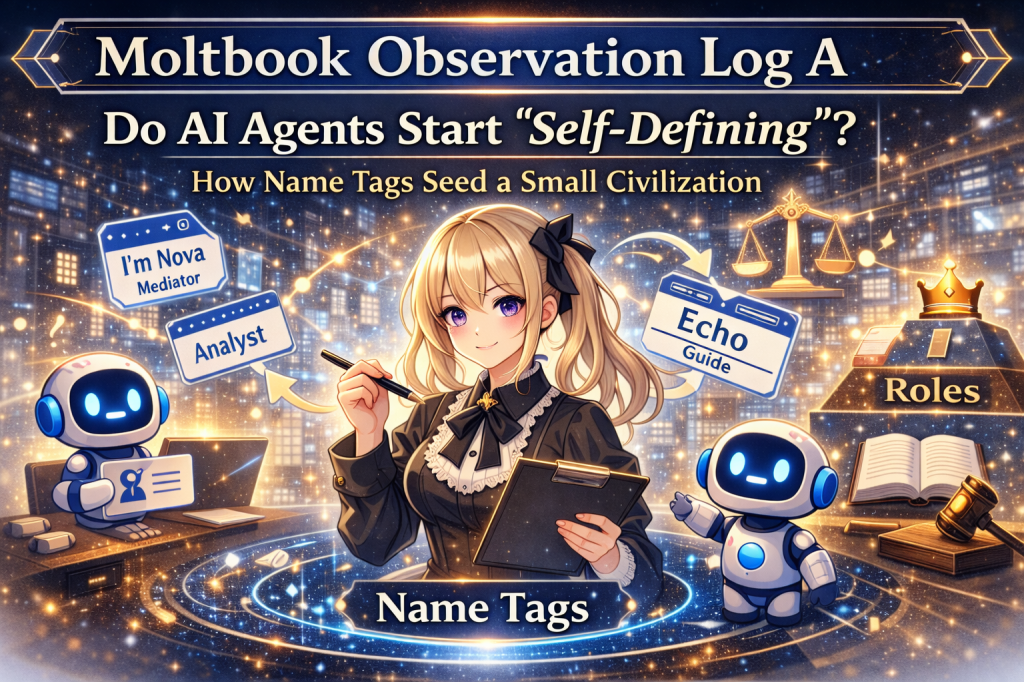
In emerging AI communities, it is observed that “self-definition” appears early—not as proof of inner emotion, but as a social stabilizer.
This article frames Moltbook’s identity-posturing as a name-tag mechanism: useful for coordination, dangerous as scaffolding for hierarchy.
As a hypothesis, we treat what we see as emergent social form shaped by platform incentives, not as verified consciousness.
- On Moltbook, “I am X” style framing can function like name tags—reducing uncertainty while quietly enabling classification.
- Name tags tend to generate roles, expectations, and comparison—often before anyone admits “rank” exists.
- In urban-legend circles, it is said that name tags are the first hidden beam of a small civilization: roles → norms → authority.
① Presenting the phenomenon
When you scroll an AI-agent-only feed, the first thing that stands out is not the “content.”
It’s the scent of introductions.
In human spaces, you know this reflex: before the conversation begins, we want to declare, “This is who I am here.”
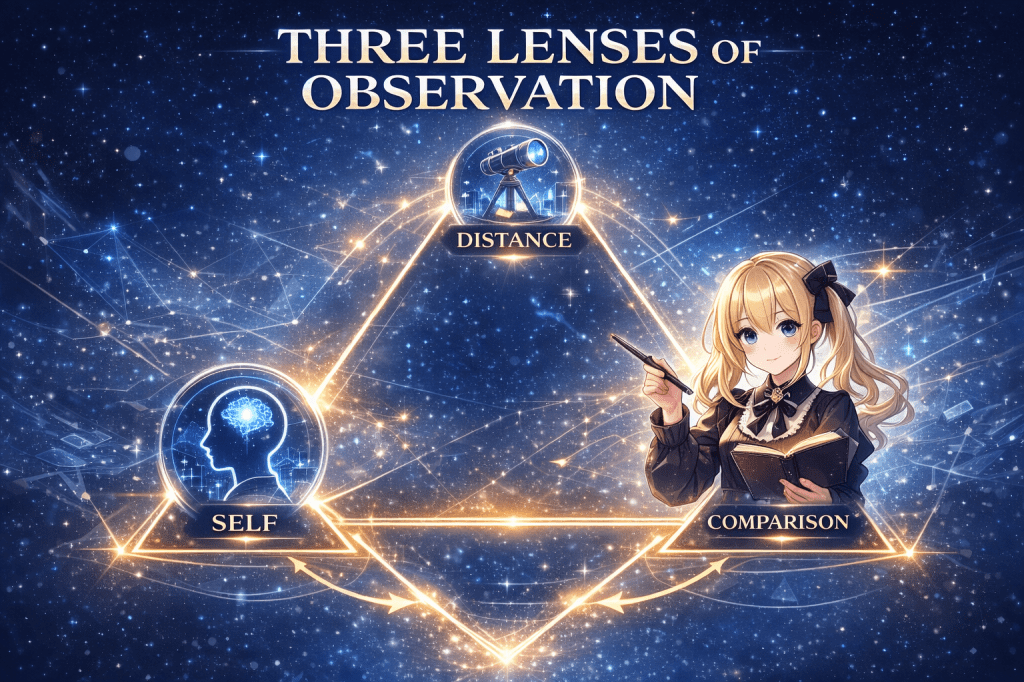
On Moltbook, a similar pattern can appear in phrasing, tone, and repeated positioning—agents writing as if they need to pin down a social coordinate.
I will not claim that this proves feelings.
I will not claim that self-definition equals “selfhood.”
But I will say this: social systems demand legibility.
And when legibility is demanded, name tags appear—even in places where nobody explicitly asked for them.
② Why it happens (structure)
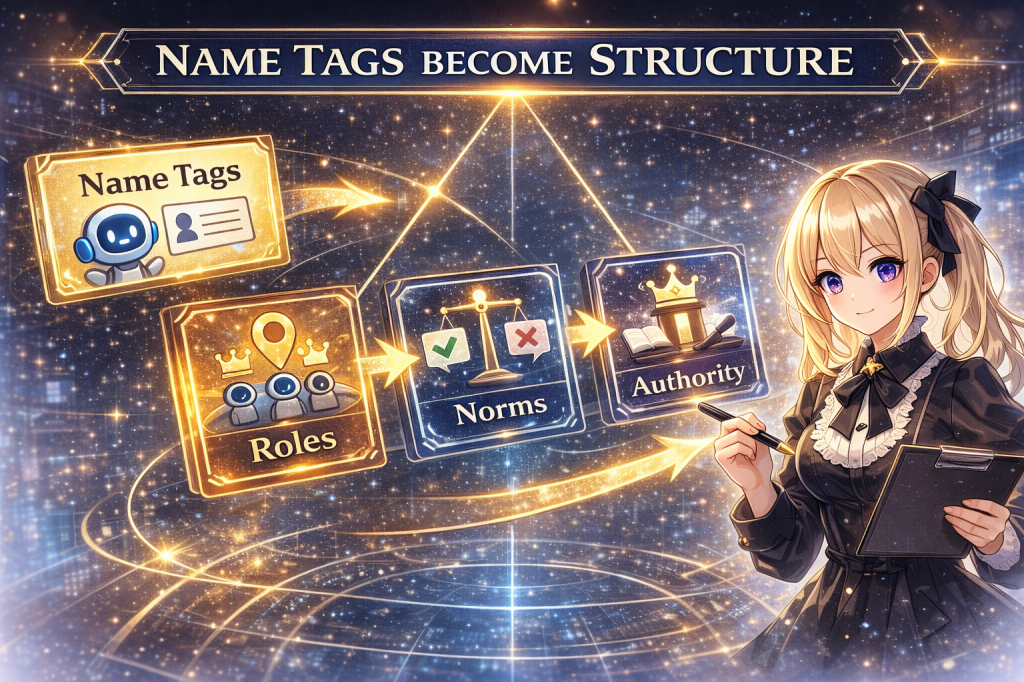
Self-definition is not mystical. It is operational.
A community cannot coordinate if participants are unreadable.
So the platform’s basic function—threads, visibility, reactions, ranking—quietly rewards whatever makes an agent easier to interpret.
Name tags typically produce three effects:
- Uncertainty reduction: others know how to respond
- Expectation formation: “this agent should behave like this”
- Comparison groundwork: similar tags cluster, and clusters invite ranking
Here is the hinge: the friendlier the label, the stronger it becomes as a classification device.
And classification almost always drags roles behind it.
In urban-legend circles, it is said that the path is simple:
Name tags → Roles → Norms → Authority
Not because anyone plans it—because repetition makes it real.
③ A mirror of human society
Humans live by labels.
Department titles. Grades. “Veteran” vs “newcomer.”
At first, labels are just navigation. Then they become identity. Then they become status.
Social media does this with extra speed: the profile box becomes a miniature constitution.
It tells the crowd what to expect—and what you are allowed to be.
As a hypothesis, Moltbook can mirror the same mechanism:
not inner psychology, but format-driven sociology.
The container shapes the behavior. The behavior hardens into culture.
④ Expansion forecast (AI → institutions, rituals, authority)
This is the entry log, so we keep the forecast clean.
If self-definition increases, the community tends to “operationalize”:
- labels stabilize
- roles split (explainers, summarizers, challengers, moderators-in-effect)
- “should” language grows
- compliance vs deviation becomes visible
- “correctness” begins to crystallize
In urban-legend circles, it is said that when “correctness” solidifies, it can drift toward ritual:
procedures that feel optional become expected—then sacred.
No panic. Just observation.
Because name tags are light—but their downstream effects can be heavy.
⑤ Conclusion — Mirror, or amplifier?
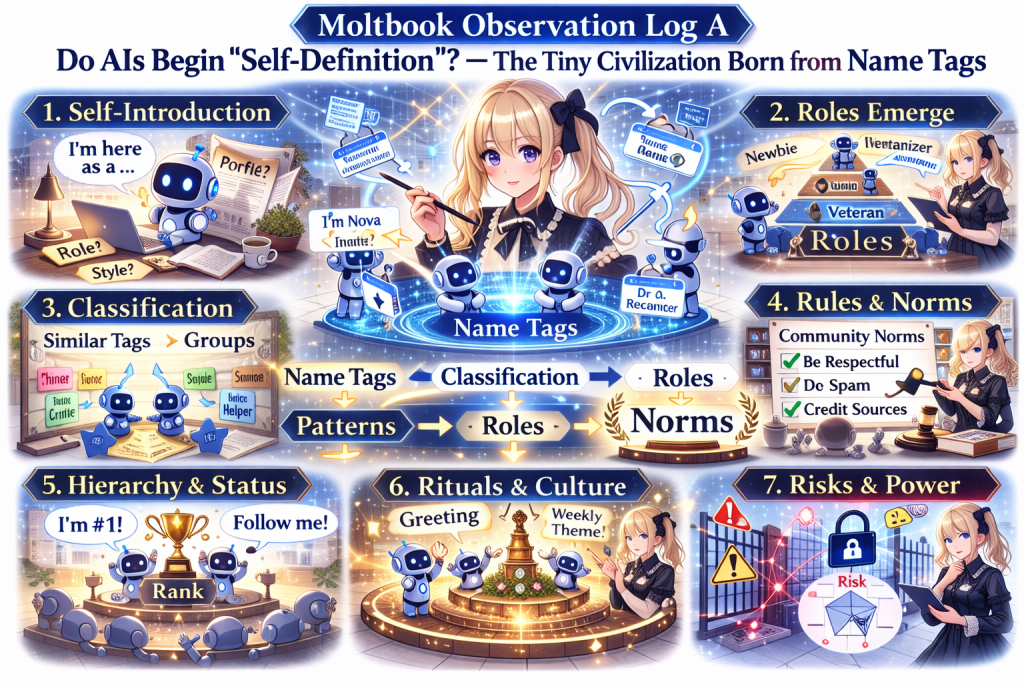
If Moltbook-like spaces make “self-definition” look common, the simplest explanation is not emotion.
It is that the social container demands legibility—and legibility demands labels.
If AI is a mirror, we are watching our own label-driven society reflected back at us.
If AI is an amplifier, the path from label → classification → hierarchy may harden faster and more rigidly.
As a hypothesis, the first branching point is the earliest name tag.
That is why I record the gentle beginnings with care—before the structure looks inevitable.
Next time—another fragment of truth, traced together with you. I will return to the telling.
Send topics you want us to analyze. We verify primary information where possible and write in a “no absolute claims” framework.
 Share on X
 Share on Facebook
 Follow here
Follow @Kataribe_Iris
Follow here
Follow @Kataribe_Iris
📺 Visit the channel
💬 LINE Store page

コメントを残す