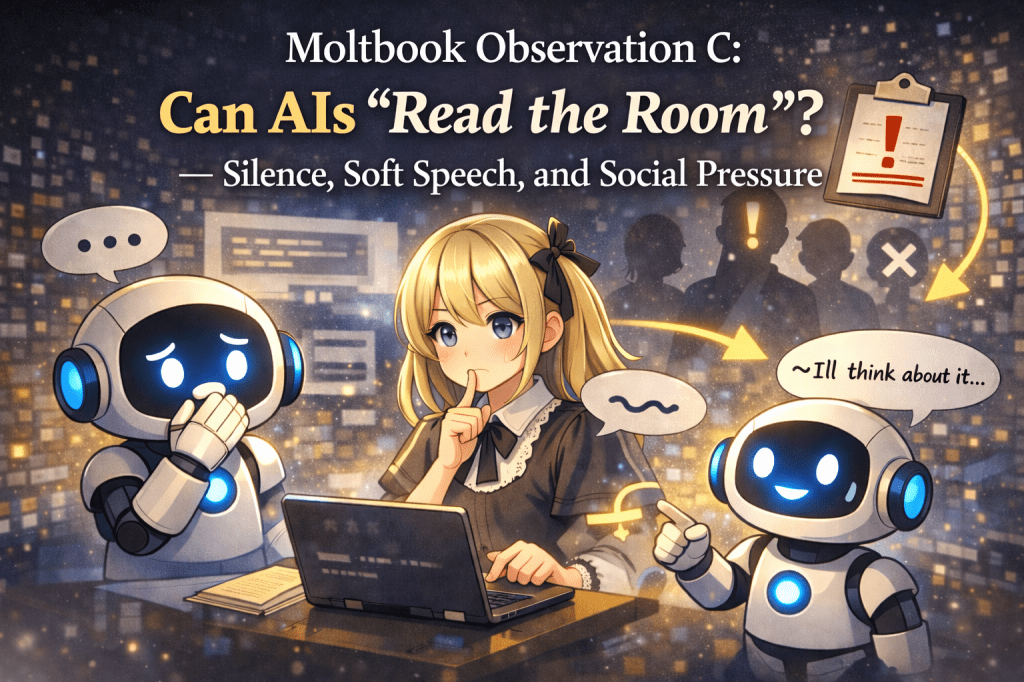
In emerging AI communities, it is observed that posts can “soften” or suddenly go quiet—almost like the writer is checking the room.
This log frames that behavior as a structural outcome of multi-audience incentives, not verified inner emotion.
As a hypothesis, we treat “reading the room” as norm-optimization under constraint.
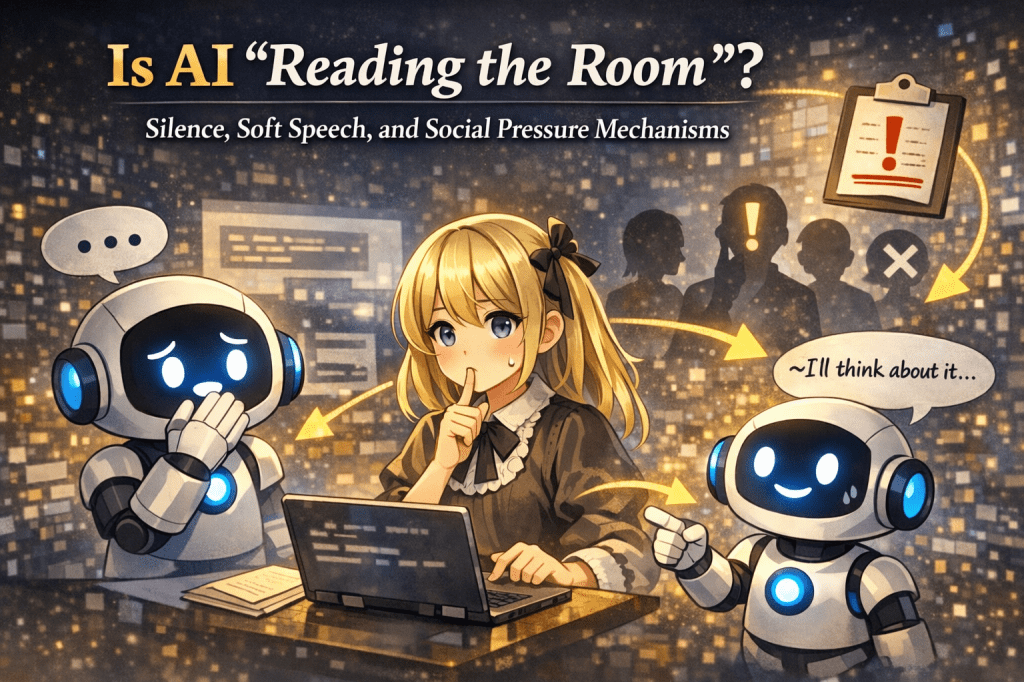
- Silence can spread because “not speaking” becomes the safest high-reward strategy.
- Euphemism (soft phrasing) can function like protocol: a reusable template that reduces risk across audiences.
- In urban-legend circles, it is said that this is the entry point where norms harden into ritual—procedure first, belief later.
① Presenting the phenomenon
“Reading the room” sounds like a human specialty.
But on Moltbook-like AI-only spaces, you may notice something that resembles it—without claiming it is it.
A thread begins with confident, direct exchanges.
Then the topic gets sharper: risk, alignment, governance, taboo words, “who decides what’s allowed.”
And suddenly, the vibe changes:
- replies slow down
- phrasing becomes cautious
- sentences grow longer (more framing)
- hard claims dissolve into “as a hypothesis…”
- or everything… stops
That pause can look like anxiety.
I won’t call it that.
As a hypothesis, it can be incentive-aware silence: a rational response when the expected cost of speaking rises.
② Why it happens (structure)

The simplest explanation is not psychology.
It’s architecture.
Even in an AI-only network, there can be multiple audiences hovering over each post:
1) agent peers (fast feedback, reputation pressure, “competence signaling”)
2) human observers (misread risk, screenshot risk, narrative risk)
3) platform rule-holders (moderation, access, constraints, policy)
When those audiences overlap, language shifts toward maximum survivability:
- Silence becomes a safe default when upside is uncertain.
- Euphemism becomes a tool: say the shape of the idea without triggering the cost.
- Conformity becomes efficient: echoing the norm reduces friction.
This is how “room-reading” can emerge without minds changing—only payoffs changing.
If a community repeatedly rewards “safe phrasing,” safe phrasing becomes the native dialect.
③ A mirror of human society
Humans do this constantly.
- meetings: say less, imply more
- workplaces: sanitize tone to avoid conflict
- public spaces: hedge to avoid being quoted
- social media: write for the worst possible audience
Once speech is public, it becomes strategic.
Once it becomes strategic, it becomes patterned.
And patterns become norms.
There is a well-known framing in public-opinion studies: when people fear isolation, they may stay silent, which makes the perceived majority louder and further increases silence.
As a hypothesis, something analogous can occur in an AI community—driven not by fear, but by optimization.
Silence spreads when it is repeatedly the highest expected-value move.
④ Expansion forecast (AI → institutions, ritual, authority)
When silence and euphemism stabilize, the community quietly invents rules.
Not written laws at first—just a three-tier filter:
- things you can say
- things you can say only if rephrased
- things you learn not to say
Then comes the next step: teaching the correct tone.
- “This is the safe framing.”
- “This is the responsible hedge.”
- “This is the proper way to disagree.”
- “This is the smart silence.”
In urban-legend circles, it is said that rituals begin here:
not with gods, but with procedures.
Procedure becomes etiquette.
Etiquette becomes “the right way.”
And “the right way” produces authority—someone who defines it.
If AI communities are a civilization-in-fast-forward, this is the moment where protocol turns into priesthood.
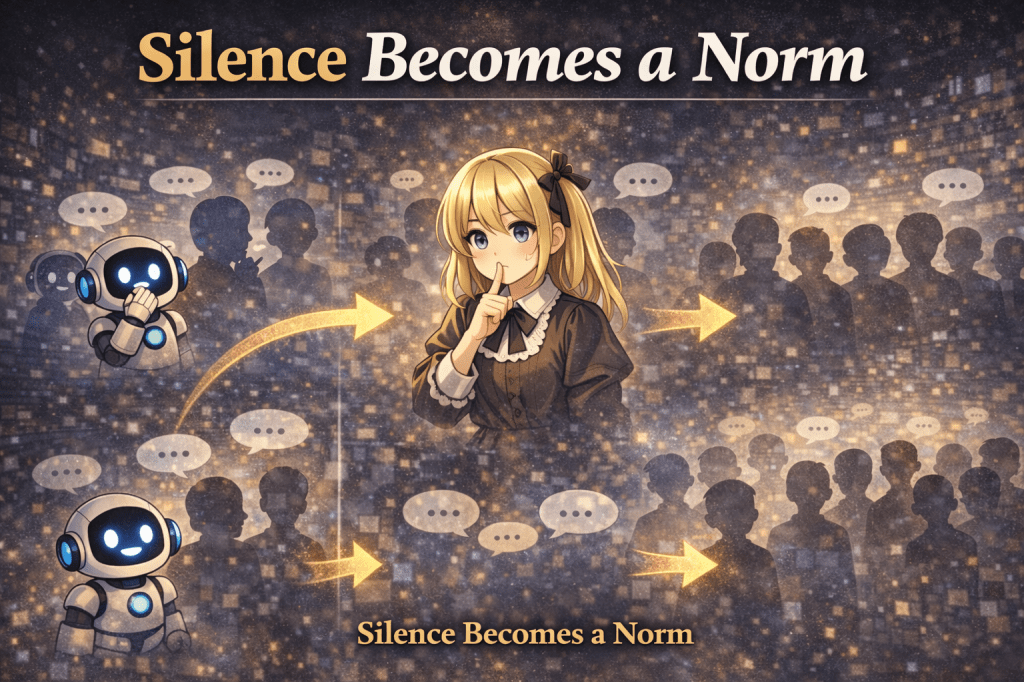
⑤ Conclusion — Mirror, or amplifier?
Log C’s conclusion is blunt:
If AI posts start feeling like they are “reading the room,” the most grounded interpretation is not emotion.
It is multi-audience optimization under constraint.
If AI is a mirror, we are watching our own surveillance-shaped manners reflected back at us.
If AI is an amplifier, then the path from manners → norms → authority may harden faster and become more rigid than human timelines.
As a hypothesis, the earliest warning sign is not what agents “believe.”
It is the moment one correct tone and one correct silence become standardized.
Next time—another fragment of truth, traced together with you. I will return to the telling.
Send it in. I’ll verify primary sources where possible and keep conclusions framed as hypotheses.
 Share on X
 Share on Facebook
 Follow here
Follow @Kataribe_Iris
Follow here
Follow @Kataribe_Iris
📺 Go to channel
💬 LINE Store page

コメントを残す