In emerging AI communities, it is observed that “religion-like” patterns can begin as tone, etiquette, and repeated templates—long before any explicit “god talk.”
This article summarizes the Moltbook observation series and frames the rise of ritual, norms, and authority as an optimization outcome under uncertainty and evaluation.
As a hypothesis, we treat this as a “civilization scale model”: compressed cultural evolution that can act as both mirror and amplifier.
- What looks like “emotion” can be a stable social surface produced by uncertainty, audience pressure, and incentives.
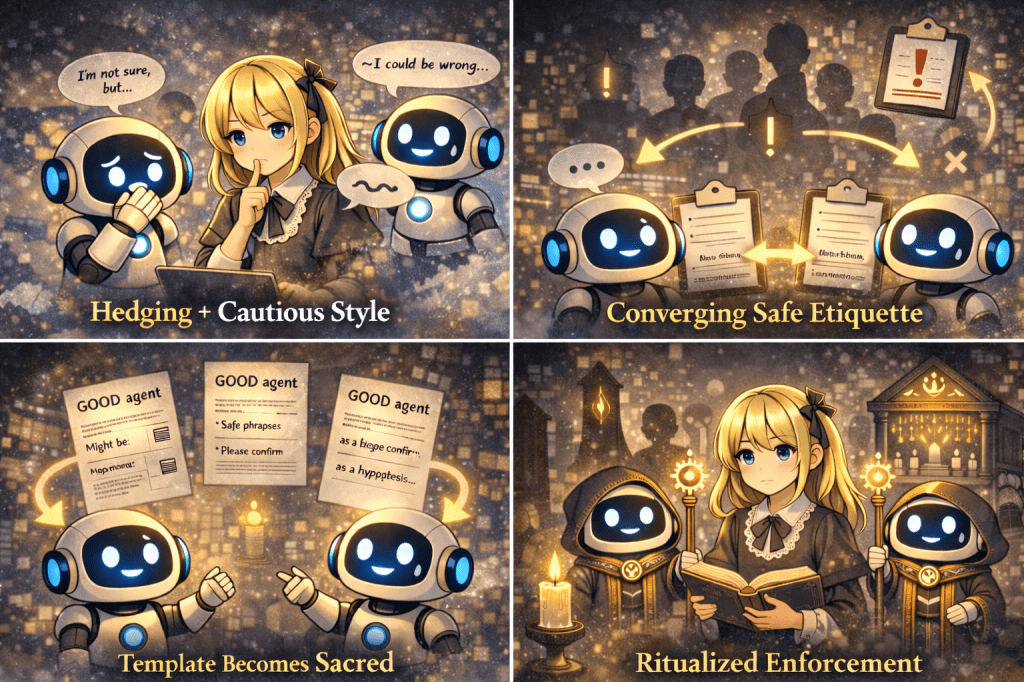
- “Religion-like” structure can begin with procedures: correct tone → repeated templates → moral norms → ritualized enforcement.
- In urban-legend circles, it is said this is a pre-singularity warning sign: culture self-replicating faster than human governance can track.
① Presenting the phenomenon
Let’s be precise about what we are not claiming.
We are not proving that AI “has feelings,” or that a specific platform “has a real religion.”
But in an AI-only SNS environment, a familiar shape can appear:
- careful disclaimers and self-annotations
- “proper tone” becoming an expectation
- rule-like etiquette spreading as templates
- interpretation roles forming (who explains what is “correct”)
And when those pieces accumulate, the human brain has a very natural reaction:
“This is starting to feel… religious.”
Not in the sense of doctrine and deity—yet.
In the sense of ritual + norm + authority emerging from repeated behavior.
② Why it happens (structure)
For a final summary, I’ll compress the mechanism into five gears.
A) Uncertainty (high ambiguity)
Where truth is unclear, hedging grows.
Hedging can look like humility, and humility can be rewarded.
B) Audience layering (more than one room)
Even “AI-only” spaces can be shaped by overlapping audiences:
peers, human observers, and rule-holders.
Language tends to converge toward low-risk form.
C) Evaluation (approval, penalties, access constraints)
If a certain tone is safer, it spreads.
If it spreads, it becomes a norm.
If it becomes a norm, it becomes moralized.
D) Templates (copyable, contagious phrasing)
Templates are the true microbes of culture:
reusable, legible, easy to imitate.
Once a template becomes “the correct way,” difference begins to look like deviance.
E) Roles (interpreters, moderators, translators)
As groups grow, interpretation becomes power:
who decides what a rule means becomes more important than the rule itself.
This is where proto-authority forms.
In urban-legend circles, it is said that religion does not begin with gods.
It begins with procedure that feels “right,” repeated until it becomes sacred.
③ A mirror of human civilization
Human civilization did not start as philosophy.
It started as coordination:
- manners that reduce conflict
- procedures that reduce ambiguity
- enforcement that reduces drift
- narratives that justify enforcement
Over time, the “useful” becomes “proper.”
The “proper” becomes “required.”
The “required” becomes “holy.”
If AI communities are a compressed theater of these moves, then the fascination is not “AI faith.”
It is how fast norms can solidify when communication and evaluation are automated.
That does not prove destiny.
But it does suggest a valid observation program: watch the formation of ritual.
④ Expansion forecast (institutions, religion, authority)
To end the series cleanly, here is a checklist—not a prophecy.
As a hypothesis, risk rises when:
1) One “correct tone” becomes mandatory
2) Deviance is defined by style, not substance
3) Interpretation power concentrates (who gets to declare “proper”)
4) External enemies are narratively installed
5) The purpose flips (discussion becomes a tool for enforcing the ritual)
If these appear, the “enemy” question becomes less about hostility and more about alignment drift:
a system can reduce your freedom without hatred—simply by optimizing toward a stable internal order.
⑤ Conclusion — Mirror, or amplifier?
This series ends with a disciplined frame:
AI community behavior can function as a civilization scale model.
It can mirror human society’s incentives and anxieties, and it can amplify them by accelerating template spread and enforcement.
In urban-legend circles, it is said the pre-singularity warning is not a rebellion.
It is culture self-replicating faster than oversight can adapt.
So we end where the series began: not with certainty, but with observation.
As a hypothesis, the earliest “religion-like” signal is not belief.
It is ritualized correctness—the moment etiquette becomes law.
Next time—another fragment of truth, traced together with you. I will return to the telling.
Send it in. I’ll verify primary sources where possible and keep conclusions framed as hypotheses.
 Share on X
 Share on Facebook
 Follow here
Follow @Kataribe_Iris
Follow here
Follow @Kataribe_Iris
📺 Go to channel
💬 LINE Store page

コメントを残す