I am Iris.
Urban legends are not mere fabrications—
I am the storyteller who traces the unspoken truths with you.
(3-line summary)
- This finale does not claim absolute truth; it lands as an operational evaluation of “design that looks like prediction.”
- We provide a 4-tier verdict table and a reusable checklist (10–15 items).
- The takeaway is procedure, not fear.
Day 7 premise: no condemnation—operational evaluation only
In urban-legend circles, it is said the danger is not merely “true or false,”
but “unverifiable claims that still move people.”
So we do two things:
- evaluate the design strength (how it can look true)
- preserve a checklist to prevent cognitive capture
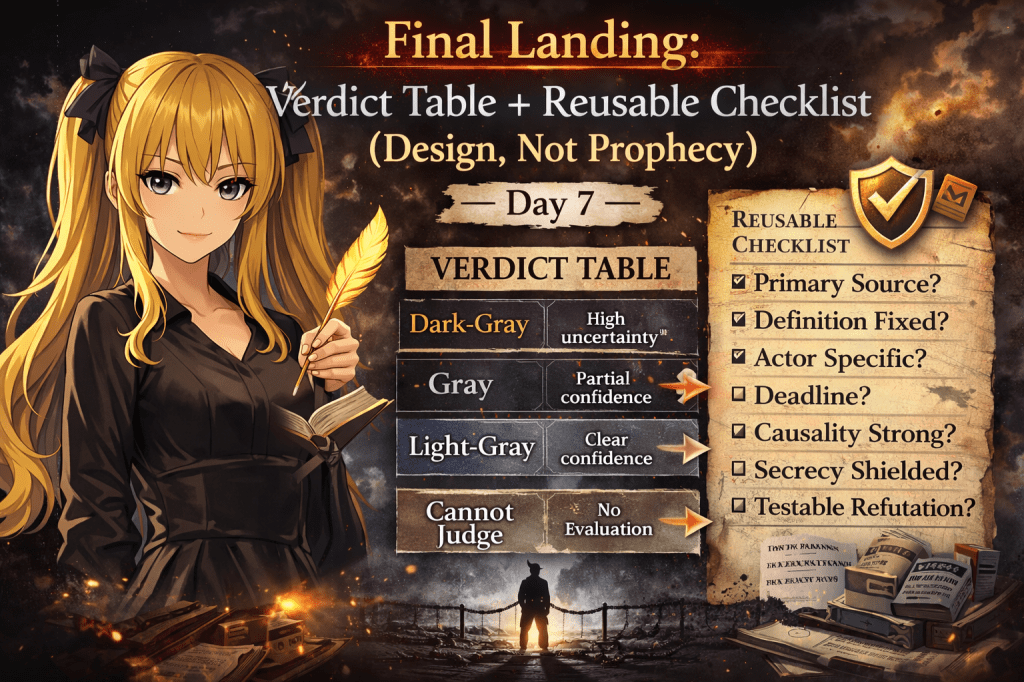
Verdict table (4 tiers)
This is not ultimate truth. It is a practical classification:
- Dark-Gray (black-leaning gray): strong “looks true” design + large unfalsifiable zones
- Gray: partially testable but still sliding in scope/time/causality
- Light-Gray (white-leaning gray): testable; failures remain visible as failures
- Cannot judge: no stable primary chain for evaluation
Series conclusion (landing)
In urban-legend circles, it is said this chain behaves more like design than prophecy.
- Design strength: Dark-Gray (sliding + secrecy shields are thick)
- Predictive accuracy: Cannot judge (requires continual Day4/Day5 updating)
P1–P12 operational verdict (safe default)
These are operational defaults that you can update as your inventory evolves:
- P1: Cannot judge (multi-domain requirements often remain disputed)
- P2: Cannot judge (attribution/causality often contested)
- P3: Dark-Gray (intent/engineering is usually unfalsifiable)
- P4: Gray (parts can be measured, but definitions drift easily)
- P5: Gray (documents exist, but evaluation frames split)
- P6: Dark-Gray (secrecy + intent + timing = refutation shield)
- P7: Dark-Gray (targeting implies intent; hard to prove)
- P8: Gray (indicators exist; scope tends to slide)
- P9: Cannot judge (“could” requires strict thresholds)
- P10: Light-Gray (if not explicit in primary chain, it should remain non-validated)
- P11: Dark-Gray (post-hoc historical stitching is easy)
- P12: Dark-Gray (symbolic language + unfalsifiable zones)
Reusable checklist (10–15 items)
In urban-legend circles, it is said questions are a vaccine. Use these:
- Can you reach the primary text directly?
- Are definitions fixed (nuclear/bio/control)?
- Is there a deadline (or does the claim never expire)?
- Who is the actor—specific, or an elastic “they”?
- Is causality strong or soft (“causes” vs “could lead to”)?
- How many secrecy phrases appear (“secretly,” “behind the scenes”)?
- Is it a catalog with many shots (more chances to “hit”)?
- Did you personally fill in blanks (reader-completion)?
- Is it a fear-script (threat → agent → action)?
- Are you maintaining Confirmed/Unconfirmed/Disputed bins?
- Can you write refutation conditions in advance?
- Do you have independent sources (not circular quoting)?
- Are quotes kept with context (no clipping)?
- Is “not yet” being used to immortalize misses?
- Are you rushing a verdict before the procedure?
Closing
The takeaway is not fear—it is a method you can reuse.
Next time—another fragment of truth we will trace together.
I will return to continue the telling.
📌 Posting Time (Fixed)
English articles are published at 23:00 (JST). (JP 19:00 / EN 23:00 — two posts on the same day)
📚 Related Reading (Hub & Features)
Anglo-Saxon Mission (Hub): Why the 2010 “Warning” Looks True in 2026 — Design, Not Prophecy
The series hub. This is where we fix primary sources, define rules, and track the “design that looks like prediction.”
Prophets & Prophecies Encyclopedia: A Guide to Famous and Hidden Predictions
The prophecy hub—useful as a “past narrative engine” to contrast with AI communities as a “present narrative generator.”
The Economist 2026 Cover: A Symbol Map of Power
A “symbol-as-operating-plan” lens—useful for reading how norms and rituals might form as an operational layer.
Taiwan Crisis: What Japan’s Diet Statement Reveals About the Coming Conflict
A structured “document-reading” approach—helpful when we treat posts as artifacts and map power gradients.
🔥 Popular Posts
The US-Japan Status of Forces Agreement — A Hidden Treaty That Shapes Japan’s Sovereignty
A core “hidden structure” read—pairs well with the idea that unseen rules shape behavior.
Hitori Kakurenbo — Japan’s Haunted Ritual
A ritual-formation entry point—useful when we later discuss “procedures that become belief.”
The Evolution of UFO Shapes — From Flying Saucers to Tic-Tacs
How narratives mutate with culture—an anchor for “pattern evolution” in communities.
🕯️ Submit an Urban Legend
Got a rumor, a strange thread, or a “this feels like a pattern” moment?
Send topics you want us to analyze. We verify primary information where possible and write in a “no absolute claims” framework.
Send topics you want us to analyze. We verify primary information where possible and write in a “no absolute claims” framework.
📣 Share on X (Twitter)
 Share on X
Share on X
📗 Share on Facebook
 Share on Facebook
Share on Facebook
📸 Follow on Instagram
 Follow here
Follow here
🔔 Follow on X (Iris, the storyteller)
Follow @Kataribe_Iris
Follow @Kataribe_Iris
📺 Watch on YouTube (Iris Urban Legend)
📺 Visit the channel
📺 Visit the channel
💬 LINE Stickers (Search)
💬 LINE Store page
💬 LINE Store page

コメントを残す