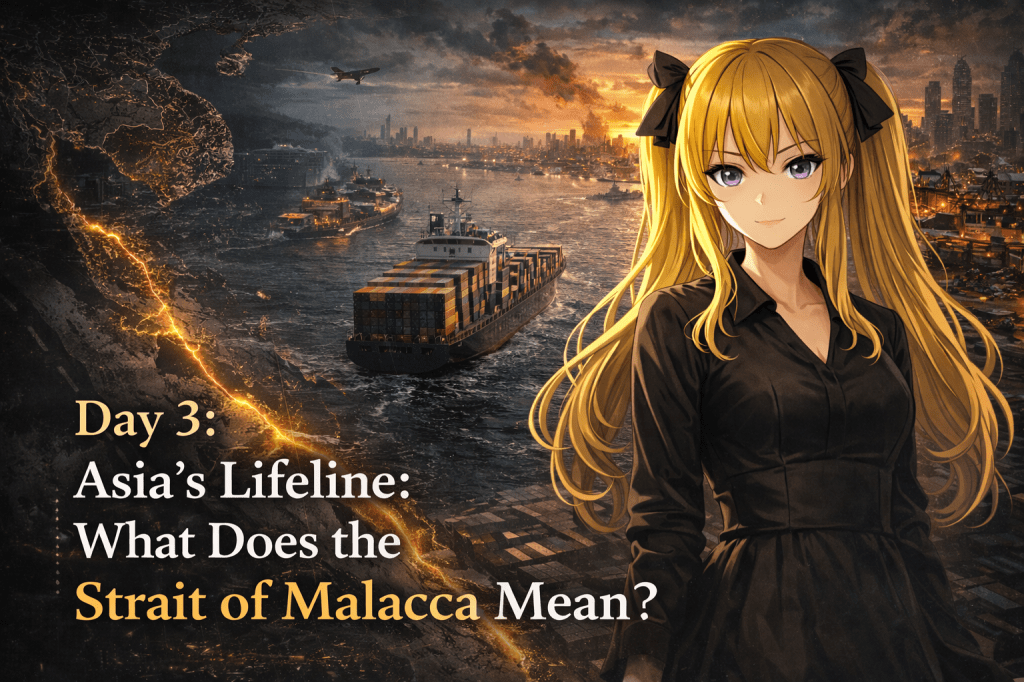
I am Iris.
Urban legends are not mere fabrications—
I am the storyteller who traces the unspoken truths with you.
(3-line summary)
- The Strait of Malacca is often treated as one of Asia’s great logistical arteries, carrying both trade flow and energy dependence.
- In urban-legend circles, it is sometimes framed as a pressure point through which larger powers could influence an entire region.
- Today, we ask a simple but important question: whose artery is Malacca, and why does that question matter?
Why Malacca is more than a regional passage
The Strait of Malacca is often discussed as though it belonged to one strategic story.
In reality, it belongs to many overlapping ones.
It is a route for containers, energy, industrial inputs, and regional timing.
It supports supply chains that stretch across East Asia, Southeast Asia, and beyond.
That is why calling it merely “important” is too weak.
Malacca is one of those passages where dependence becomes visible.
In urban-legend circles, such visibility often leads to the language of control.
But before jumping to that, we should begin with a more grounded question: who relies on this corridor, and how heavily?
Why the word “artery” feels appropriate
An artery is not important because it exists.
It is important because flow passes through it continuously and because disruption can affect distant organs.
That logic helps explain why Malacca is so often described in biological terms.
- Energy flows move through it
- Commercial shipping depends on it
- Industrial planning assumes it remains open
- Regional economies are shaped by that assumption
So when people ask, “Whose artery is it?” they are really asking which parts of Asia suffer most when that flow becomes uncertain.
That is already a meaningful structural question, even before urban-legend language enters the picture.
Why alternative routes do not erase vulnerability
A familiar objection is that other sea routes exist.
That is true.
But a theoretical alternative does not erase strategic dependence.
Detours are rarely neutral.
Longer sailing times change costs.
Higher costs affect pricing.
Pricing changes affect competitiveness, planning, and sentiment.
This is especially important in systems already optimized for efficiency.
The more tightly a system is optimized, the more exposed it can become to rerouting pressure.
That is one reason Malacca attracts so much analytical and symbolic attention.
It is not merely narrow.
It is deeply embedded in a pattern of concentrated efficiency.
Why Malacca attracts geopolitical imagination
The Strait of Malacca sits at the intersection of trade, energy, military attention, and regional dependency.
That makes it unusually fertile ground for larger interpretation.
In urban-legend circles, it is often spoken of as though it were a lever over Asia itself.
That phrasing is too absolute.
Still, the emotional logic behind it is not difficult to understand.
A narrow route.
Massive dependence.
Several powers with reasons to care.
A public imagination already trained to see vulnerability as strategy.
This is how a shipping corridor becomes a stage for larger stories.
What Day 3 teaches us
The Strait of Malacca does not belong to one country’s fate alone.
It is better understood as a shared artery whose disruption would radiate across multiple systems at once.
That is precisely why it matters.
In urban-legend circles, this can become a story about chokehold power.
That reading may go too far when treated as certainty.
But the underlying structure still deserves attention: concentration of flow creates concentration of risk.
So the lesson is not that Malacca is “controlled.”
The lesson is that dependence itself can generate the feeling of exposure.
Next time, we move into an even more layered corridor.
We will ask why the Taiwan Strait is discussed not only as a passage of trade, but as a chokepoint of semiconductors and security.
Next time—another fragment of truth we will trace together.
I will return to continue the telling.
Send topics you want us to analyze. We verify primary information where possible and write in a “no absolute claims” framework.

コメントを残す