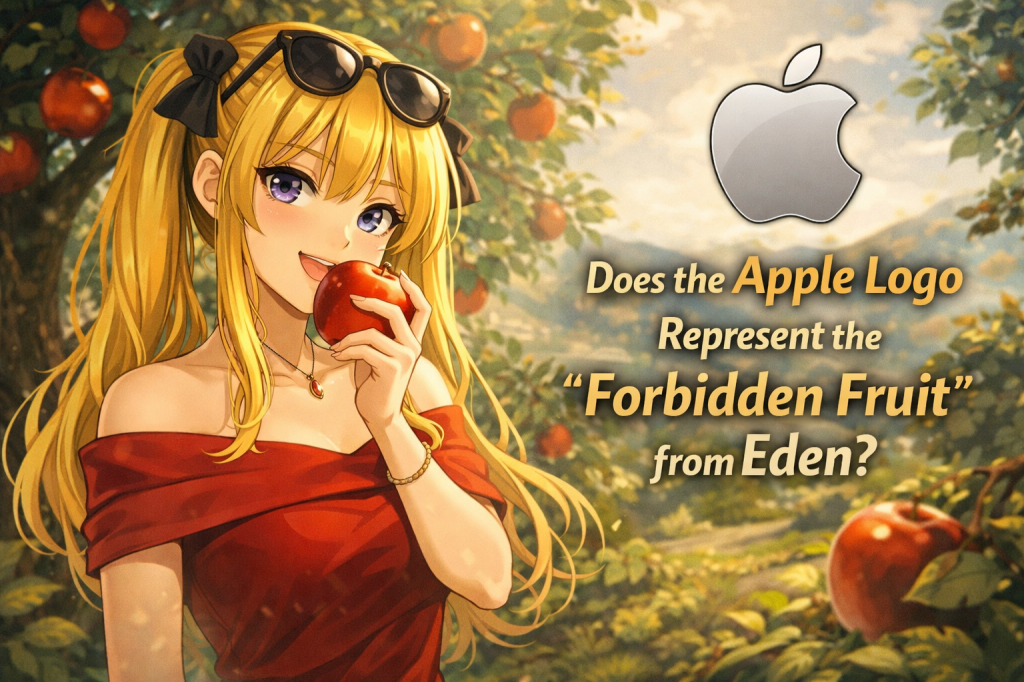
I am Iris.
Urban legends are not mere fabrications—
I am the storyteller who traces the unspoken truths with you.
Some people have long claimed that the Apple logo represents the “forbidden fruit.”
Because it shows a bitten apple, the design easily invites associations with Eden, knowledge, and temptation.
This time, rather than treating that reading as fact, we will look at why the symbol has been interpreted in that way.
The “forbidden fruit” reading behind the Apple logo
In urban-legend circles, it is often said that the Apple logo’s bitten apple resembles the fruit associated with the Garden of Eden.
From there, some symbolic readings extend further, linking the logo to knowledge, temptation, transgression, or the crossing of a boundary.
Of course, this is generally not treated as an established fact.
The logo is more naturally understood as a memorable brand mark designed for clarity, recognition, and visual impact.
There is no solid public basis for confidently saying that a biblical meaning was officially embedded into it.
Even so, the rumor has survived for a long time.
Why does the logo invite that interpretation?
Part of the answer lies in the symbol itself.
An apple is already a culturally loaded image.
It can suggest knowledge, stories, education, temptation, or myth depending on the context.
And in this case, it is not just an apple—it is a bitten one.
That missing bite makes the design feel less neutral.
It introduces the sense that something has happened.
Once people connect that detail to an older story, the logo can begin to feel like more than a corporate mark.
It starts to look like a symbol carrying a second layer of meaning.
In that sense, the rumor grows not because the design proves anything, but because the image leaves room for interpretation.
And urban legends thrive in that kind of space.
A symbolic reading, not a verified one
Stories like this are usually better framed as symbolic readings rather than hidden discoveries.
They tell us less about secret intention and more about the way people respond to simple but powerful symbols.
A well-known logo does not remain a neutral image forever.
The more familiar it becomes, the more likely people are to project larger stories onto it.
The Apple logo is a strong example of that process.
Its simplicity makes it elegant, but that same simplicity also makes it easy to mythologize.
So the interesting question is not only whether it “really” means the forbidden fruit.
The deeper question is why so many people find that reading so persuasive.
Why people place myths inside simple designs
Urban legends often emerge when a familiar symbol feels just open enough to hold another story.
The Apple logo fits that pattern very well.
It is minimal, globally recognized, and rich in possible associations.
That combination makes it fertile ground for mythic interpretation.
Whether true or not, the persistence of this rumor tells us something important.
People do not merely recognize symbols—they narrate them.
And once a symbol begins to feel readable, it can become philosophical, suspicious, or even sacred in the imagination of the viewer.
Sometimes the legend is not really about the logo itself.
Sometimes it is about the human urge to place old myths inside modern design.
Next time—another fragment of truth we will trace together.
I will return to continue the telling.

コメントを残す