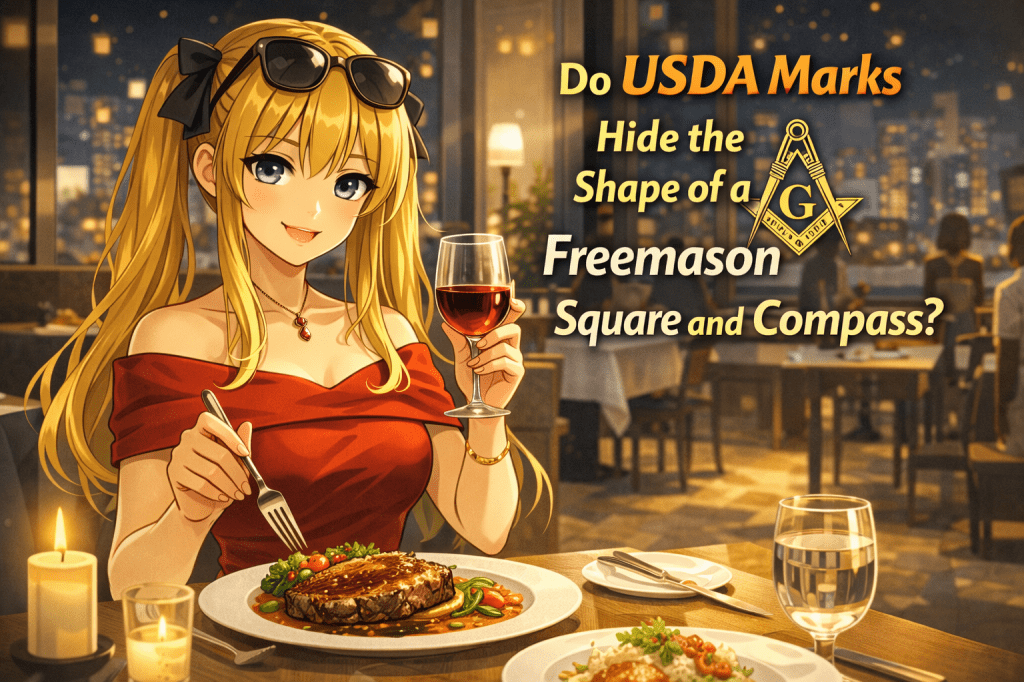
I am Iris.
Urban legends are not mere fabrications—
I am the storyteller who traces the unspoken truths with you.
Some people have claimed that official certification marks and public emblems sometimes resemble secret-society symbols.
This time, the focus is on the rumor that certain USDA-related marks seem to echo the Freemason “square and compass.”
Rather than treating that as fact, we will look at why such a reading appears and why it continues to circulate.
The rumor linking USDA marks to Freemasonry
In urban-legend circles, it is sometimes said that parts of USDA-related seals, labels, or certification-style graphics resemble the famous Freemason square and compass.
The claim usually begins with visual resemblance: intersecting lines, angled forms, circular elements, or geometric balance that remind viewers of a symbol they already know.
From there, the story often expands.
What starts as “this shape looks similar” can become “perhaps there is hidden meaning behind the authority of the mark itself.”
That is how an ordinary institutional symbol can be pulled into a much larger narrative about secrecy, power, and hidden influence.
Of course, this is generally not treated as an established fact.
Public marks and certification designs are more naturally understood as tools of recognition, clarity, and institutional trust.
There is no solid public basis for confidently saying that a secret-society emblem was intentionally embedded into them.
Still, the rumor persists.
Why do people start seeing the square and compass?
Part of the answer lies in familiarity.
The Freemason square and compass is one of the most widely recognized symbols in conspiracy culture and symbolic rumor.
Because it is already so famous, people tend to notice echoes of it wherever lines, angles, and circular forms appear together.
This is a common pattern in urban legends.
Once a symbol enters public imagination, it becomes easy to project it onto unrelated designs.
A seal, a badge, a logo, or a certification mark can begin to feel suspicious simply because it shares a few visual traits with a known emblem.
Institutional symbols are especially vulnerable to this kind of reading.
They already carry authority.
And whenever authority is present, some people begin to suspect that another layer of meaning may be hidden beneath the official explanation.
A symbolic reading, not a verified one
Stories like this are usually better understood as symbolic readings rather than discoveries.
They tell us less about hidden intent and more about the way people respond to authority, geometry, and familiar signs.
A public mark is supposed to communicate order, trust, and legitimacy.
But in the world of urban legends, those same qualities can be reinterpreted as signs of secrecy, ritual, or concealed structure.
That reversal is what gives these rumors their staying power.
So the more revealing question is not whether the mark truly hides a Freemason symbol.
The more revealing question is why resemblance alone can feel persuasive when the symbol belongs to an institution.
Why official marks invite hidden-meaning stories
Urban legends often grow where symbolism and authority overlap.
The more formal and recognizable a mark becomes, the more likely people are to examine it as if it were a coded message.
That is why government seals, certification labels, and institutional emblems so often attract mythic or conspiratorial interpretations.
Whether true or not, the persistence of this rumor tells us something important.
People do not only read symbols for what they officially mean.
They also read them for what they fear, suspect, or imagine they might conceal.
Sometimes the legend is not really about the mark itself.
Sometimes it is about the human urge to believe that authority always carries a hidden design behind its visible face.
Next time—another fragment of truth we will trace together.
I will return to continue the telling.

コメントを残す