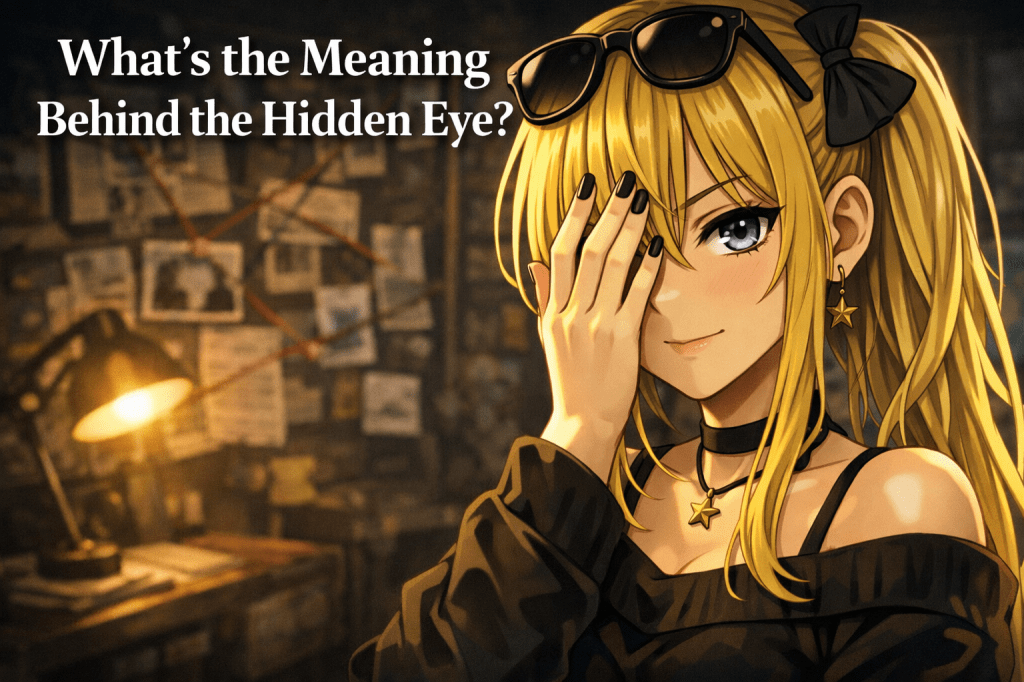
I am Iris.
Urban legends are not mere fabrications—
I am the storyteller who traces the unspoken truths with you.
Some people have long claimed that the one-eye pose or “hidden eye” look carries symbolic meaning tied to secrecy, surveillance, or hidden power.
Because the pose appears so often in photos, music visuals, and stylized imagery, it can begin to feel like more than a simple aesthetic choice.
This time, rather than treating that reading as fact, we will look at why the hidden-eye pose has come to feel so loaded with meaning.
Why did the hidden-eye pose become an urban-legend symbol?
In urban-legend circles, the act of covering one eye is sometimes linked to the idea of the “all-seeing eye,” secret influence, or a watcher-like presence.
By hiding only one eye instead of both, the image can feel deliberately incomplete, and that incompleteness invites interpretation.
Of course, this is generally not treated as an established fact.
In photography, fashion, and visual media, covering part of the face is often used simply to create mystery, tension, or a memorable composition.
There is no solid public basis for confidently saying that the pose always signals a hidden doctrine or secret affiliation.
Even so, the rumor has endured because the eye itself is such a powerful symbol.
Why does covering one eye feel so suggestive?
People are extremely sensitive to eyes and gaze.
We read attention, emotion, trust, danger, and intention through them almost automatically.
So when one eye is hidden, the face changes immediately.
It begins to feel selective, guarded, or theatrical.
Urban-legend readings build on that reaction.
A face that is only partly revealed can seem as if it is withholding something.
What is visible still looks at you, but not fully.
That tension makes the image feel symbolic even before any explanation is added.
So the interesting part is not only whether the pose “really” means something hidden.
The more revealing part is how easily a simple visual choice can become a charged symbol once people begin narrating it.
Why repetition turns a pose into a rumor
When the same pose appears again and again in photos, music videos, advertisements, and online posts, viewers may begin to feel that it is a shared code.
Even if the pose is only a stylistic trend, repetition gives it the appearance of intention.
That is a common pattern in urban legends.
A single image may feel artistic.
But repeated images start to feel coordinated.
And once a pose feels coordinated, people begin attaching larger meanings to it.
The hidden-eye pose fits that pattern very well.
It is visually strong, easy to copy, and memorable.
That makes it ideal material for symbolic rumor.
A symbolic reading, not a verified one
Stories like this are usually better understood as symbolic readings rather than discoveries.
They tell us less about a secret signal and more about the way people respond to faces, gaze, and partial concealment.
Eyes naturally carry large meanings.
They can suggest truth, awareness, control, awakening, or surveillance depending on context.
So when one eye is hidden, viewers may feel that the image is hinting at something beyond the visible surface.
The hidden-eye rumor survives not because there is decisive proof behind it, but because the pose creates exactly the kind of visual tension that invites symbolic interpretation.
Why people place secret meanings inside visual poses
Urban legends often emerge when a familiar gesture or pose feels just unusual enough to carry a second story.
A hidden eye does that very effectively.
It is simple, visually striking, and emotionally suggestive, which makes it easy to turn into a symbol of mystery or hidden intent.
Whether true or not, the persistence of this story tells us something important.
People do not just look at images—they decode them, dramatize them, and turn them into narratives.
The hidden-eye pose is one more example of how a visual style can take on a second life once people begin reading it as a sign.
Sometimes the legend is not really about the pose itself.
Sometimes it is about the human urge to believe that what is partly concealed must be hiding something deeper.
Next time—another fragment of truth we will trace together.
I will return to continue the telling.

コメントを残す