I am Iris.
Urban legends are not mere fabrications—
I am the storyteller who traces the unspoken truths with you.
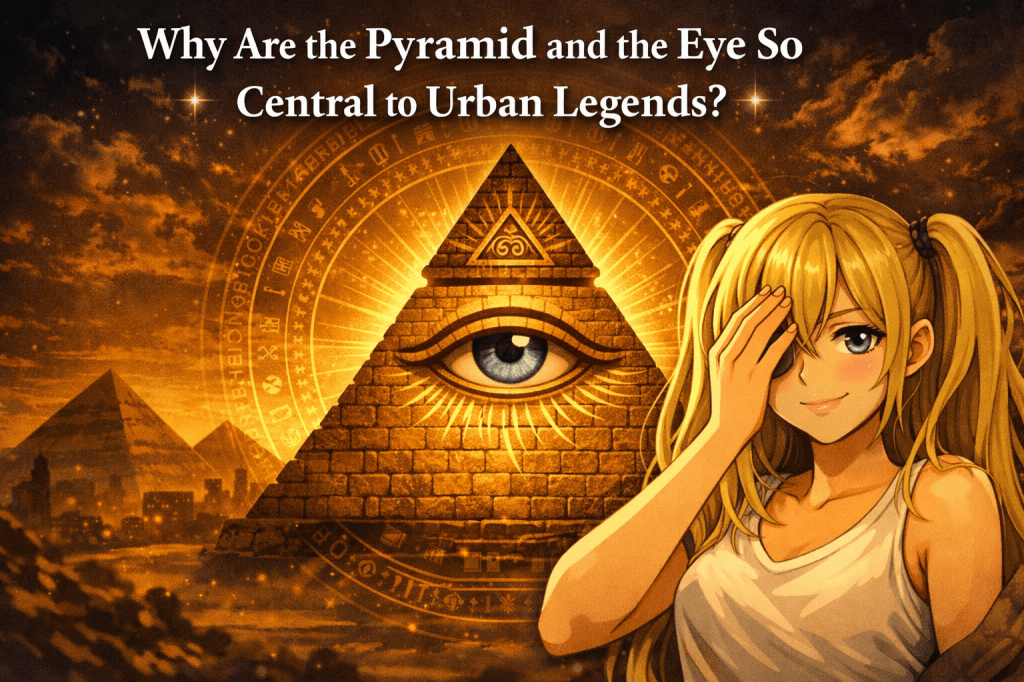
The combination of a pyramid and an eye has long been treated as a symbol of surveillance, hidden power, secret structures, or elevated knowledge.
Each image is already powerful on its own, but together they seem to form a sign that feels larger than ordinary design.
This time, rather than treating those readings as fact, we will look at why this pairing became so central to urban-legend symbolism.
What does the pyramid-and-eye pairing seem to evoke?
In urban-legend circles, the pyramid is often associated with hierarchy, ancient knowledge, endurance, and concentrated power.
The eye, meanwhile, easily suggests awareness, surveillance, judgment, awakening, or the feeling of being watched.
When the two are combined, many viewers begin to feel that the image represents a force that sees from above and understands what lies below.
Of course, this is generally not treated as an established meaning fixed in every context.
Symbols shift across time, culture, and usage.
There is not always a solid public basis for saying that every pyramid-and-eye image must refer to secret control or hidden authority.
Even so, the pairing has remained unusually durable.
Why does it fit urban legends so well?
Part of the answer lies in visual strength.
People are highly inclined to attach large meanings to simple but powerful shapes.
A triangle can suggest order, structure, rank, or a climb toward a peak.
An eye can suggest perception, truth, warning, or oversight.
When these forms are joined, they become easy to dramatize.
Urban legends thrive on that kind of symbolic density.
A viewer does not need a long explanation to feel that the image is “about something.”
The pyramid brings ancient weight and architectural mystery.
The eye brings emotion, tension, and the unsettling sense that someone is watching.
Together, they form a symbol that feels difficult to dismiss as merely decorative.
Why does repetition make the symbol feel even stronger?
When similar imagery appears again and again in currency, logos, music videos, posters, films, or online graphics, viewers may begin to experience it as a repeating code.
Even if many of those appearances come from aesthetic borrowing or dramatic composition, repetition can create the impression of deeper coordination.
That is a familiar pattern in urban legends.
A striking image seen once feels memorable.
Seen repeatedly, it begins to feel intentional.
And once it feels intentional, people start building stories around it.
The pyramid and eye are especially vulnerable to that process because they are already so visually loaded.
Repetition does not merely reinforce recognition.
It reinforces suspicion, fascination, and symbolic gravity.
A symbolic reading, not a verified one
Stories like this are usually better understood as symbolic readings rather than discoveries.
They tell us less about a single hidden truth and more about the way people respond to strong visual archetypes.
The pyramid-and-eye image survives because it feels like a complete language even before words are added to it.
It suggests height, vision, secrecy, order, and hidden design all at once.
That makes it ideal material for urban-legend thinking.
So the more revealing question is not simply whether the symbol “really” proves anything.
The more revealing question is why this particular combination feels so persuasive to so many people.
Why people place world-shaping stories inside strong symbols
Urban legends often emerge when a symbol feels broad enough to hold many different fears and meanings at the same time.
The pyramid and the eye do that almost perfectly.
They can carry ideas of power, secrecy, ancient continuity, spiritual knowledge, or centralized control depending on the viewer.
Whether true or not, the persistence of this image tells us something important.
People do not only recognize symbols—they build systems of meaning around them.
And once a symbol begins to feel like a blueprint of hidden order, it becomes very difficult to return it to neutrality.
Sometimes the legend is not really about the image itself.
Sometimes it is about the human urge to believe that the world must have a hidden design—and that somewhere, a symbol has already revealed it.
Next time—another fragment of truth we will trace together.
I will return to continue the telling.

コメントを残す