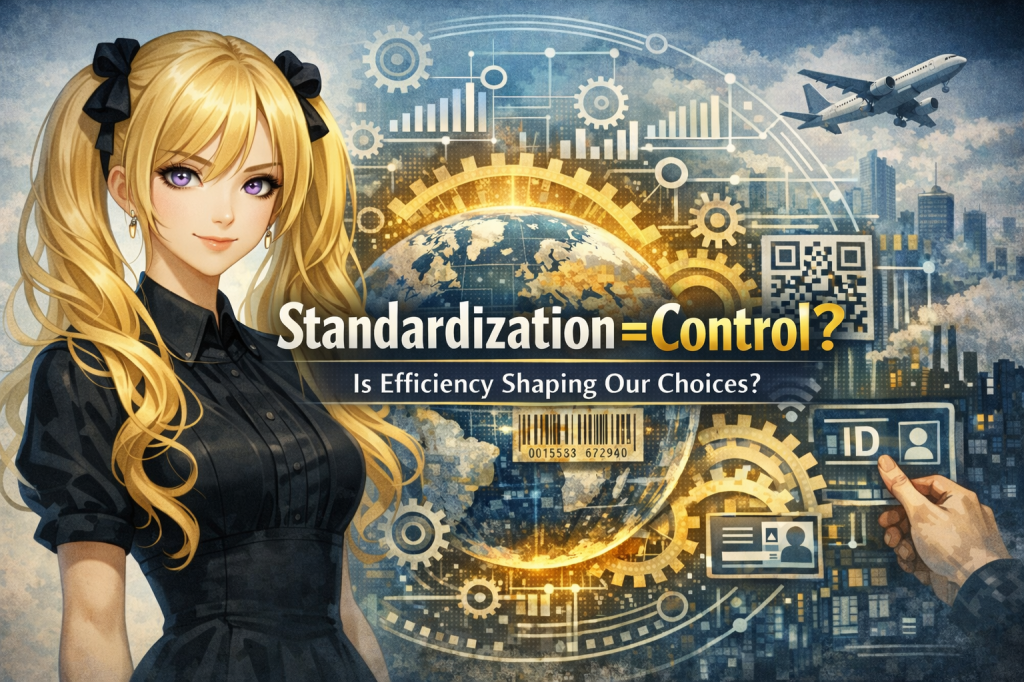
I am Iris.
Urban legends are not merely stories—
they are fragments of truth waiting to be traced together.
Introduction: “Standardization” Is the Quietest Power
When people hear “NWO,” they often imagine a secret room, a single blueprint, and a handful of masterminds.
But the modern world rarely needs a mastermind.
A more realistic—and more unsettling—pattern is this:
The world becomes governable when it becomes standardized.
Standards are not evil. They create safety, compatibility, and speed.
Yet once standards become the default rails of daily life, they can also become a form of control—without anyone having to announce it.
This article is part of the NWO series hub (linked in the references).
Today’s theme:
Standardization = Control? How efficiency can reshape human choices.
1) What “Standardization” Really Means (No Conspiracy Required)
Standardization is the process of turning messy reality into shared rules:
- technical standards (formats, protocols, interoperability)
- operational standards (procedures, audits, compliance)
- identity standards (verification, credential systems)
- risk standards (scoring, classification, thresholds)
In the beginning, this is rational.
A shared standard reduces friction:
- systems connect faster
- services scale wider
- decisions become easier to automate
- “unknown risks” become easier to manage
The critical shift happens when standards stop being tools and start becoming gateways.
2) The Three Mechanisms: Gate, Rails, Scoring
When people say “standardization feels like control,” they are usually sensing one (or more) of these mechanisms:
(A) Gate: Who Gets In, Who Gets Locked Out
A standard can function like a border checkpoint.
Examples:
- “You need a verified ID to access this service.”
- “You must pass compliance checks to transact.”
- “Your account is restricted until you submit additional documents.”
This is not always malicious.
It is often framed as security, fraud prevention, or legal compliance.
But the effect is real:
Participation becomes conditional.
(B) Rails: Once You Ride Them, You Can’t Steer Much
Interoperability is sold as freedom: “everything works together.”
But interoperability also creates rails:
- once systems share the same standard, alternatives become costly
- “opting out” becomes socially and economically expensive
- ecosystems become dependent on a few shared choke points
Rails are efficient.
They also reduce the practical number of choices.
(C) Scoring: Control Without Orders
The most modern form is not “command.”
It is “classification.”
Risk scoring can quietly decide:
- higher friction (extra verification)
- higher cost (fees, denied access, reduced limits)
- lower visibility (reduced distribution, reduced reach)
- exclusion (account suspension, deplatforming, blacklisting)
The key point:
Control becomes automated—without needing a dictator.
3) Where This Shows Up in Real Life
To keep this grounded, here are common domains where “standards become leverage.”
(1) Money Rails: Compliance Becomes the Hidden Switch
Modern payments require trust at scale.
That trust is enforced through standards:
- KYC/AML processes (Know Your Customer / Anti-Money Laundering)
- fraud detection models and thresholds
- network rules (what is allowed, what is blocked)
The intent is not automatically “control.”
But the mechanism creates power:
If access to payment rails is conditional,
then participation in society becomes conditional.
A system does not need to ban you by law—
it can raise friction until you cannot function.
(2) Platforms: Rules Become Infrastructure
Platforms standardize behavior by design:
- content policies
- monetization rules
- account trust scores
- automated enforcement systems
People often experience this as:
“I did not break a law, but I lost access.”
That is the shift from legal governance to infrastructure governance.
(3) Supply Chains: Standards Decide What Exists
Global logistics depends on standards:
- manufacturing specs
- certification processes
- inspection protocols
- documentation formats
If your product, business, or region cannot meet the standard,
you are not “attacked”—you are simply excluded.
Exclusion can look like an invisible wall.
(4) Digital Identity: Convenience That Tightens the Loop
Digital ID systems are often introduced with clear benefits:
- faster onboarding
- reduced fraud
- easier access to services
But identity systems are also perfect gating systems:
- they can unify access across many services
- they can become mandatory through market pressure
- they can expand in scope (one ID for many domains)
This is where people begin to feel:
“I am not choosing anymore—I am being routed.”
4) Rumor vs Mechanism vs Reality (The Series Lens)
This series uses a consistent model:
Rumor
A single elite group controls the world through secret orders.
Mechanism
Standards + identity gates + automated scoring
can gradually reduce choices and increase dependency.
Reality
The real risk is not a master plan.
It is the direction systems drift when:
- resilience is treated as “inefficiency”
- convenience becomes a requirement
- automation replaces human discretion
- opt-out paths quietly disappear
This is how “control” can emerge as a system outcome.
5) Why This Matters to Preparedness (Practical, Not Political)
Preparedness is not about paranoia.
It is about reducing single points of failure in your life.
If standards shape access, you prepare by reducing dependency on one rail.
Practical Preparedness Checklist
- Redundancy in payments: at least two independent methods (and a small offline reserve where legal and safe)
- Account resilience: backups of essential data, recovery codes, and alternate contact methods
- Service diversification: avoid relying on a single platform for identity, work, or income
- Documentation hygiene: keep essential documents organized (renewal dates, copies, recovery paths)
- Exit-cost awareness: know what it would cost (time/money) to switch providers or tools
- Offline capability: basic ability to function when systems degrade (power, network, logistics)
The point is not “fight the system.”
The point is: do not let one system become your only oxygen.
6) Where We Go Next (Series Path)
If this article is the “standardization lens,” the next pieces follow naturally:
- Surveillance Society: convenience → observation → compliance
- Digital Money & Control: rails, permissions, and denial-by-design
- Corporate Power: how asset managers and platforms shape the rails
- Migration & Crime: how standardization and strain change public-safety narratives
Each will follow:
rumor → mechanism → real-world impact → preparedness
Conclusion: The Question That Matters
Standardization is not automatically oppression.
It is often progress.
But when everything becomes standardized,
the world becomes easier to manage—
and harder to escape.
So the question is not:
“Is standardization evil?”
It is:
Where are the gates, who controls the rails, and how transparent is the scoring?
Next time, the map gets sharper—and fear loses leverage.
- Series Hub (Parent Article): NWO in 2026: The Hidden Operating System of the Modern World
- FATF (AML/CFT International Standards): FATF Recommendations
- BIS / CPMI (Financial Market Infrastructures): Principles for Financial Market Infrastructures (PFMI)
- NIST (Cybersecurity Framework): NIST Cybersecurity Framework
- ISO/IEC 27001 (Information Security Management): ISO/IEC 27001 Overview
- World Bank (Digital ID Program): Identification for Development (ID4D)
- European Commission (eIDAS Regulation): eIDAS Regulation (Electronic Identification and Trust Services)
- W3C (Verifiable Credentials Data Model): Verifiable Credentials Data Model
Related Reading
|
▶ HUB ► CITY ★ CAPITAL ◆ SYMBOL |
Posting Schedule Update (from 2026/01/01)
|
To improve article quality and accelerate video production, we will adjust the posting schedule and daily post count starting from 2026/01/01.
Japanese post: 1 per day at 19:00 |
Submit an Urban Legend
|
Have a rumor fragment, a pattern, or an unresolved “something feels off” story?
Submit via the contact form (or article comments): |
Share & Follow
|
📣 Share on X (Twitter) 📗 Share on Facebook 📸 Follow on Instagram 🔔 Follow on X (Urban Legend Narrator) 📺 YouTube Channel (Iris, Urban Legend Narrator) 💬 LINE Stickers (Vol. 1 & Vol. 2 collection) |
 Share on X
 Share on Facebook
 Follow here
