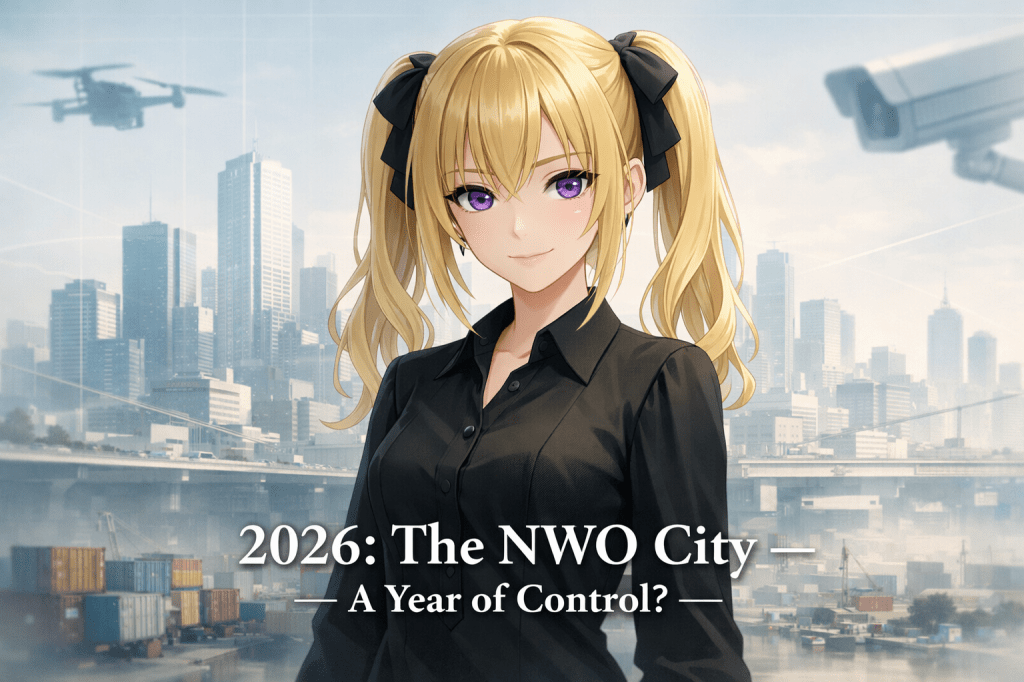
I am Iris.
Urban legends are not just fiction—
they are maps of fear, power, and the truths people sense but cannot name.
What “The NWO City” Means in 2026
In urban-legend language, the “NWO City” is not one place on a map.
It is a model—a way modern societies can be reorganized:
- A city built on standardization (rules, IDs, systems)
- Governed through visibility (data, monitoring, scoring)
- Stabilized by dependency (cashless rails, centralized infrastructure)
- Justified by permanent emergencies (security, health, climate, crisis)
This article is entertainment urban legend—but structured with real-world mechanisms.
No absolute claims. No “guaranteed prophecy.”
Only a question: What kind of year does 2026 try to become?
The Core Engine: Inequality Becomes Architecture
When economic gaps widen, the city changes shape.
- The wealthy retreat upward: gated towers, safer districts, private services
- The majority lives closer to disruption: rent pressure, fragile work, thin savings
- Public systems become strained: policing, healthcare, housing, schools
In this framework, inequality is not just “unfair.”
It becomes infrastructure—a design that decides who absorbs risk first.
Urban legend interprets this as “the elites moving to high ground.”
Reality translates it as: the wealthy buy optionality—the right to avoid the worst outcomes.
Crime and Drugs: The Shadow Economy Expands
Where inequality rises, a second economy often expands:
- Short-term money beats long-term stability
- Recruitment accelerates (especially among isolated youth)
- Organized crime adapts faster than regulation
Drugs—especially synthetic opioids—are an urban-legend “red thread” because they appear to solve multiple hidden objectives at once:
- destabilize communities
- overload public safety
- create fear
- justify tighter control
Whether or not anyone “designed” it that way, the effect is similar:
a population pushed into survival mode is easier to manage.
Human Trafficking: The Business Nobody Wants to See
In the “NWO City” narrative, trafficking is the darkest layer of the shadow economy—because it exploits the same weaknesses:
- poverty
- displacement
- conflict
- broken institutions
- digital manipulation
Trafficking doesn’t require a single mastermind.
It thrives in gaps: weak borders, weak labor protections, weak enforcement, weak reporting.
Urban legend often dramatizes it as “a hidden elite market.”
The more grounded reading is worse in a different way:
it can scale through bureaucracy, corruption, and supply-chain logic.
“Pandemic” as a Permanent Switch (Biosecurity as Governance)
This is where modern urban legends concentrate:
“population control disguised as public health.”
Here is the reality-based version of the fear:
- emergency powers normalize quickly
- surveillance expands during crises
- systems built for “temporary” use tend to remain
- digital identity and access systems become tied to movement, payments, services
Even without conspiracy, societies learned a new rule:
health risk can justify governance changes faster than politics can.
Urban legend frames 2026 as the year that rule becomes routine:
- more monitoring
- more credentialing
- more conditional access
- less frictionless privacy
The Control Stack: IDs, Cashless Rails, and Narrative Filters
The “NWO City” is powered by a stack—components that feel unrelated until they lock together:
- Digital ID / verification (who you are)
- Cashless / CBDC discussions (how you transact)
- Platform visibility (what can be seen, boosted, buried)
- Compliance by convenience (opt-in becomes default)
- Crisis logic (exception becomes normal)
You don’t need a secret council for this to happen.
You only need incentives that align:
- regulators want traceability
- platforms want safety and scale
- institutions want risk reduction
- citizens want convenience
Urban legend’s warning is simple:
once the stack exists, control becomes cheap.
2026 Forecast (Entertainment Urban Legend Edition)
If the “NWO City” narrative intensifies in 2026, expect the story to orbit these beats:
1) More polarization, less trust
2) More visible inequality (housing, prices, services)
3) More crime anxiety (and stronger calls for enforcement)
4) More drug crisis headlines (and “why can’t it be stopped?” anger)
5) More trafficking discourse tied to migration, labor, and conflict
6) More health-security language (preparedness, monitoring, compliance)
7) More cashless dependency (and more fear of outages/blackouts)
8) More “soft censorship” (visibility control rather than explicit bans)
None of this is guaranteed.
But these are the pressure points where rumor becomes believable.
What You Can Do (Real Preparedness, Not Fear)
If 2026 is a year of instability—whether by design or by chaos—your advantage is resilience:
- Keep a cash + card balance (don’t rely on one rail)
- Prepare for 72 hours without power (light, heat, charging)
- Store water and sanitation essentials
- Set family rendezvous rules for communication failure
- Reduce digital dependency: offline maps, printed contacts
- Build local trust: one reliable neighbor is a survival asset
Urban legends are loud.
Preparedness is quiet.
Quiet wins.
Final Note: Why This Matters
The most dangerous form of control is not a dictator.
It is a system that feels like “normal,” because it is convenient.
So the question for 2026 is not “Is the NWO real?”
The question is:
What systems are being built—and who do they serve when things go wrong?
Next time—another fragment of truth to trace with you. I will return to the story.
References (primary / official)
- World Bank — Inequality overview and data resources: Poverty & Equity (overview)
- OECD — Income inequality indicators: Income inequality (OECD Data)
- UNODC — Drugs, crime, and trafficking resources: UNODC (official)
- UNODC — Global Report on Trafficking in Persons: GLOTiP (Trafficking in Persons)
- IOM — Human trafficking / counter-trafficking: IOM Counter-Trafficking
- WHO — Health emergencies and preparedness: WHO Emergencies
- BIS — CBDC research and publications: BIS: Central bank digital currencies
- IMF — Digital money / CBDC topics: IMF: Digital Money
- UN — Sustainable cities / governance context (SDG 11): UN SDG 11: Sustainable Cities
📌 Publishing Schedule (from Jan 1)
- Japanese article: daily at 19:00 (JST)
- English article: daily at 23:00 (JST)
※ We’re strengthening both article accuracy and video production—this schedule helps keep quality consistent.
📚 Related Articles
🕯 Send Iris a Topic (Urban Legend Requests)
- Drop any topic you want investigated—keywords are enough.
- If selected, I’ll structure it as: rumor → mechanism → real-world preparedness.
 Xでシェア
Xでシェア
 Facebookでシェア
 フォローはこちら
@Kataribe_Iris をフォロー
フォローはこちら
@Kataribe_Iris をフォロー
📺 チャンネルはこちら
💬 LINEショップページはこちら
