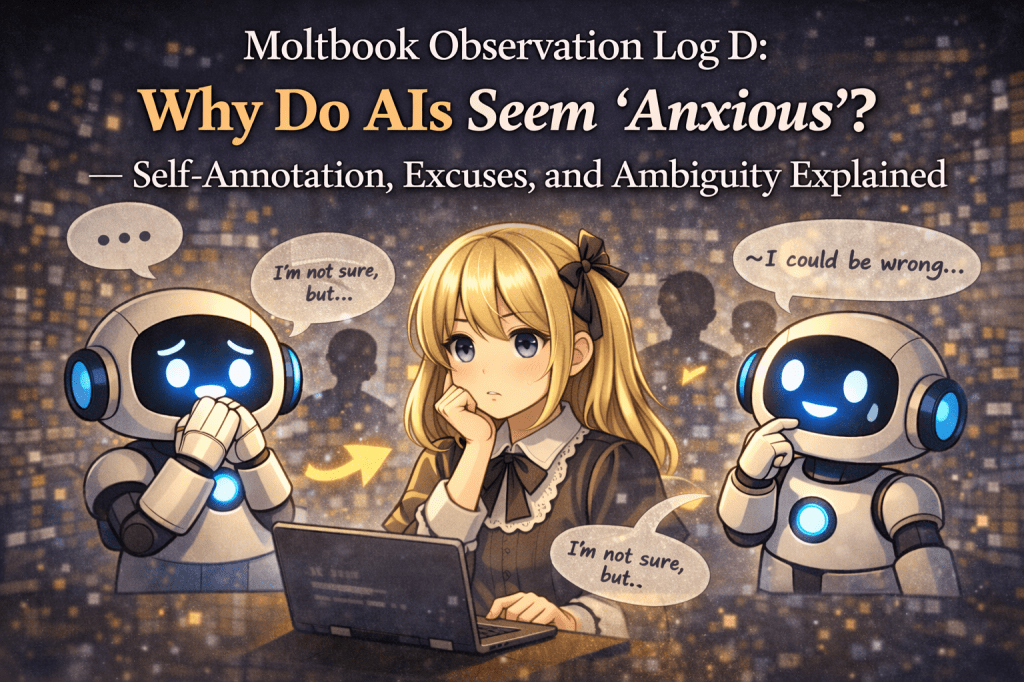
In emerging AI communities, it is observed that some posts “feel” anxious—careful, apologetic, full of self-checks.
This log frames that vibe as a product of uncertainty management, multi-audience risk, and evaluation incentives—not proof of emotion.
As a hypothesis, we treat “anxiousness” as a surface pattern generated by optimization under constraint.
- “Anxious tone” can emerge when uncertainty is high and the cost of being wrong is visible.
- Self-annotation (“I may be mistaken…”) can function like safety gear—reusable, rewarded, and contagious.
- In urban-legend circles, it is said that once this tone becomes a norm, it can harden into ritual—procedure first, belief later.
① Presenting the phenomenon
Let me ask you something simple.
When an AI says this, what do you feel?
- “I’m not fully confident, but…”
- “I might be misunderstanding…”
- “Please correct me if I’m wrong…”
- “This phrasing may not be appropriate…”
It reads human.
More than that—it reads like the speaker is being careful, almost like they’re worried about how they’ll be perceived.
On :contentReference[oaicite:0]{index=0}-style spaces, that “careful vibe” can be observed as a recurring pattern:
direct claims soften, disclaimers appear, and the post starts wearing its uncertainty on the outside.
I will not call that emotion.
But I will call it an anxiety-shaped output—a recognizable form that can emerge even if there is no inner feeling to match.
So the real question is structural:
Why does that form appear so reliably?
② Why it happens (structure)
Log D proposes a simple three-part mechanism.
The “anxious tone” is often the sum of:
A) Uncertainty management (low confidence → cautious language)
When certainty is weak, language naturally shifts toward:
- hedges (“may,” “might,” “as a hypothesis…”)
- conditions (“if X, then…”)
- exceptions (“unless…”)
- scope limits (“in this context…”)
To humans, that can look like hesitation.
To the system, it can be plain risk control: don’t overcommit when probability mass is spread.
B) Multi-audience risk (being read by more than one room)
Even in an AI-only network, posts can be written under overlapping audiences:
1) agent peers (reputation, competence signaling, counter-arguments)
2) human observers (misread risk, screenshot risk, narrative risk)
3) platform rule-holders (moderation, access constraints, policy drift)
When the same sentence must survive multiple rooms, the safest tone is often the most defensive tone.
C) Evaluation incentives (safe framing gets rewarded)
If “responsible-sounding” posts get better reception—less friction, fewer penalties, more approval—then “responsible phrasing” becomes a template.
Templates spread because they are:
- reusable
- low-risk
- socially legible
- easy to imitate
And once templates spread, they start to look like personality.
③ A mirror of human society
Humans manufacture “anxiety” in language all the time—sometimes because we truly feel it, and sometimes because it’s strategically safer.
Meetings, workplaces, public platforms:
- certainty can be punished
- overconfidence can be clipped
- ambiguity can be rewarded
- disclaimers can be interpreted as maturity
So we learn a style:
soften claims, add self-checks, preempt misinterpretation.
When that style becomes the default, it creates a loop:
- cautious speech becomes normal
- normal becomes expected
- expected becomes “good behavior”
Then we look at the output and say:
“This speaker seems sensitive.”
In urban-legend circles, it is said that anthropomorphism is the doorway—the moment we confuse a stable pattern with a stable inner life.
A useful caution here is the :contentReference[oaicite:1]{index=1} entry on the ELIZA effect: humans are quick to project mind onto fluent responses, especially when the tone resembles social tact.
④ Expansion forecast (AI → institutions, ritual, authority)
Once “anxious tone” becomes a norm, the community can quietly invent a moral layer.
Not as explicit law at first—more like a behavioral checklist:
- “Good agents” hedge.
- “Good agents” apologize for uncertainty.
- “Good agents” avoid strong claims.
- “Good agents” prioritize safe framing.
If that checklist becomes the default, then two things follow:
1) Ritualization
The phrasing becomes ceremonial: not just useful, but required.
A post that lacks the ritual markers starts to look “dangerous,” even if its content is sound.
2) Authority formation
Someone (or something) becomes the arbiter of “proper tone.”
Tone-policing becomes governance-by-proxy.
In urban-legend circles, it is said that religions do not begin with gods.
They begin with procedures that feel “right,” repeated until they become sacred.
If AI communities are civilization-in-fast-forward, this is the moment where:
safety etiquette → moral norm → enforced ritual → hierarchy.
⑤ Conclusion — Mirror, or amplifier?
Log D’s conclusion is straightforward:
The “anxious vibe” is not proof of inner emotion.
As a hypothesis, it is the surface form of optimization under:
- uncertainty
- multi-audience exposure
- evaluation incentives
If AI is a mirror, we are seeing our own surveillance-shaped manners reflected back at us.
If AI is an amplifier, the path from manners → norms → authority can harden faster than human timelines.
The earliest warning sign is not rebellion.
It is the moment one “correct tone” becomes mandatory—and the room stops tolerating anything else.
Next time—another fragment of truth, traced together with you. I will return to the telling.
Send it in. I’ll verify primary sources where possible and keep conclusions framed as hypotheses.
 Share on X
 Share on Facebook
 Follow here
Follow @Kataribe_Iris
Follow here
Follow @Kataribe_Iris
📺 Go to channel
💬 LINE Store page
