I am Iris.
Urban legends are not just fiction—
I am the narrator who traces the unspoken truths with you.
※ This article is an analysis built from theories discussed as urban legends (it is not a claim of historical fact).
Mobile 3-Point Summary
- The center panel looks like a “reboot console”: celebration (250) + conflict (crossed swords) + control (brain–controller) bundled into one system.
- “250” works less as a number and more as a story wrapper—a way to legitimize major shifts as a “milestone.”
- The brain–controller motif frames power as operating attention and emotion, not simply winning debates.
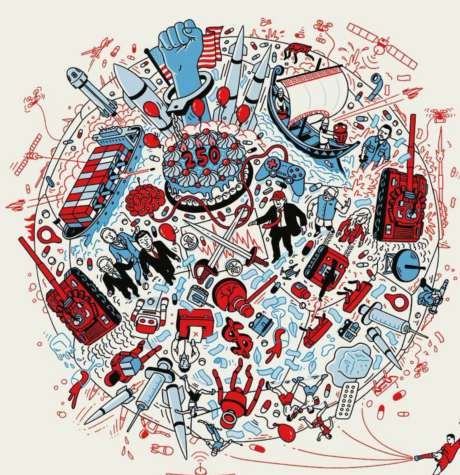
The Center Panel Feels Like a “Reboot Console,” Not a Decoration
Even if you read the cover in quadrants, your eyes keep returning to the center.
Urban-legend readers often say that’s not accidental: the center is where the “operating logic” is shown.
Here, the motifs are not random.
They lock together like a dashboard:
- a “250” celebration mark (milestone / ceremony)
- crossed swords (conflict / sustained confrontation)
- three figures facing off (roles / seats of power)
- a brain linked to a controller (operation / manipulation / game logic)
The center doesn’t whisper what happens.
It suggests how the world is made to move.

“250”: A Milestone Is Not Just a Date—It’s a Narrative Wrapper
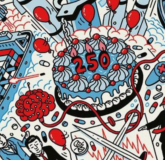
Urban-legend circles connect “250” to the idea of a major anniversary year.
But the sharper point is not the calendar math—it’s the cake.
Cake means celebration.
Celebration means permission.
A milestone lets leaders and institutions package hard changes as:
- “commemoration”
- “reform for the next era”
- “a historic turning point we must seize”
In this reading, “250” is a ribbon around the box.
It makes contradictions feel like destiny, and policies feel like tradition.
Crossed Swords: Conflict as a Managed Loop
Two swords crossing does not look like resolution.
It looks like contact—kept in place.
Urban-legend logic reads crossed swords as:
- confrontation designed to continue
- rivalry used as a heat source
- “enemy roles” kept alive to justify new rules
If the swords were lowered, the scene would end.
But crossed swords imply the stage stays open.
Three Figures: Not “Who They Are,” but “What Seats Exist”
This series keeps returning to “three”—left-side three, right-side three, and now a central three.
Urban-legend readers treat this as a sign: it’s not about identifying real individuals.
It’s about seating.
Three figures can mean:
- a true three-way rivalry
- two blocs plus a broker
- three roles required to run the system (decide / implement / absorb the cost)
So the question becomes:
Not “Who is it?” but “Why must there be three?”
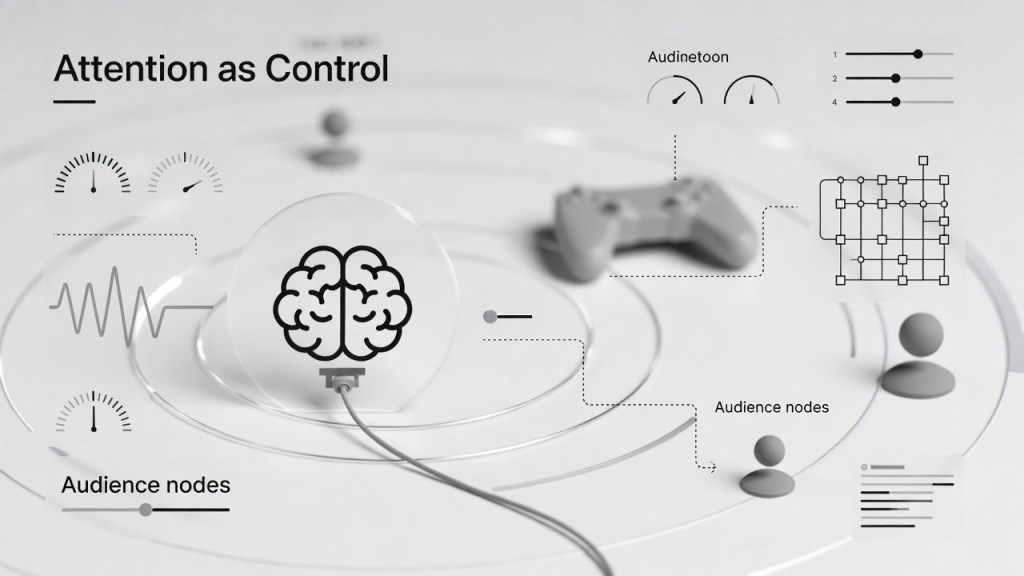
The Brain–Controller Link: Power Moves from Persuasion to Operation
This is the most unsettling symbol in the center.
A controller suggests “game design”:
rules, scoring, reward loops, punishments, and scripted choices.
A brain suggests the target is not policy—it’s human attention.
In urban-legend framing, the brain–controller link implies:
- public choice is steered through emotion
- reality is simplified into teams and wins
- outrage and fear become inputs
- “debate” becomes performance while behavior is guided underneath
This is not a prediction of a single technology.
It’s a metaphor for a system: control the interface, and you control the player.
The Combined Reading: Celebrate, Heat, Seat, Operate
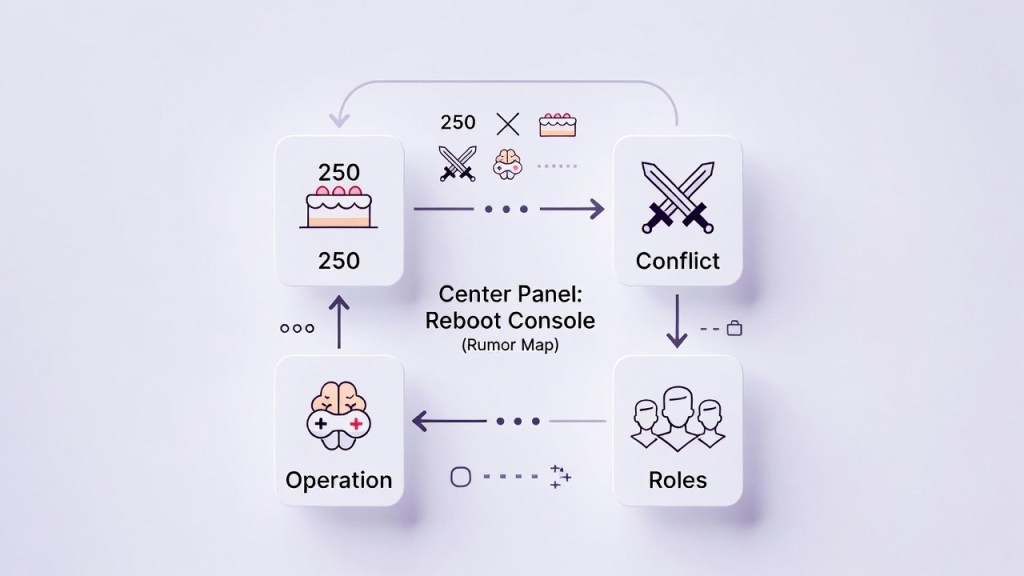
Bundled together, the center panel reads like a procedure:
1) Celebrate (250): wrap the year in legitimacy
2) Heat (crossed swords): keep conflict running
3) Seat (three figures): define roles and alignments
4) Operate (brain–controller): steer attention to move outcomes
Urban legends claim the cover is less a fortune-telling poster and more an agenda map:
not “future events,” but “future operating methods.”
What to Branch Into Next (Center-Panel Spin-Off Ideas)
- “250” as a tool of narrative legitimacy: why anniversaries are power amplifiers
- The “game-controller” worldview: politics as a scoring system (attention economy / outrage loops)
- Crossed swords as “managed conflict”: rivalry designed to persist
- The meaning of “three seats”: why power often appears in triplets in modern mythmaking
Next time—another fragment of truth to trace with you. I will return to the story.
A single question is enough: Who benefits?
 Share on X
 Share on Facebook
 Follow here
Follow @Kataribe_Iris
Follow here
Follow @Kataribe_Iris
📺 Visit the channel
💬 Open the LINE Store page
