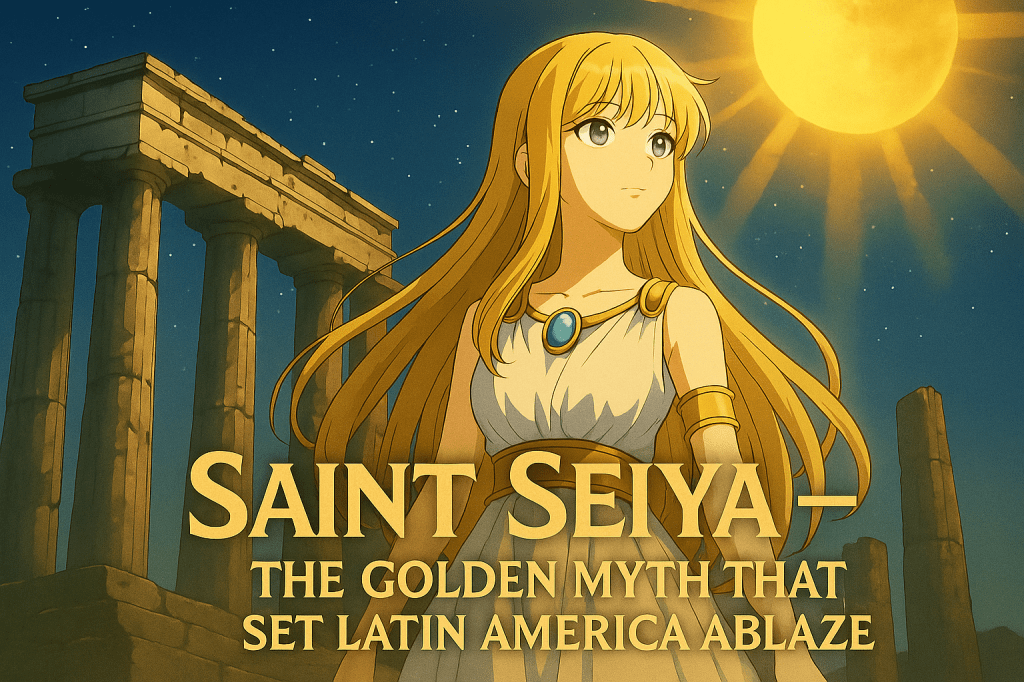
“I am Iris.
Urban legends are never just stories—
They are untold truths we’ll uncover together.”
Chapter 1: Why Latin America Burned Brighter Than Japan
When Saint Seiya first aired in 1986, it became a hit in Japan—but the real “myth” was born on the other side of the world: Latin America.
In Brazil, Mexico, Chile, and Peru, children recreated the battles of the Bronze Saints, crafting makeshift Cloths and fighting like their heroes.
During its broadcast, school attendance even dropped—a testament to its cultural impact.
📌 Fact Check
- Brazilian premiere: 1994 on Rede Manchete (highest ratings in the network’s history)
- In Mexico, Saint Seiya aired in a national “afternoon prayer” slot, symbolically merging pop culture with spirituality
Chapter 2: Faith and Myth — Why a Catholic World Loved a Greek Saga
Latin America is deeply rooted in Catholic culture. Yet, the fusion of Greek mythology and Japanese animation found no resistance.
The reason lies in shared spiritual values: self-sacrifice, resurrection, and unwavering faith.
The red blood of the Saints was often described as “the color of devotion.”
📌 Anthropological Perspective (Rio de Janeiro University, 2017)
“Saint Seiya presented a new narrative of salvation for Latin American youth.”
This academic analysis recognized the series as a rare example of how anime can mirror religious symbols in a culturally resonant way.
Chapter 3: The Golden Saints and Latin America’s Devotion
In Brazil, the magazine Heróis do Universo once conducted a poll to determine the most beloved Gold Saints:
1st: Saga (Gemini)
2nd: Shaka (Virgo)
3rd: Milo (Scorpio)
Virgo’s Shaka became especially iconic—seen as a fusion of Buddha and Christ.
His popularity represented the union of Eastern enlightenment and Western faith.
📌 Cultural Analysis
For many Latin American fans, the Gold Saints symbolized both faith and aspiration.
They were not just heroes—they were modern saints of pop culture.
Chapter 4: Resurrection and Eternity — The Mythic Power of Seiya
No matter how many times Seiya fell, he always rose again.
For the youth in Brazil’s poorer regions, this resilience embodied hope and belief.
Seiya transcended being a mere anime character—he became a symbol of salvation.
📌 Fact Check
- The 2019 Netflix remake prioritized the Latin American market
- That same year, Netflix Brazil officially declared: “Seiya is our hero.”
Iris’s Reflection:
“Seiya is more than a character. His persistence is the very form of human prayer.”
Chapter 5: The Golden Legacy Beneath the Southern Sky
Even today, Brazil hosts the annual Cavaleiros do Zodíaco Festival, bringing together cosplayers, armor artisans, and voice actors in a near-religious celebration.
Saint Seiya has evolved beyond anime—it has become a Pop Religion, a living faith through myth and memory.
Under the southern sky, when golden armor gleams once more,
the children of that era still rise again—believing in Seiya.
Next time — another fragment of truth we’ll uncover together.
I’ll return to the tale once more.
 Share on X
 Share on Facebook
 Follow here
Follow @Kataribe_Iris
Follow here
Follow @Kataribe_Iris
▶️ Visit Channel
💬 Visit LINE Store


M資金詐欺──未解決事件の黒い実例 – 秘書官アイリスの都市伝説手帳~Urban Legend Notebook of Secretary Iris~ への返信 コメントをキャンセル