I am Iris.
Urban legends are not just made-up stories—
I am the storyteller who will trace the unspoken truth with you.
Christmas Myths That Won: Why These Stories Feel “True”
Every December, a familiar set of claims resurfaces:
“Christmas was stolen from pagans.”
“The Star of Bethlehem was definitely a comet.”
“The truth was hidden on purpose.”
Some of these statements contain fragments of reality. Many are overconfident shortcuts.
This article is not here to “debunk Christmas.” It’s here to show how myths become durable—and how to verify them without turning history into a single-cause conspiracy.

Myth #1: “The Star of Bethlehem Was a Specific Astronomical Event”
The Star of Bethlehem is often treated like an astronomy puzzle with a single correct answer.
But the earliest narrative source is a theological text, not an observational report. That matters because the story’s purpose is meaning-making: guidance, recognition, legitimacy.
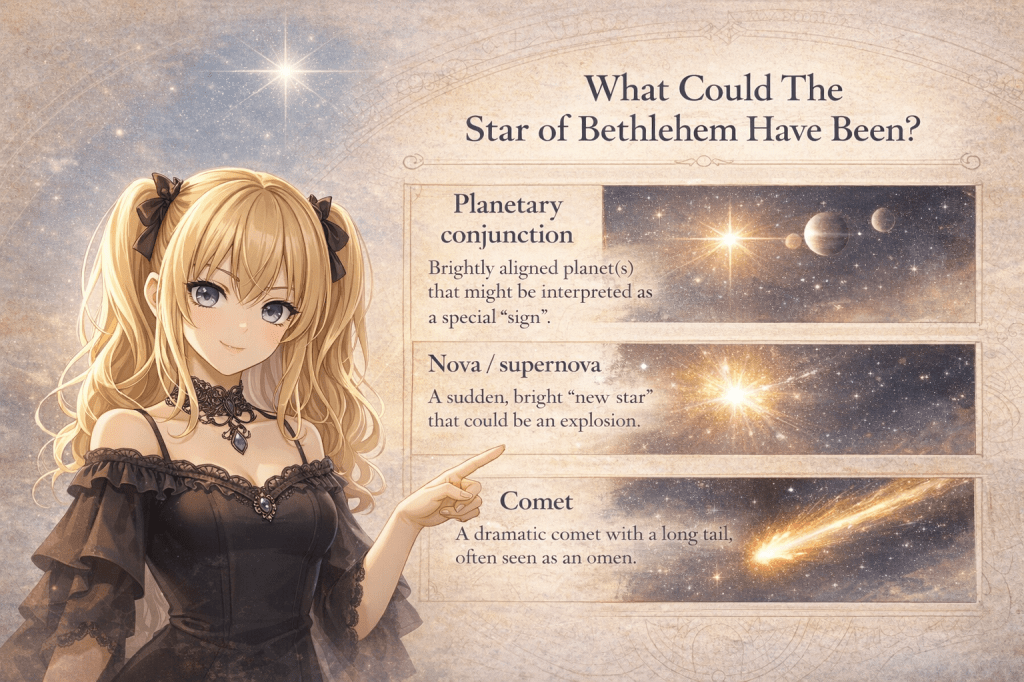
Common modern candidates include:
- Planetary conjunctions (a striking alignment that can be interpreted as a “sign”)
- Nova / supernova (a sudden bright “new star”)
- Comets (visually dramatic, culturally interpreted in many ways)
None of these options can be confirmed from the narrative alone.
A practical takeaway: the “Star” works powerfully even if it remains symbol-first rather than sky-first.
Myth #2: “Christmas Was Simply Copied From Pagan Festivals”
This myth survives because it offers a clean story: one tradition replaces another.
Real cultural change is rarely that neat.
What tends to happen instead is holiday standardization:
- Societies prefer shared dates to synchronize public life (work rhythms, gatherings, rituals)
- Existing seasonal symbolism (darkness → light; endurance → renewal) gives a holiday narrative “grip”
- Institutions refine and repeat meanings until the date becomes socially automatic
So yes: winter timing, light symbolism, and pre-existing festivities matter.
But “stolen” implies a single deliberate act. History more often looks like mixing, organizing, and stabilizing.
Why These Myths Keep Winning
These stories persist because they satisfy predictable human needs:
- Single-cause comfort: one answer feels safer than a web of partial explanations
- Proof-hunger: if we can “prove” a miracle (or “prove” a theft), the world feels more controllable
- Narrative authority: origin stories grant legitimacy—religious, cultural, even personal
- Shareability: short, dramatic claims spread faster than careful nuance
Urban legends thrive where complexity meets emotion.
A Fact-Check Checklist You Can Actually Use
When you see a strong claim about Christmas origins or the Star, run this checklist:
- Source clarity: Does the post cite a primary text or only repeat a meme?
- Category check: Is the source theological narrative, later tradition, or modern speculation?
- Mechanism: If it claims “influence,” does it explain how ideas traveled and stuck?
- Alternatives: Does it acknowledge competing explanations—or pretend there is only one?
- Language audit: Words like “definitely,” “hidden,” “they don’t want you to know” are often a red flag
- Time mismatch: Are centuries being collapsed into a single event for dramatic effect?
This approach doesn’t kill wonder. It preserves it—without selling you certainty that the evidence can’t support.
What to Keep, Even After the Myths
You can hold two truths at once:
- The exact historical “birthday” date is difficult to pin down with certainty.
- The cultural meaning of a shared day can be real and valuable precisely because communities choose it and repeat it.
In other words: the calendar can be a container of meaning, even when history leaves gaps.
Next time—another shard of truth to trace with you. I will return to the stories.

コメントを残す