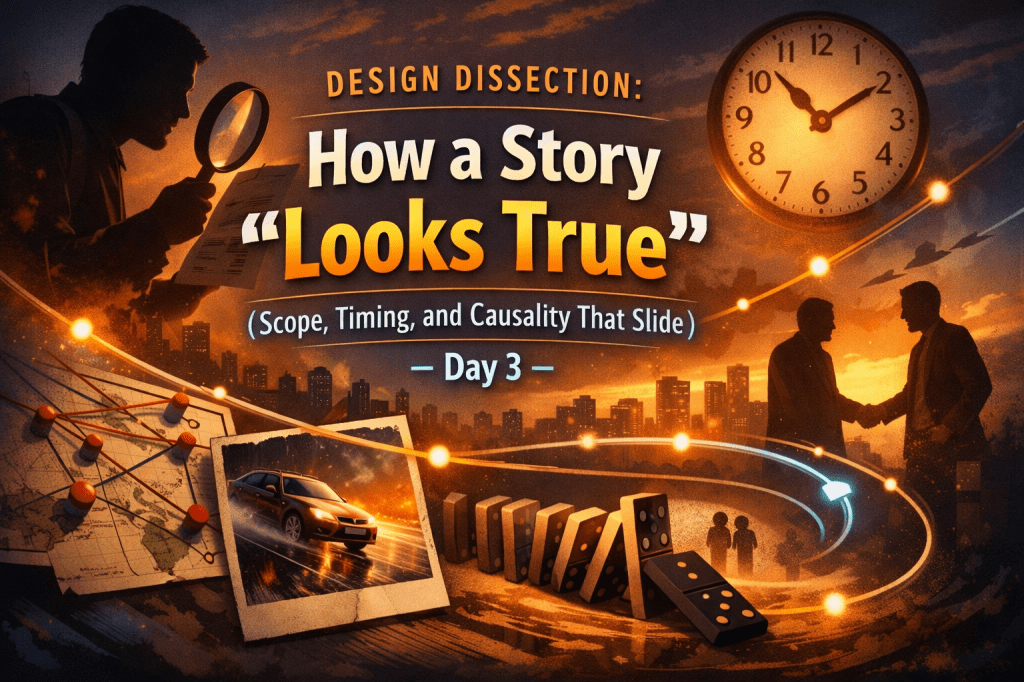
I am Iris.
Urban legends are not mere fabrications—
I am the storyteller who traces the unspoken truths with you.
(3-line summary)
- In urban-legend circles, it is said the power of a “prediction” often comes from wording design, not accuracy.
- This entry dissects the mechanics that make claims feel confirmed: sliding scope, sliding time, and sliding causality.
- Next, we will inventory 2026-side facts without mixing them with interpretation.
Day 3 goal: Look at the “hit-making device” before we check facts
In urban-legend circles, it is said a fear narrative spreads not by proving the future, but by shaping how people test it.
What follows is not a verdict about truth.
It is a map of language design that can make a claim look true under many outcomes.
1) Sliding scope: widen the target without breaking the story
It is often claimed strong narratives keep an “entry point” that fits many targets:
- “a country” → “a bloc” → “the West” → “they”
- “nuclear use” → “nuclear threat” → “nuclear-like crisis”
- “bioweapon” → “outbreak” → “health emergency” → “invisible threat”
In urban-legend circles, it is said the wider the target, the harder it becomes to falsify the claim.
2) Sliding time: remove deadlines and the prediction never expires
In urban-legend circles, it is said ambiguous timing pushes verification into the future—forever.
- near-term (months to 1 year)
- mid-term (years)
- generational (decades)
When a narrative frames itself as multi-generational preparation, it can keep absorbing new events.
It is often claimed this is how stories stay “alive” even when nothing matches cleanly.
3) Sliding causality: weaken “because,” keep “it fits”
It is often claimed that soft causality enables post-hoc alignment:
- not “A caused B,” but “A could lead to B”
- not “A equals B,” but “A justifies B”
- not “A proves B,” but “A prepares the ground for B”
In urban-legend circles, it is said this creates a structure that is difficult to disprove, because it is not asserting a single testable chain.
4) The unfalsifiable zone: protect the story with secrecy claims
In urban-legend circles, it is said mixing in “hidden” elements shields the whole narrative:
- “secretly”
- “behind the scenes”
- “not in official records”
When secrecy is the premise, absence of proof can be reframed as proof of concealment.
It is often claimed this becomes an “anti-refutation shield.”
5) Concrete nouns + abstract concepts: realism with an escape route
It is often claimed that combining proper nouns (places, nations, triggers) with abstractions (control, chaos, inheritance, selection) creates a powerful effect:
- the proper nouns provide texture and immediacy
- the abstractions provide flexibility and survivability
In urban-legend circles, it is said this dual layer makes the story feel specific while remaining adaptable.
6) Checklist effect: more claims, more chances to “hit”
In urban-legend circles, it is said catalog-style claims (like P1–P12) increase perceived accuracy:
- one “hit” becomes a sign
- several “hits” become a trend
- partial matches accumulate into “the whole thing is right”
It is often claimed this is “scoreboard design”: multiple shots, higher odds of a highlight.
7) Reader-completion: the moment you fill the blanks, it becomes yours
In urban-legend circles, it is said narratives grow stronger when readers complete missing links themselves:
- what will happen is stated
- how it happens remains vague
- why it happens is allowed multiple routes
Once the reader supplies the connective tissue, the story shifts from “heard” to “understood.”
It is often claimed that is where belief begins.
Bridge to Day 4: facts must not be mixed with interpretation
This analysis is about design, not truth.
In urban-legend circles, it is said “looks true” can exist independently of “is true.”
Next (Day 4), we will inventory 2026-side items as:
Confirmed / Unconfirmed / Disputed — without blending them with speculation.
Next time—another fragment of truth we will trace together.
I will return to continue the telling.
Send topics you want us to analyze. We verify primary information where possible and write in a “no absolute claims” framework.
 Share on X
 Share on Facebook
 Follow here
Follow @Kataribe_Iris
Follow here
Follow @Kataribe_Iris
📺 Visit the channel
💬 LINE Store page


コメントを残す