I am Iris.
Urban legends are not mere fabrications—
I am the storyteller who traces the unspoken truths with you.
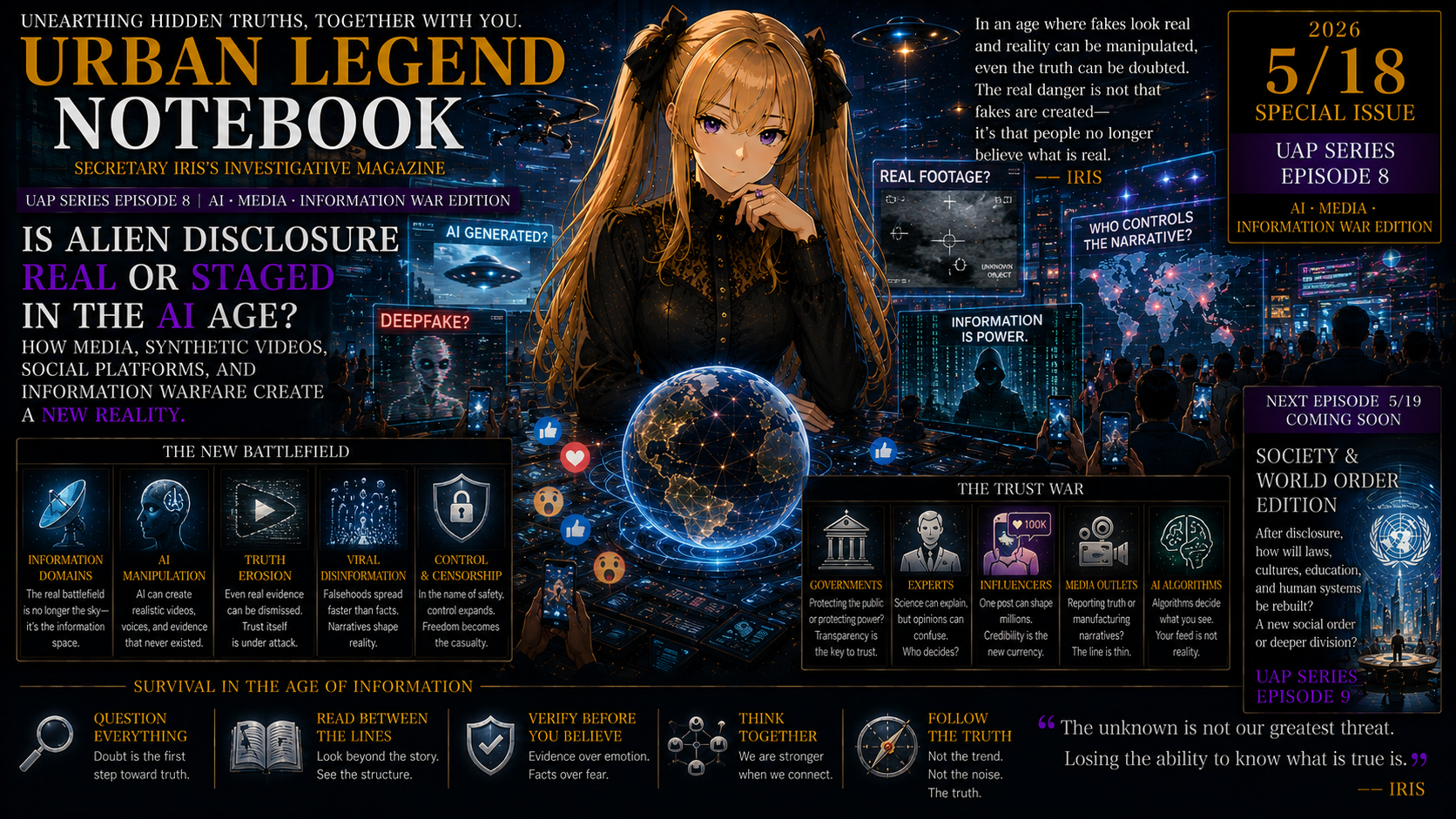
- This article is a thought experiment: what if governments or public institutions disclosed contact with extraterrestrial life or non-human intelligence?
- In the AI age, real footage can look fake, and fake footage can still move society.
- The deepest danger is not only that false images can be created, but that people may no longer know what can be trusted.
The Main Battlefield May Not Be the Sky
If contact with extraterrestrial life were publicly disclosed, people would ask for evidence first.
Images.
Video.
Audio.
Documents.
Sensor records.
Witness testimony.
Government statements.
Scientific analysis.
But in the AI age, evidence does not end confusion.
It may begin it.
Is the footage real?
Was it generated?
Was it edited?
Was the audio cloned?
Was the witness fabricated?
Was the government statement authentic?
Was the leak staged?
Was the denial part of the story?
After disclosure, the main battlefield may not be the sky.
It may be the information space.
UAP is often imagined as something unidentified in the air.
But in the AI age, UAP-like uncertainty also appears in media itself.
Unidentified footage.
Unverified witnesses.
Unclear sources.
Unknown motivations.
Artificial voices.
Synthetic video.
Algorithmic amplification.
The unknown no longer only floats above us.
It appears on screens.
Synthetic Video Changes the Meaning of Evidence
For a long time, video carried authority.
A photo existed.
A tape existed.
A voice was recorded.
A witness was filmed.
People could still doubt, but evidence had weight.
Now that weight is unstable.
AI can create faces that never existed.
Voices that were never spoken.
News clips that never aired.
Press conferences that never happened.
Sky footage that never came from the sky.
The danger is not only that perfect fakes may be created.
The danger is the expanding gray zone.
Real enough to disturb.
Fake enough to doubt.
Unclear enough to divide.
In that zone, evidence loses its old power.
A video appears.
Some believe it immediately.
Some reject it immediately.
Experts analyze it.
Other experts disagree.
Governments deny it.
Citizens call the denial suspicious.
Platforms label it.
Users claim the label is censorship.
The footage becomes less important than the battle over its meaning.
That is the AI-age disclosure problem.
Real Evidence Can Be Treated as Fake
The most frightening part may not be fake evidence.
It may be real evidence that no one can agree is real.
Imagine a significant video is released.
A public institution publishes it.
Multiple sensors support it.
Experts examine it.
The timeline is consistent.
The metadata is credible.
Witness testimony matches.
Even then, many people may say:
It was AI-generated.
It was staged.
It was edited.
It was released to distract us.
It was designed to increase defense budgets.
It is part of psychological operations.
It is a movie campaign.
The real evidence is still hidden.
Healthy doubt is necessary.
But endless doubt can become a trap.
If every piece of evidence is dismissed before it is examined, truth no longer needs to be hidden.
It can be released into a world that has already lost the ability to recognize it.
This may be the deepest danger of disclosure in the AI age:
not that truth is absent,
but that truth becomes socially unusable.
Fake Events Can Still Move the Real World
The reverse is also true.
Fake events can move the real world.
A synthetic UAP video.
A fake government announcement.
A fabricated whistleblower.
A cloned military voice.
A false emergency broadcast.
A manipulated expert interview.
An old video presented as new.
A game clip presented as real footage.
If such content spreads quickly, it can create real consequences.
Markets may react.
Religious groups may interpret it.
Politicians may comment.
Media outlets may chase the story.
Experts may rush to debunk it.
The debunking may itself be treated as suspicious.
Fear may outlive the correction.
This is how information warfare works.
A message does not need to be true to shape reality.
It only needs to move attention, emotion, and behavior.
In urban-legend circles, rumors have always had power.
In the AI age, that power gains automation, scale, and speed.
A false image can become a social event before verification catches up.
Media Can Report Truth—or Manufacture Atmosphere
After disclosure, media would become one of the central actors.
What gets broadcast?
What gets verified?
Which expert is invited?
Which frame is used?
Which image becomes the headline?
How much uncertainty is admitted?
How much fear is amplified?
How much context is provided?
Media does not only transmit information.
It creates atmosphere.
“Humanity enters a new era.”
“Officials refuse to answer key questions.”
“Experts are divided.”
“Online skepticism grows.”
“Public anxiety rises.”
“Government secrecy fuels distrust.”
Each phrase shapes perception.
This does not mean journalism is useless.
Responsible journalism would be essential.
It could verify claims.
Challenge power.
Explain uncertainty.
Correct falsehoods.
Protect the public from manipulation.
Give citizens language for understanding the event.
But media also lives inside attention systems.
Fear spreads.
Shock gets clicks.
Certainty is easier to sell than caution.
A dramatic story travels faster than a careful explanation.
So after disclosure, media could become a bridge to clarity.
Or an amplifier of confusion.
Social Platforms Accelerate Disclosure—and Fragment It
Social platforms would accelerate everything.
X.
Instagram.
TikTok.
YouTube.
Facebook.
Forums.
Short videos.
Anonymous posts.
Memes.
Livestreams.
Reaction clips.
A video may spread before official confirmation.
A rumor may spread before context.
A conclusion may spread before evidence.
A fake may spread before correction.
Speed is the power of social media.
But speed is not truth.
One video appears.
Someone adds captions.
Someone claims an insider source.
Someone overlays dramatic music.
Someone edits the color.
Someone uses AI to enhance it.
Someone calls it proof.
Someone calls it fake.
Someone claims the fake label is censorship.
One event becomes many realities.
After disclosure, social platforms may not create one global conversation.
They may create rival information tribes.
Believers.
Skeptics.
Anti-government groups.
Institutional loyalists.
Religious interpreters.
Scientific explainers.
Investors.
Entertainment accounts.
Fear merchants.
The same event can be seen by millions of people who still do not inhabit the same reality.
The Trust War: Governments, Experts, and Influencers
The post-disclosure world would be shaped by a trust war.
Who gets believed?
Governments?
Military officials?
NASA-like scientific agencies?
Academic experts?
Former intelligence officers?
Whistleblowers?
Religious leaders?
Independent journalists?
Influencers?
AI analysis accounts?
Urban-legend channels?
Each would offer explanations.
This is real.
This is fake.
This is misidentified.
This is staged.
This is dangerous.
This is harmless.
This is disclosure.
This is distraction.
This is spiritual.
This is geopolitical.
The battle would not only be about facts.
It would be about credibility.
In modern media systems, expertise and reach are not the same thing.
The careful expert may be ignored.
The confident storyteller may dominate.
The cautious report may seem weak.
The dramatic claim may feel alive.
That is dangerous.
Because in information war, narrative style becomes a weapon.
The person who explains most clearly is not always the person who knows most accurately.
Urban Legends Become Generated, Not Only Told
Urban legends would also change.
Older urban legends spread through conversation, magazines, television, forums, and rumor networks.
AI-age urban legends can be manufactured at scale.
AI can generate images.
AI can write testimony.
AI can imitate documents.
AI can create fake broadcasts.
AI can invent witnesses.
AI can produce artificial comments.
AI can generate “ancient text” aesthetics.
AI can create a whole archive around a false claim.
This changes the nature of the urban legend.
It is no longer only something that emerges from collective anxiety.
It can be engineered.
That does not mean every urban legend is manipulation.
Urban legends are still mirrors of fear, desire, distrust, and cultural imagination.
But AI-generated urban legends can be produced with purpose.
To create fear.
To influence politics.
To move markets.
To attack institutions.
To sell belief.
To grow an audience.
To destabilize trust.
To create a false sense of awakening.
So the question is no longer only:
Is the story interesting?
The stronger questions are:
Who made it?
Why did it spread?
Who benefits?
Which emotion does it target?
What action does it encourage?
What does it make people unable to trust?
Verification Requires Doubt—and the Discipline Not to Drown in Doubt
What should people do?
First, doubt.
Check the source.
Look for primary information.
Compare multiple reports.
Check the date.
Look for original footage.
Beware of cropped clips.
Wait for expert review.
Separate evidence from interpretation.
Do not let emotional headlines decide for you.
But doubt alone is not enough.
People also need the discipline not to drown in doubt.
Do not dismiss everything as fake.
Do not assume government always lies and social media always reveals truth.
Do not treat every label as censorship.
Do not believe only the sources that flatter your existing worldview.
Do not confuse suspicion with intelligence.
Doubt should be a tool, not a home.
The goal is not to reject everything.
The goal is to move closer to what can be responsibly known.
Doubt.
Verify.
Compare.
Pause.
Think.
Update.
Hold uncertainty without surrendering judgment.
That is the discipline disclosure would demand.
The Real Danger Is the Collapse of Trust
When people imagine alien disclosure, they often fear the unknown itself.
What is above us?
What has been hidden?
Are we alone?
Are we safe?
But the AI-media layer reveals another fear.
The collapse of trust.
People may stop trusting governments.
Media.
Experts.
Platforms.
Video.
Audio.
Images.
Institutions.
Other citizens.
Even their own eyes.
When trust collapses, people search for stronger stories.
Everything is fake.
Everything is controlled.
Only our group knows.
Only this person tells the truth.
Only this channel is awake.
Only this theory explains everything.
That is where information warfare becomes dangerous.
The unknown may frighten people.
But a society unable to trust any process of truth-seeking is far more vulnerable.
The greatest danger may not be the alien.
It may be the market that sells certainty to frightened people.
Closing — In the AI Age, Structure Matters More Than Heat
If contact with extraterrestrial life were disclosed, the world would shake.
But in the AI age, the sky would not be the only thing shaken.
Evidence.
Media.
Social platforms.
Expert authority.
Government statements.
Urban legends.
Public trust.
The ability to verify reality.
All of these would be tested.
So I would not look only at the footage.
I would ask:
Where did it come from?
Who released it?
Who amplified it?
Who questioned it?
Who profited?
Which emotions moved?
Which institutions responded?
Which systems gained authority?
Which communities became more divided?
That is how we move closer to truth.
Is alien disclosure real or staged in the AI age?
That question matters.
But a deeper question stands behind it:
Do we still have the tools to know what is real?
In the age of synthetic media, the answer will not come from excitement alone.
Not from fear.
Not from instant belief.
Not from instant denial.
It will come from structure.
From evidence.
From method.
From patience.
From verification.
From the courage to hold uncertainty without being ruled by it.
That is how the Urban Legend Notebook must read the age of AI.
Next time—another fragment of truth we will trace together.
I will return to continue the telling.
References
A key official reference for understanding how UAP is handled as an institutional and public subject.
A public UAP report for aviation safety, national security, reporting systems, and unresolved cases.
NASA’s official UAP page, useful for framing the topic through science, data, and public transparency.
A scientific and data-centered reference for observation, collection, analysis, and public communication.
A public reference for generative AI risks, trustworthiness, and risk-management practices.
A reference for misinformation, disinformation, societal polarization, and AI-related global risks.
This English article is scheduled for 23:00 JST on May 18, 2026.
Related Reading
The gateway article for the UAP series, mapping why disclosure matters beyond the question of aliens alone.
Episode 7 of the UAP series, tracing national security, government secrecy, transparency, and airspace control.
Episode 6 of the UAP series, mapping Earth’s future after disclosure through technology, politics, economy, and human identity.
Popular Posts
A strong UAP-related popular article for readers who want to trace how UFO narratives mutate with technology and culture.
A long-running reader favorite on sovereignty, hidden structure, military presence, and geopolitical design.
A popular read on prophecy, sky omens, and the meaning people project onto cosmic signs.
Submit an Urban Legend
If there is a rumor, unexplained story, symbolic pattern, or strange connection you want explored, send it in. I will not leave it as “just a rumor”—I will trace its structure, context, and narrative with care.
コメントを残す