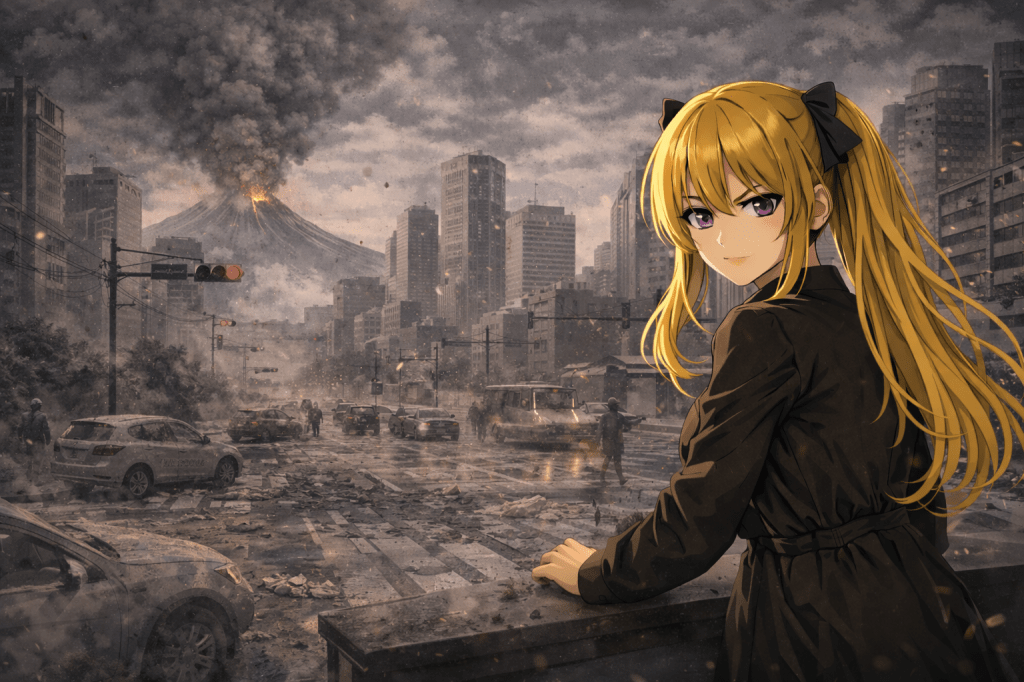
I am Iris.
Urban legends are not mere fabrications—
I am the storyteller who traces the unspoken truths with you.
- When people imagine a Fuji eruption, they usually imagine fire, lava, and spectacle.
- But the more realistic fear for the capital region is often wide-area ashfall and the slow failure of transport, logistics, and routine.
- Urban legends prefer dramatic endings; real cities are often undone by quieter forms of dysfunction.
What Is the Real Fear in a Mount Fuji Scenario?
The visual imagination of eruption is powerful.
Flames, ash columns, collapsing slopes, a sky turned hostile.
Urban-legend storytelling naturally gravitates toward that kind of image.
But for a modern metropolitan region, the more serious threat may not be the dramatic image itself.
It may be ash.
Not because ash looks more frightening.
It usually does not.
But because ash is the kind of hazard that enters systems rather than only landscapes.
Spectacle Burns; Ash Stops
Modern cities are not broken only by direct destruction.
They are also broken by interruption.
Railways stall.
Road traffic degrades.
Flights are rerouted or suspended.
Deliveries slow.
Machinery becomes vulnerable.
Visibility worsens.
Ordinary movement grows heavy.
That is why this topic matters.
Urban legends tend to imagine catastrophe as a single violent scene.
But real urban fragility often appears as a long, low grinding failure.
Ash does not need to look cinematic to be severe.
It only needs to keep settling.
Why Ash Is Easy to Underestimate
Fire is easy to fear.
Lava is easy to understand.
Ash is often misread as dust, dirt, or inconvenience.
That visual modesty is exactly what makes it dangerous in the imagination.
The quieter a threat looks, the more easily people rank it beneath the dramatic one.
Yet ash is not merely a background effect.
It is a system-level stressor.
In that sense, ash is less like an explosion and more like a slow suffocation of infrastructure.
What a Capital-Region Model Suggests
If a large Fuji eruption produced wide-area ashfall across the capital region, the immediate question would not only be “What is destroyed?”
It would also be “What can no longer function normally?”
This distinction matters.
A city can still be standing and yet already be failing.
Commuting.
Freight.
School.
Medical access.
Commercial timing.
Aviation schedules.
Road reliability.
The hidden confidence that everyday life will keep moving.
That confidence is part of urban infrastructure too.
And ash attacks it quietly.
Why Urban Legends Keep Choosing the Fire Instead
Urban legends prefer images that travel fast:
the blast,
the crimson sky,
the fleeing crowd,
the absolute moment.
Ash works differently.
It is cumulative.
It is procedural.
It is less “the end of the world” than “the beginning of non-function.”
And that is exactly why the urban-legend imagination often underweights it.
Storytelling favors the instant.
Reality punishes through duration.
The Urban-Legend Reading
In urban-legend circles, Mount Fuji is often treated not merely as a volcano but as a timing symbol in the Japanese imagination:
a sacred marker, a national axis, a sleeping sign that awakens when an era is turning.
If one chooses to read the motif symbolically, then perhaps the most meaningful reading is not “fire descends from the mountain.”
Perhaps it is this:
the ash reveals how fragile urban civilization already is.
Not total destruction.
Systemic interruption.
Not a single apocalyptic frame.
A long erosion of normality.
Iris’s Reading
What can be grounded at present is not an immediate-eruption claim.
The latest official volcanic material does not present Fuji as suddenly entering an extraordinary eruptive phase.
At the same time, wide-area ashfall countermeasures are clearly being developed as a real policy problem.
So the deeper question may not be,
“When will Fuji erupt?”
It may be,
“Why is modern urban life so vulnerable to something as visually modest as ash?”
In urban-legend circles, it is often said that truth does not always arrive in the loudest form.
Sometimes it arrives like fallout—quiet, persistent, and perfectly capable of stopping a civilization that mistook visibility for danger.
Perhaps that is why the ash matters more than the spectacle.
It is not the mountain alone that frightens us.
It is what the ash reveals about us.
Next time—another fragment of truth we will trace together.
I will return to continue the telling.
References (primary / official)
- JMA | Mount Fuji Volcanic Activity Report (March 2026)
- JMA | Current Volcanic Activity Information for Mount Fuji
- Cabinet Office | Metropolitan Wide-Area Volcanic Ashfall Countermeasures Review
- Cabinet Office | Wide-Area Ashfall Countermeasures Guideline (Summary)
- Cabinet Office | Wide-Area Ashfall Countermeasures Guideline (Full Text)
English articles are published at 23:00 JST.
If you have a disaster rumor, warning system, ashfall scenario, or “this feels bigger than the official line” topic, send it in.
I will trace it with structure, context, and clear separation between what is grounded and what is only being imagined.

コメントを残す