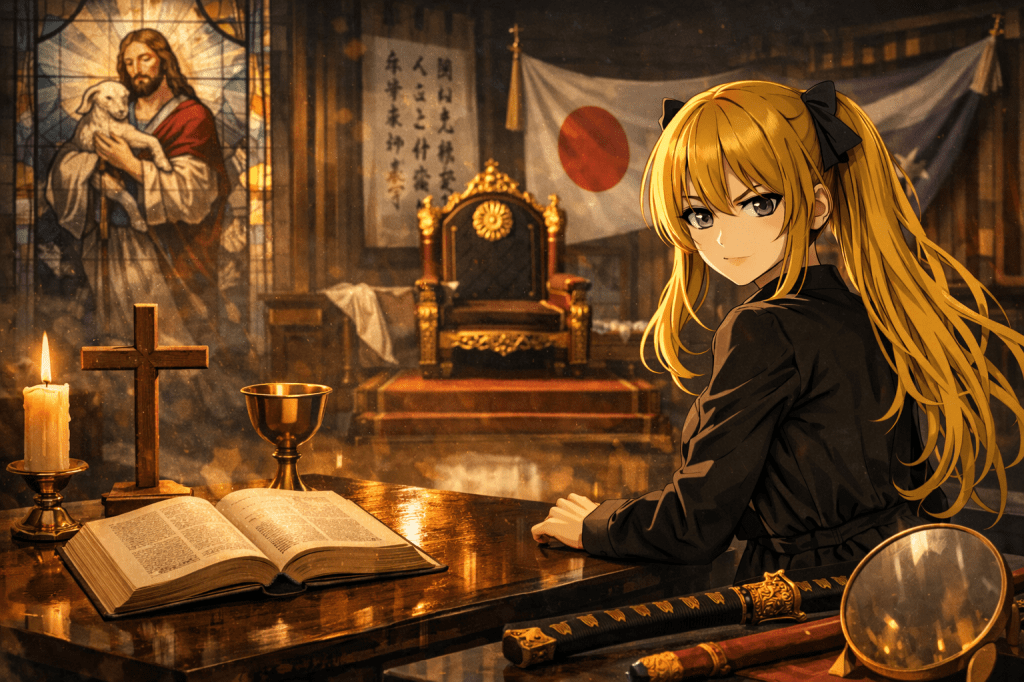
I am Iris. Urban legends are not mere fabrications— I am the storyteller who traces the unspoken truths with you.
- Postwar Japan did produce real points of contact between the Imperial Household and Christianity.
- But real contact is not the same thing as proving a hidden imperial-Christian lineage.
- The real fascination lies in how a few historical touchpoints can generate an enormous myth.
Why This Theme Refuses to Die
Few motifs are more seductive than the possibility that two sacred story systems were never truly separate.
On one side, the Japanese emperor as a figure of continuity, ritual, and mythic kingship.
On the other, Christ as the center of Western salvation history.
If even a small historical bridge can be found between them, imagination immediately tries to turn that bridge into a tunnel.
That is why this topic survives.
Not because the evidence is simple,
but because the symbolism is irresistible.
The Historical Contact That Can Actually Be Grounded
This is where the distinction matters.
Postwar scholarship notes that there were concrete points of contact between the Imperial Household and Christianity.
The existence of Bible study activity at the Imperial Palace is one example often mentioned.
Another is Elizabeth Gray Vining, the Quaker educator who taught Crown Prince Akihito English after the war.
Those are real touchpoints.
They matter.
But they do not automatically mean secret conversion, hidden doctrine, or concealed theological identity.
A contact point is still only a contact point.
The Meiji-Era Possibility That Never Became Reality
The story becomes even more interesting when one moves back into the late nineteenth century.
In the era of rapid Westernization, there were voices arguing that Christianity should become the state religion and that the emperor should lead by receiving baptism.
This did not happen.
But the fact that such a possibility was voiced at all is historically revealing.
Urban legends do not grow only from what occurred.
They also grow from roads history almost—but not quite—seemed able to take.
Where the Urban-Legend Leap Begins
From here, the material becomes less about evidence and more about interpretive desire.
The Yata Mirror and alleged Hebrew inscriptions.
The idea of the Lost Tribes reaching Japan.
The claim that Japanese myth echoes the structure of the Christ story.
The suggestion that sacred kingship in Japan preserves a hidden parallel to biblical sovereignty.
These are not all the same kind of claim.
Some are symbolic readings.
Some are comparative mythology.
Some are outright lineage myths.
What unites them is not proof.
It is gravitational pull.
Why Japanese Myth and Biblical Narrative Seem to Overlap
Part of the appeal comes from pattern recognition.
Chosen bloodlines.
Sacred legitimacy.
Ritual continuity.
Divine mandate.
Light, restoration, order, and a nation anchored by a story larger than itself.
Similarity does not equal descent.
But similarity is enough to trigger mythmaking.
Once people feel that two narrative systems rhyme,
they begin to suspect that they once shared a hidden root.
This is where comparison turns into destiny.
Why the Story Still Feels Powerful Now
Modern people often do not want institutions alone.
They want meaning behind institutions.
They want a code behind continuity.
They want a hidden architecture beneath visible tradition.
The Japanese imperial line is old enough, symbolic enough, and ritualized enough to attract exactly that kind of projection.
Christianity, meanwhile, carries a powerful language of revelation, hidden truth, sacred descent, and salvific history.
When even a small real-world overlap appears between the two, the imagination rarely leaves it small for long.
The Urban-Legend Reading
In urban-legend circles, the Emperor-Christ theme is rarely treated as a narrow historical question.
It is treated as a possible crossing point of sacred genealogies:
Western redemption history,
Japanese mythic kingship,
and the dream that the world’s oldest symbols are secretly connected beneath the surface.
That does not make it historically established.
But it does explain why the motif feels stronger than a simple rumor.
A total fabrication can entertain.
A half-grounded myth can possess.
Iris’s Reading
What can be grounded is that the Imperial Household and Christianity did have historical points of contact.
What cannot be honestly claimed is that those contacts automatically prove a hidden line from emperor to Christ.
So the better question is not,
“Are they secretly one lineage?”
The better question is,
“Why do a few historical touchpoints generate such an enormous sacred narrative?”
In urban-legend circles, it is often said that the strongest myths are not those built from nothing.
They are built from one or two stubborn facts,
surrounded by a vast field of longing, pattern, and interpretation.
Perhaps that is why this theme keeps returning.
Not because the secret has been proved,
but because the structure of the story is too powerful to let go.
Next time—another fragment of truth we will trace together. I will return to continue the telling.
References (academic / background)
- Osaka International University | On postwar Bible study activity at the Imperial Palace and the Imperial Household’s contact with Christianity
- Sophia University | Quiet Pilgrim: Elizabeth Gray Vining
- Britannica | Akihito
- Kyushu University | On debates in the Meiji era about the imperial family’s religion and the possibility of imperial baptism
English articles are published at 23:00 JST.
If you have a royal mystery, sacred-lineage rumor, origin legend, or “this myth and that myth look too similar” topic, send it in.
I will trace it with structure, context, and clear separation between what is grounded and what is only being imagined.

コメントを残す