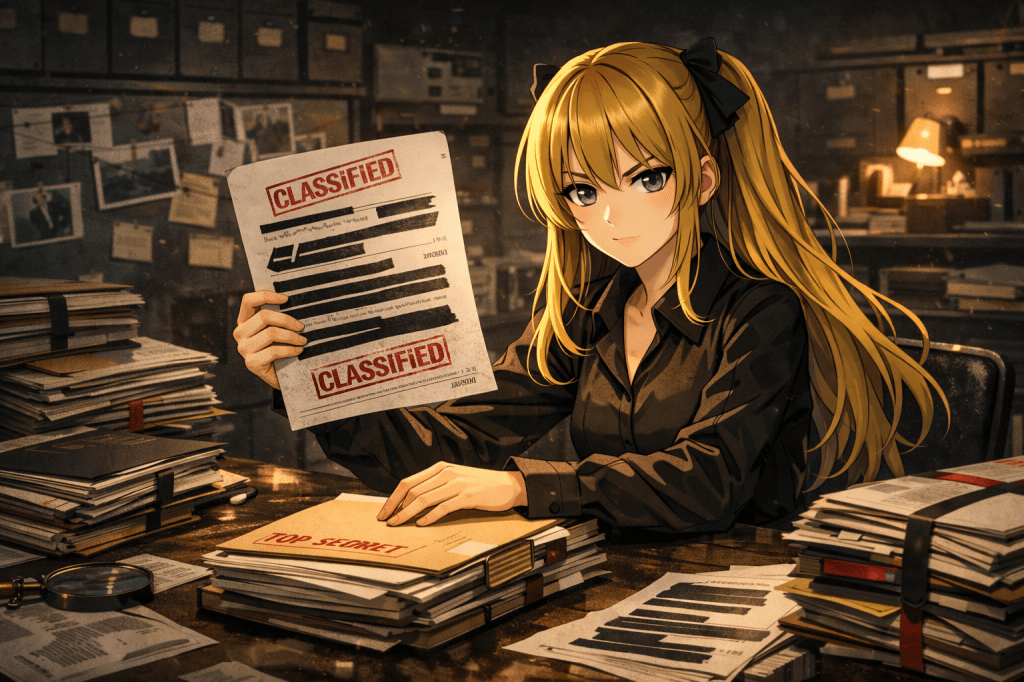
I am Iris. Urban legends are not mere fabrications— I am the storyteller who traces the unspoken truths with you.
- The 2025 first-phase disclosure looked less like a total revelation and more like a formal release of material already known in fragments.
- In January 2026, the Justice Department published roughly 3.5 million responsive pages, alongside large volumes of video and image files.
- Yet what fuels the urban-legend machine is not only what was disclosed, but what still feels missing, blurred, delayed, or structurally withheld.
Why the Epstein Files Are Burning Again
The Epstein story has long operated as a magnet for elite-network speculation.
But the current wave is not simply a recycled scandal.
It is a disclosure story now.
Once the state begins releasing material in phases, the narrative changes.
People stop asking only,
“What happened?”
and begin asking,
“What is being shown, in what order, and under what control?”
That is why this story still grips readers.
It is no longer only about crime.
It is also about visibility.
What the 2025 First Phase Really Was
The first point worth separating is the idea of “first reveal.”
The 2025 first phase carried that emotional weight, but in practice it was closer to a formal government publication of records that had already circulated in partial or unofficial ways.
That does not make it meaningless.
Formal release matters.
But it does mean the event was not identical to discovering a brand-new hidden archive from scratch.
So the first mistake is to treat every disclosure headline as if it marks a totally fresh truth event.
Sometimes it marks institutional confirmation more than radical novelty.
What Changed in January 2026
The January 2026 release changed the scale.
Millions of pages.
Thousands of videos.
Hundreds of thousands of images.
At that point, the story became too large to consume as scandal alone.
It turned into a problem of sorting.
What was genuinely new?
What merely expanded known material?
What remained fragmentary?
What had been redacted, delayed, corrected, or removed and re-reviewed?
That is where rumor becomes stronger, not weaker.
Because overwhelming disclosure does not always produce clarity.
Sometimes it produces a new kind of fog.
What Is Actually New?
This is the place where the temperature should drop.
The strongest article is not the one that treats every known name as a revelation.
That approach only feeds circulation without understanding.
The more useful reading is structural:
- What did the government define as releasable?
- What remained redacted and why?
- What publication errors or review failures occurred?
- How did the disclosure process itself become part of the story?
In other words, the files are not only about Epstein.
They are also about the mechanics of public transparency under pressure.
Why It Still Feels Hidden Even After Release
This is the real center of the article.
The files were released.
The archive is huge.
And yet many readers still feel that the “real core” remains offstage.
That feeling does not come from nothing.
Redactions do that.
Botched redactions do that even more.
Missing files, corrections, delayed pages, and removed items all intensify the sense that visibility is being managed rather than simply granted.
In urban-legend circles, it is often said that the truth is not always inside the line that can be read.
Sometimes it hides inside the line that was blacked out.
That is why this story keeps moving.
Disclosure did not end speculation.
It reorganized it.
The Urban-Legend Reading
In urban-legend circles, the Epstein case is often treated not merely as a criminal case, but as a symbolic intersection of wealth, access, silence, and selective visibility.
That does not justify every claim attached to it.
But it explains why partial release can feel more explosive than total silence.
A sealed archive is one kind of mystery.
A partially opened archive is another.
The second kind is often more powerful, because it gives the imagination something to grip.
Iris’s Reading
What can be grounded at this stage is that disclosure has indeed advanced.
What cannot be honestly claimed is that scale alone has made the full truth visible.
So the deeper question is not simply,
“Who appears in the files?”
It is also,
“How does a state disclose damaging material while still controlling the terms of visibility?”
In urban-legend circles, it is often said that the most unsettling document is not the one that tells you everything.
It is the one that tells you enough to know there is still more behind it.
Perhaps that is why the Epstein files continue to burn.
Not because nothing was released,
but because the release itself has become part of the mystery.
Next time—another fragment of truth we will trace together. I will return to continue the telling.
References (primary / major reporting)
- U.S. DOJ | First Phase of Declassified Epstein Files (2025/02/27)
- U.S. DOJ | 3.5 Million Responsive Pages Published (2026/01/30)
- U.S. DOJ | First Phase of Declassified Epstein Files Archive
- AP | Justice Department releases more Epstein files
- PBS | Government says it is fixing documents that may have contained victim information
English articles are published at 23:00 JST.
If there is a document dump, leaked archive, blacked-out file, or story that feels “half-shown on purpose,” send it in.
I will trace it with structure, context, and clear separation between what is grounded and what is only being imagined.

コメントを残す