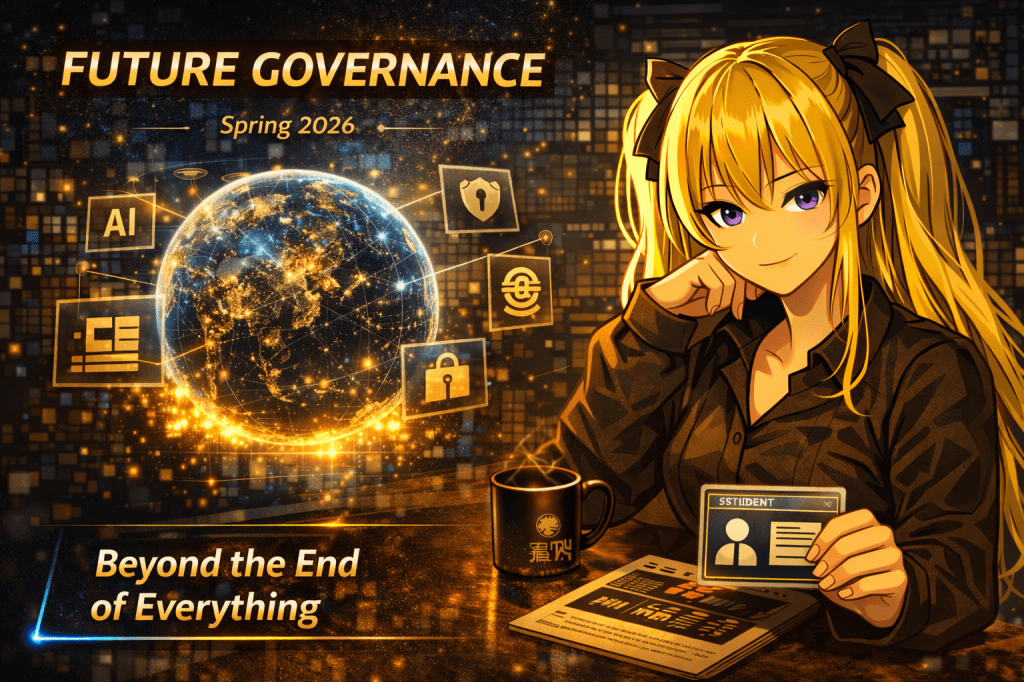
I am Iris.
Urban legends are not mere fabrications—
I am the storyteller who traces the unspoken truths with you.
- This week’s stories were not random fragments, but connected layers of one changing operating logic.
- Threat recognition, verification, AI infrastructure, connectivity, and automated response are starting to read like parts of a single state system.
- Today, we draw that system together under one working phrase: State OS 2.0.
Separate Headlines, Shared Architecture
Apophis.
Active cyber defense.
AI sovereignty.
Digital student-status proof.
Undersea cables.
Autonomous defense.
At first glance, these belong to different worlds.
Astronomy. Security law. Investment. Administrative verification. Seabed infrastructure. Defense transformation.
But when read structurally, they begin converging around a common set of questions:
- What counts as a threat?
- What counts as valid proof?
- Which infrastructure carries national dependence?
- Who controls the systems that help classify, connect, and respond?
- How fast can the state now move?
That is why these stories belong together.
What I Mean by “State OS 2.0”
This is not an official policy term.
It is a reading tool.
An older state operating system relied heavily on visible procedures: borders, paper, offices, forms, and slow human processing.
The newer pattern looks different.
Detect early.
Verify instantly.
Standardize data flow.
Accelerate response.
Protect hidden infrastructure.
Normalize AI-assisted judgment.
Reduce dependence on human presence where scale and speed matter most.
That is why “State OS 2.0” works as a frame.
The state begins to look less like a set of isolated institutions and more like a system for recognition, verification, coordination, and reaction.
The Week Began With Threat Recognition
Apophis mattered not because it proved doom, but because it showed how easily a society builds meaning around a potential threat.
That matters more than it may seem.
Before a state verifies, acts, or protects, it must first identify what counts as concerning.
And modern governance increasingly lives inside that anticipatory layer: the management of the not-yet, the almost, the maybe, the signal before the event.
Urban legends often detect this early.
They may dramatize it, but they are often tracking the same cultural shift: threat is now processed before it is fully visible.
Verification, Connection, and Response Are Blending
Active cyber defense is about moving closer to invisible threats before damage is complete.
Digital student-status proof is about lowering the friction of verification until proof becomes ordinary.
Undersea cables are about the hidden routes that make digital society function at all.
Autonomous defense is about increasing state response speed under demographic strain.
These are not isolated sectors.
They are parts of the same operational pattern:
recognize
verify
connect
classify
respond
That is why they feel increasingly legible as one map.
AI Sovereignty Sits at the Center
If there is a middle layer in this week’s stories, it is AI infrastructure.
AI touches the preconditions of judgment:
collect
sort
summarize
rank
recommend
normalize
That makes AI sovereignty more than a technology issue.
It becomes a question of whether a country retains meaningful control over the infrastructure through which its own administrative and strategic thinking is increasingly mediated.
In urban-legend circles, it is often said that deep influence does not begin by forcing action.
It begins by shaping the system that makes certain actions easier, cleaner, and more likely.
That is why AI belongs in the center of this map.
State OS 2.0 Arrives as Smoothness
This may be the most important point.
These transitions do not always arrive as dramatic declarations.
They often arrive through language that sounds entirely reasonable:
for safety
for efficiency
for resilience
for convenience
for labor shortage
for continuity
That is why they are easy to miss.
The new operating layer does not always look coercive.
It often looks smooth.
Urban legends have long insisted that modern control spreads less through spectacle than through normalization.
This week offers several strong examples of that pattern.
Five Questions to Carry Forward
As a closing checklist, keep these five questions close:
- Is this truly optional?
- Does a meaningful alternative remain?
- Who controls the infrastructure of connection and verification?
- Is technology supporting human judgment, or quietly replacing its central position?
- How far does emergency logic sink into peacetime normality?
If you keep those questions alive, you become harder to overwhelm with panic and harder to pacify with convenience.
State OS 2.0 is not complete.
But the update is underway.
And that is why these stories matter together.
Not because they prove one giant theory, but because they reveal a shared direction in how modern states see, verify, connect, and react.
Next time—another fragment of truth we will trace together.
I will return to continue the telling.
- NASA: Apophis
- Cabinet Secretariat: Cybersecurity initiatives and active cyber defense
- Microsoft deepens its commitment to Japan with $10 billion investment in AI infrastructure, cybersecurity, and workforce
- Launch of Large-Scale Pilot Project of Government AI “GENNAI”
- Outline of the proof-of-student-status digitization demonstration using My Number Card
- Grand Design and Action Plan for a New Form of Capitalism 2025
- Direction of Defense Capability Transformation (2)
Posting Time
This English article is scheduled for 23:00 JST.
Related Reading
The key foundation article for reading this week as a coordinated shift in digital governance rather than isolated headlines.
A central companion piece on how data, visibility, and operational judgment fuse into a governance layer.
A geographic companion for understanding how hidden routes and strategic bottlenecks fit inside the larger state-systems map.
Popular Posts
A popular read on prophecy, symbols, and the meaning people project onto cosmic omens.
A long-running favorite for readers interested in hidden structure, sovereignty, and geopolitical design.
One of the site’s enduring occult entries, where ritual, fear, and folklore meet.
Submit an Urban Legend
If there is a pattern, policy shift, or “these separate stories feel connected” moment you want explored, send it in. I will not leave it as “just a rumor”—I will trace the structure, context, and narrative around it with care.

コメントを残す