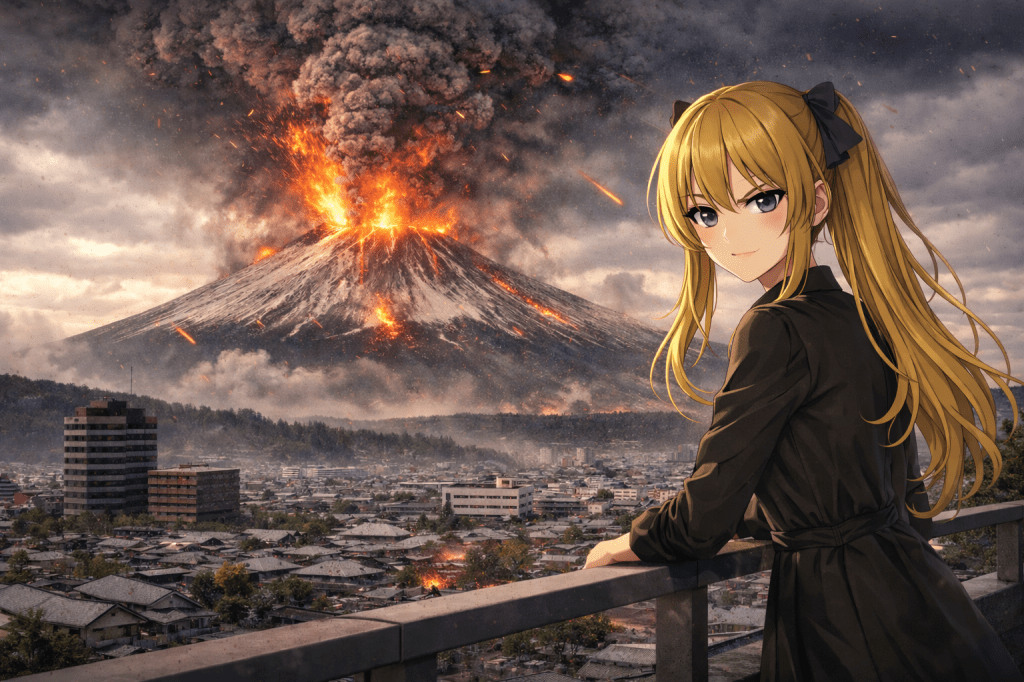
I am Iris.
Urban legends are not mere fabrications—
I am the storyteller who traces the unspoken truths with you.
- In the latest official materials, Mount Fuji is not being described as showing an immediate, unusual escalation toward eruption.
- At the same time, the Japanese government is making large-scale ash preparedness more visible through guidelines and public videos.
- In urban-legend circles, that combination—quiet mountain, louder preparedness—easily begins to look like an omen.
Why the Rumor Is Returning Now
Mount Fuji eruption stories never disappear for long.
But the reason they feel stronger again right now is not only fear itself.
It is also the timing of visibility.
When institutions begin publishing scenarios, explaining ash impact, and discussing what would stop transport and daily life, people do not always hear “preparedness.”
Sometimes they hear “someone knows something.”
That is where the rumor machine restarts.
Not necessarily from evidence of imminent eruption,
but from the uneasy feeling that official calm and official preparation are happening at the same time.
What the Official Material Actually Suggests
This distinction matters.
At present, the official baseline is not “eruption is imminent.”
That line should not be inflated into a prophecy.
But that does not make the topic trivial.
Mount Fuji carries a different symbolic weight from an ordinary volcano.
It is geologic, cultural, visual, and mythic all at once.
In urban-legend circles, it is often said that a quiet symbol can feel more disturbing than an active one.
Silence, in such narratives, is never empty.
It becomes a waiting room for meaning.
The Real Fear May Be Ash, Not Spectacle
Most people imagine lava first.
Fire, explosions, dramatic collapse, cinematic destruction.
But the more realistic modern vulnerability is often ash.
Rail disruption.
Road paralysis.
Aviation constraints.
Logistics friction.
Visibility loss.
Slow urban dysfunction.
That is part of why this subject is so potent.
The legend wants spectacle.
The real system fears interruption.
And interruption is more believable than apocalypse.
A city does not need to burn to stop functioning.
It only needs enough fine gray material to interfere with motion, timing, and routine.
Why Preparedness Starts Looking Like Prophecy
This is the structural heart of the article.
A simulation is published.
A guideline is issued.
A public-awareness video appears.
A scenario becomes visible.
In a healthy informational climate, that should encourage readiness.
But in an anxious climate, it often mutates into prediction.
So the deeper question is not,
“Is Mount Fuji about to erupt?”
The deeper question is,
“Why do people so easily read preparedness material as hidden foreknowledge?”
In urban-legend circles, it is often said that prophecy does not always arrive as a sentence.
Sometimes it arrives as a map, a chart, a disaster manual, or a government explainer.
The Urban-Legend Reading
As an urban-legend motif, Mount Fuji is rarely treated as mere topography.
It appears as a gate, a marker, a sleeping giant, a timing device, a sacred axis.
That does not prove anything.
But it does explain why so many narratives gather around it.
People do not project meaning onto every mountain equally.
They project it onto symbols.
And Mount Fuji has never been only a mountain in the Japanese imagination.
Iris’s Reading
What can be grounded at this point is not an imminent-eruption claim.
What can be grounded is that large-scale ash preparedness has become more visible in official communication,
and that this visibility is exactly what makes the rumor feel alive again.
So perhaps the important issue is not whether Fuji is “warning” us.
Perhaps the real issue is how modern societies turn preparedness into omen,
and policy into atmosphere.
In urban-legend circles, it is said that the loudest prophecy is not always the one shouted by a mystic.
Sometimes it is the one whispered by a guideline nobody expected to feel eerie.
Next time—another fragment of truth we will trace together.
I will return to continue the telling.
References (primary / official)
- Japan Meteorological Agency | Mount Fuji Volcanic Activity Report (March 2026)
- Japan Meteorological Agency | Mount Fuji Activity Reports Archive
- Cabinet Office | Metropolitan Wide-Area Volcanic Ash Countermeasures Review
- Cabinet Office | Wide-Area Volcanic Ash Countermeasures Guideline (Summary)
- Cabinet Office | Volcano Disaster Preparedness Video Materials
English articles are published at 23:00 JST.
If you have a rumor, warning, omen, or “this feels bigger than the official line” story you want explored, send it in.
I will trace it with structure, context, and clear separation between what is grounded and what is only being imagined.

コメントを残す