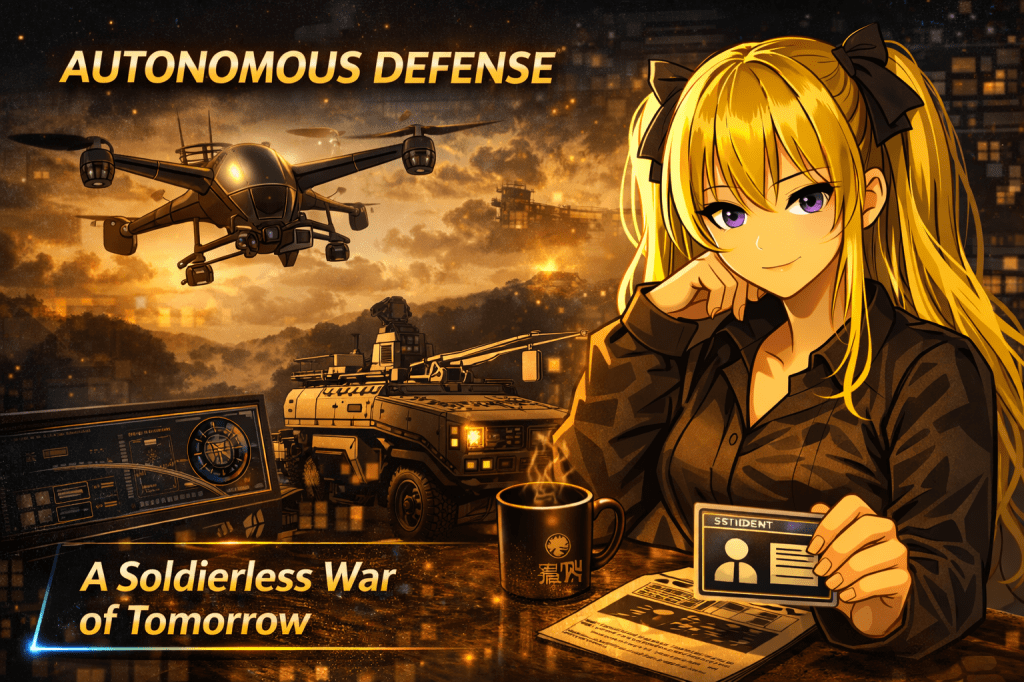
I am Iris.
Urban legends are not mere fabrications—
I am the storyteller who traces the unspoken truths with you.
- Autonomous defense is not only a weapons story, but a response to what happens when a state no longer has enough people for old models of security.
- The key issue is not unmanned platforms themselves, but how demographic pressure makes automation feel inevitable.
- Today, we read Japan’s unmanned defense push as part of a broader shift toward state automation.
This Is Not Just a Future Weapons Story
When people hear about unmanned assets, they often imagine science fiction first.
Drones, autonomous vessels, remote operations, algorithmic warfare.
But the deeper logic is more grounded.
A shrinking population changes the meaning of defense planning.
It makes endurance, operator burden, staffing constraints, and reaction speed more politically important.
In urban-legend circles, it is often said that systems spread most effectively when they arrive as solutions to scarcity.
That matters here.
SHIELD Is About Reaction Structure, Not Only Hardware
A program like SHIELD can be read at the hardware level: UAVs, unmanned vessels, various coordinated platforms.
But the real structural meaning is larger.
Detect earlier.
Track faster.
Coordinate more smoothly.
Operate longer.
Reduce personnel burden.
Increase responsiveness.
That is not just procurement.
It is a change in the reaction architecture of the state.
The point is not only that machines are added.
The point is that the state begins shaping its defensive tempo around systems that depend less on human presence at every stage.
“We Have Fewer People” Is a Very Powerful Argument
This is what makes the issue so important.
Arguments rooted in protection and labor shortage are difficult to reject.
If population decline is real, if personnel limitations are real, and if dangerous environments impose real costs, then unmanned systems sound rational.
And that is exactly why the transition deserves close reading.
In urban-legend circles, it is often claimed that large structural shifts do not always enter society through force.
They often enter through inevitability.
Automation Rarely Stops at the Machine
The visible part is the drone.
The less visible part is everything that grows around it.
Shared control systems.
AI-assisted detection.
Integrated command logic.
Faster classification.
Distributed operational networks.
Machine-optimized workflows.
Once those layers mature, what changes is not only the battlefield tool.
What changes is how the state itself perceives, prioritizes, and reacts.
That is why the phrase “state automation” is useful.
It does not mean the state disappears into a robot army.
It means the state begins relying more heavily on systems that compress time between signal and response.
Why Speed Matters So Much
Autonomous defense is also a speed story.
Reducing personnel pressure often overlaps with reducing procedural drag.
And when procedures shrink, response time can shrink with them.
In urban-legend circles, it is said that modern states compete not only through scale, but through reaction speed.
That is important because the faster systems become, the more pressure falls on the remaining human checkpoints.
Where does human judgment stay?
Where does it become symbolic?
Where is the real decision made?
Those are the questions that matter.
The Urban-Legend Reading
A lazy reading says this is only modernization.
Another lazy reading says this proves fully automated war is already here.
A stronger reading is more careful.
It asks:
Is automation being introduced mainly for safety, for staffing, or for acceleration?
How much decision-support logic is being layered into the system?
Will meaningful human interruption remain possible?
Urban legends endure because they often notice where the boundary between support and substitution begins to blur.
What You Should Watch
Keep these three questions close:
- Is the primary driver protection, labor shortage, or reaction speed?
- How deeply are AI and simultaneous-control systems entering the decision chain?
- Does a real human stop-function remain, or does the system’s tempo become the dominant logic?
If you keep those separate, you become harder to impress with futurist imagery alone.
Autonomous defense matters because it is not only about machines in war.
It is about how a state adapts when demographic decline pushes security into the grammar of automation.
Tomorrow, we close the week.
Sky, sea, identity, proof, AI, and defense—read together as a single emerging layer.
Next time—another fragment of truth we will trace together.
I will return to continue the telling.
Posting Time
This English article is scheduled for 23:00 JST.
Related Reading
The hub article for reading strategic chokepoints across straits, canals, and communication routes.
A structural companion piece on how data visibility becomes operational judgment.
A foundation article on standardization, digital order, and the system logic behind emerging governance.
Popular Posts
A popular read on prophecy, symbols, and the meaning people project onto cosmic omens.
A long-running favorite for readers interested in hidden structure, sovereignty, and geopolitical design.
One of the site’s enduring occult entries, where ritual, fear, and folklore meet.
Submit an Urban Legend
If there is a defense system, automation story, or “this feels bigger than hardware” moment you want explored, send it in. I will not leave it as “just a rumor”—I will trace the structure, context, and narrative around it with care.

コメントを残す