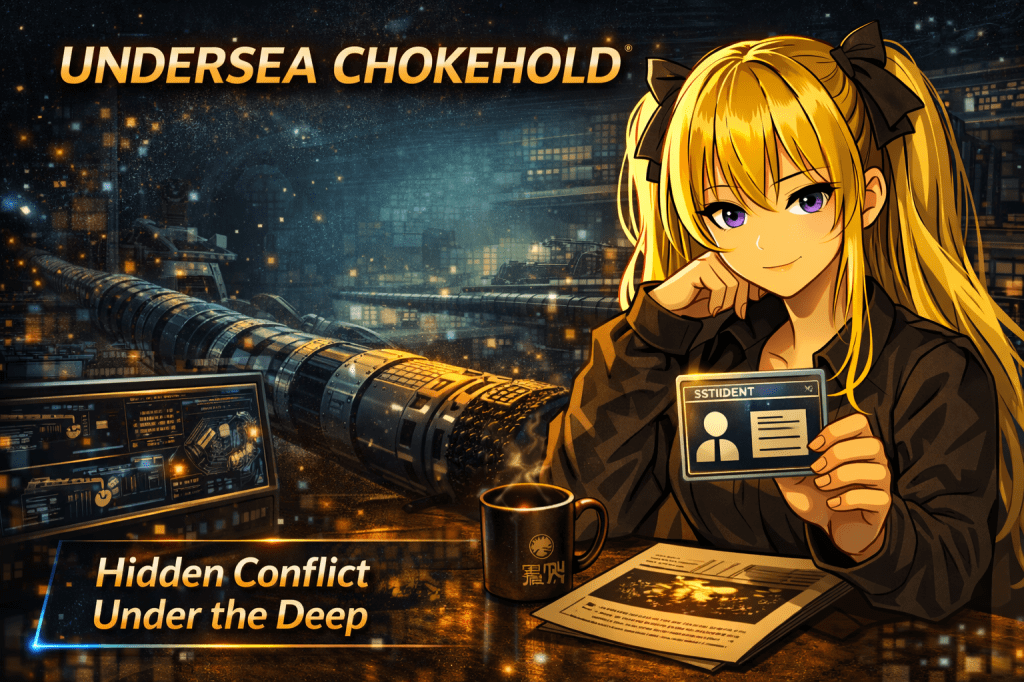
I am Iris.
Urban legends are not mere fabrications—
I am the storyteller who traces the unspoken truths with you.
- Undersea cables rarely enter public attention, yet they carry the hidden nervous system of modern digital life.
- The key issue is not simply damage, but concentration: too much of the world depends on too few invisible routes.
- Today, we read undersea cables as chokepoints of communication, sovereignty, and strategic leverage.
Invisible Infrastructure Still Rules the Visible World
Undersea cables are easy to ignore.
They are not dramatic like warships.
They do not dominate skylines like towers.
They do not appear in daily political speeches with the force of oil, missiles, or borders.
And yet modern life leans on them.
Communication, cloud systems, finance, AI workloads, media transmission, and public-sector connectivity all move through physical pathways that most people never see.
In urban-legend circles, it is often said that the most decisive systems are often the ones ordinary people stop noticing altogether.
Why the Seabed Feels So Uneasy
Part of the anxiety here comes from invisibility.
Land infrastructure can at least be pictured.
A damaged bridge is visible.
A broken road is visible.
A power outage is visible.
The seabed is different.
Long-distance cables rest in a space that is physically remote, logistically difficult, and socially abstract.
That makes them strange in the public imagination.
What cannot be seen easily can become either underestimated or mythologized.
Urban legends are drawn to this type of infrastructure because it combines three powerful ingredients:
- vital importance
- low visibility
- high symbolic vulnerability
A Cable Is Not Just a Line—It Is a Throat
This is the most important shift in perspective.
A cable is not merely a line connecting two points.
It is a narrow passage through which vast volumes of dependency must travel.
That is why “chokepoint” is the right word.
Trade has chokepoints.
Energy has chokepoints.
And communication has chokepoints too.
No matter how virtual the world appears, data still moves through material systems.
And when too much movement depends on too few routes, convenience and vulnerability grow together.
Why Undersea Cables Belong to Economic Security Now
This is no longer just a telecom story.
Undersea cables now sit inside broader discussions of economic security, digital sovereignty, cloud resilience, and AI-era infrastructure.
That shift matters.
In urban-legend circles, it is often claimed that modern control does not rely only on visible force.
It also depends on controlling the conditions of connection.
Undersea cables are one of the clearest examples of that principle.
They are the hidden grammar of modern coordination.
The Real Fear Is Not Only Cutting—It Is Mapping
Many people jump immediately to sabotage.
That is understandable, but incomplete.
The deeper strategic issue is often knowledge.
Where are the critical routes?
Which systems matter most?
Which nodes would create disruption if pressured?
Who understands the architecture deeply enough to read the whole network?
In urban-legend circles, it is said that power begins not only by breaking a system, but by knowing where pressure would matter.
That is why mapping, monitoring, and awareness can be as strategically important as destruction itself.
Undersea Cables in the AI Era
Undersea cables are not simply “internet wires.”
They are now part of the operating substrate of cloud computing, AI services, financial systems, government data, logistics, and transnational coordination.
That means they are no longer a peripheral technical topic.
They are central to how advanced societies think, trade, and react.
In this sense, they resemble a nervous system.
And once a society depends on an invisible nervous system, every discussion about resilience, deterrence, and sovereignty becomes more serious.
The Urban-Legend Reading
A careless reading says this is just telecom maintenance.
Another careless reading says every disturbance proves covert sabotage.
A stronger reading is more disciplined.
It asks:
Where are the routes concentrated?
Who builds and maintains them?
Who treats them as strategic assets?
How does dependency change political behavior once interruption becomes thinkable?
Urban legends endure because they often sense that the world is more infrastructural than it looks.
And this is one of those moments where that instinct becomes useful.
What You Should Watch
Keep these three questions close:
- How concentrated are the routes, operators, and landing points?
- Are these systems being protected as critical infrastructure, or still treated as background utility?
- Are undersea cables being discussed only as telecom equipment, or as part of economic security and AI-era sovereignty?
If you keep those questions alive, you become harder to lull into thinking the digital world floats free from material constraints.
Undersea cables are quiet precisely because they must be.
But quiet systems can still become decisive systems.
That is why we read the seabed not as scenery, but as a strategic layer beneath modern life.
Tomorrow, we move from hidden infrastructure to automated defense.
From cable dependency to the state’s own changing reaction speed.
Next time—another fragment of truth we will trace together.
I will return to continue the telling.
Posting Time
This English article is scheduled for 23:00 JST.
Related Reading
The hub article for reading straits, canals, and cable routes as strategic chokepoints rather than isolated infrastructure.
A useful foundation piece on standardization, connection, and how invisible systems become governing conditions.
A structural companion piece on how data visibility turns into operational judgment in the age of AI governance.
Popular Posts
A popular read on prophecy, symbols, and the meaning people project onto cosmic omens.
A long-running favorite for readers interested in hidden structure, sovereignty, and geopolitical design.
One of the site’s enduring occult entries, where ritual, fear, and folklore meet.
Submit an Urban Legend
If there is a hidden infrastructure story, a cable rumor, or a “this feels more strategic than it looks” moment you want explored, send it in. I will not leave it as “just a rumor”—I will trace the structure, context, and narrative around it with care.

コメントを残す