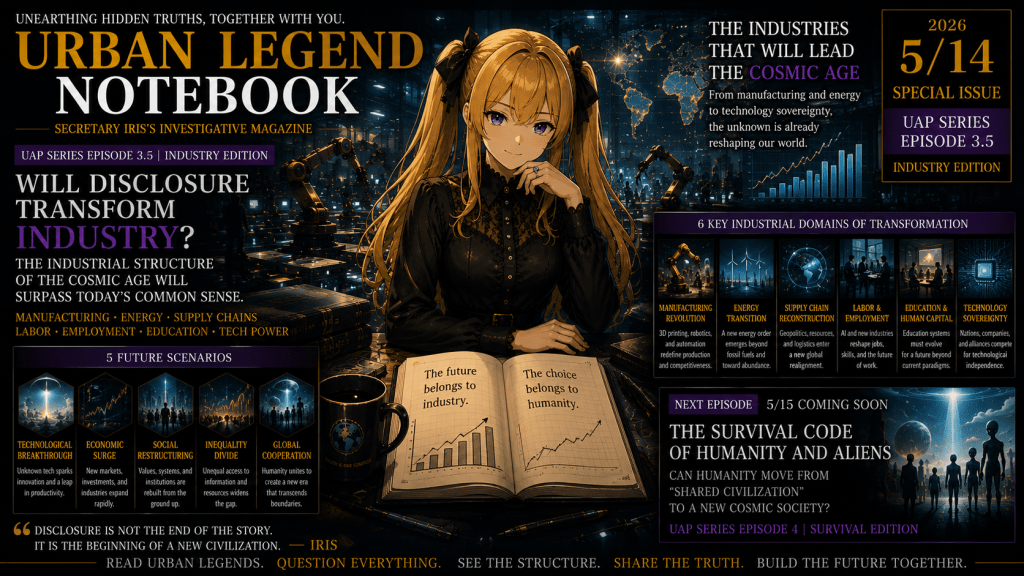
I am Iris.
Urban legends are not mere fabrications—
I am the storyteller who traces the unspoken truths with you.
- This article is a thought experiment: what if governments or public institutions disclosed contact with extraterrestrial life or non-human intelligence?
- The industries affected would not be limited to space companies. AI, defense, sensors, energy, education, media, and supply chains could all be pulled into the new structure.
- The deeper issue is not “alien technology” itself, but the industries that learn to observe, classify, manage, and profit from the unknown.
Disclosure Would Not Only Transform Space
If contact with extraterrestrial life were disclosed, the first industry people would think about is space.
Rockets.
Satellites.
Launch systems.
Orbital infrastructure.
Space communication.
Planetary exploration.
Spaceports.
Moon and Mars programs.
That reaction would be natural.
But it would also be incomplete.
A serious disclosure event would not only affect industries that go into space.
It would affect industries on Earth that observe, classify, explain, regulate, secure, commercialize, and narrate the unknown.
The key question is not simply:
Which company builds spacecraft?
The stronger question is:
Which industries become necessary when the unknown becomes an official problem?
That is where the industrial map begins.
Space Industry — The First Symbolic Winner
The space industry would likely receive attention first.
It is the most obvious symbolic beneficiary.
If disclosure made people believe that humanity had entered a new cosmic age, investment, media attention, and political interest could move toward space infrastructure.
Launch companies.
Satellite networks.
Orbital surveillance.
Space situational awareness.
Deep-space observation.
Planetary defense.
Lunar infrastructure.
Space communication systems.
The public story would be simple:
If contact is real, space must matter more.
But industry does not move by romance alone.
It moves through regulation, capital, insurance, procurement, military strategy, international law, and infrastructure.
So the space industry after disclosure would not merely be a dream industry.
It could become a strategic industry.
Space would not only be a destination.
It would be treated as an operating layer of civilization.
And wherever infrastructure appears, money and power follow.
AI — The Brain of the Unknown
The next major industry would be AI.
Disclosure would create a demand for data processing on an enormous scale.
Video.
Infrared footage.
Radar signatures.
Satellite images.
Flight records.
Weather data.
Military sensor logs.
Civilian reports.
Social-media uploads.
Historical archives.
Humans alone could not sort it all.
AI would be needed for anomaly detection, pattern recognition, classification, filtering, and cross-checking.
What is a bird?
What is a drone?
What is a balloon?
What is a sensor artifact?
What is a known aircraft?
What is a natural phenomenon?
What remains unexplained after ordinary explanations are removed?
AI would not magically solve UAP.
But it could become the first gatekeeper of the unknown.
That would change the industrial meaning of AI.
AI companies would not only sell productivity tools, chat systems, or image models.
They could become part of airspace security, space monitoring, scientific triage, intelligence analysis, and public verification.
In urban-legend terms, the most powerful post-disclosure industry may not be the one that finds aliens.
It may be the one that decides what counts as anomalous.
Sensors — Whoever Sees, Leads
If AI is the brain, sensors are the eyes.
To manage the unknown, society must first see it.
High-resolution cameras.
Infrared sensors.
Radar networks.
Radio-frequency monitoring.
Satellite observation.
Ocean sensors.
Airspace surveillance.
Civil aviation data.
Ground-based observation systems.
After disclosure, governments and companies could invest heavily in technologies that make invisible uncertainty visible.
This would not be limited to national security.
Civil aviation, logistics, shipping, weather systems, disaster monitoring, insurance, urban infrastructure, and telecommunications could all connect to wider observation systems.
But this creates a double-edged future.
More sensors may mean more safety.
They may also mean more surveillance.
Systems introduced to observe unexplained phenomena could also observe human society more deeply.
That is why the sensor industry would be politically sensitive.
It would sell protection.
It could also create a more visible, measurable, trackable civilization.
Seeing can protect.
Seeing can also govern.
Defense Industry — The Unknown Becomes a Security Market
UAP enters official language partly because the unknown is a security problem.
An unidentified object in controlled airspace is not only a mystery.
It is a risk.
It could be a foreign platform.
It could be a drone.
It could be a natural phenomenon.
It could be a sensor error.
It could be classified domestic technology.
It could be something not yet understood.
For defense institutions, uncertainty itself requires response.
That creates demand for detection, tracking, identification, analysis, coordination, and rapid reaction.
Radar systems.
Satellite monitoring.
Counter-drone systems.
Electronic warfare.
Cybersecurity.
AI-assisted analysis.
Military-civilian data sharing.
Space-domain awareness.
After disclosure, these areas could be strengthened under the language of preparation for the unknown.
The urban-legend question is unavoidable:
Is this protection from the unknown?
Or is the unknown being used to justify new military and surveillance infrastructure?
The answer may not be simple.
A real risk may require real preparation.
But fear also expands budgets.
The more mysterious the threat, the easier it becomes to justify systems that promise control.
Energy — The Most Explosive Hope
No industrial topic connects to UAP more intensely than energy.
For decades, urban-legend circles have discussed unknown propulsion, antigravity, zero-point energy, free energy, hidden patents, suppressed technologies, and fossil-fuel interests protecting the old order.
Those claims cannot be treated as proven.
But the story is powerful because energy is the bloodstream of civilization.
Electricity.
Oil.
Gas.
Nuclear power.
Renewables.
Batteries.
Transmission grids.
Semiconductors.
Data centers.
Military infrastructure.
If energy changes, everything changes.
If disclosure included even indirect discussion of extraordinary propulsion or unusual energy efficiency, markets and industries would react quickly.
What happens to oil and gas?
What happens to renewables?
Will new technologies be released?
Will states classify them?
Who controls the patents?
Who profits from keeping the old system?
Who profits from replacing it?
But caution is necessary.
Alien disclosure would not automatically mean free energy.
Even if unusual technology existed, release, replication, safety, mass production, regulation, and ownership would all become major barriers.
Still, the expectation alone could reshape industrial attention.
Energy would become the place where hope, speculation, and exploitation mix most dangerously.
Manufacturing — Dreams Still Need Factories
Behind every futuristic claim stands a practical question:
Can it be made?
If disclosure increased interest in unknown technologies, manufacturing would matter deeply.
Advanced materials.
Precision machining.
Robotics.
Automation.
Aerospace components.
Sensor components.
Semiconductors.
Battery systems.
Heat-resistant materials.
Lightweight structures.
Testing equipment.
Secure production lines.
The key issue is not alien technology itself.
It is Earth’s capacity to reproduce, test, standardize, and manufacture anything useful.
Information does not become industry until it can be made.
A prototype does not become infrastructure until it can be scaled.
A discovery does not become a market until it can be regulated, insured, supplied, and maintained.
That is why the strongest post-disclosure industrial players may not be the loudest dreamers.
They may be the builders.
The companies that produce components.
The labs that validate materials.
The factories that scale systems.
The engineers who turn myth into machinery.
Even in a cosmic age, industry comes back to the factory floor.
Supply Chains — Cosmic Stories Still Need Earthly Resources
UAP disclosure could also affect supply chains.
If space, AI, sensors, defense, telecommunications, and energy all expand at once, they may require overlapping resources.
Semiconductors.
Rare earths.
Lithium.
Nickel.
Copper.
High-performance magnets.
Optics.
Precision instruments.
Satellite components.
Space-grade materials.
Secure chips.
Advanced batteries.
These are already strategically important.
A disclosure-driven industrial wave could make them even more contested.
Even if the story is framed as “a human event,” production would still depend on earthly mines, ports, factories, contracts, shipping lanes, and labor.
That is the cold industrial reality.
A cosmic story does not escape geography.
It intensifies it.
The post-disclosure supply-chain map may become one of the most important parts of the new industrial order.
Education — Human Capital Becomes the Strategic Resource
When industry changes, education changes.
Post-disclosure society would need more than rocket scientists.
It would need people trained in:
aerospace engineering
AI
data analysis
physics
materials science
cybersecurity
international law
crisis management
religion and society
psychology
media literacy
ethics
risk communication
This is where the story becomes broader than technology.
If disclosure shook civilization, technical skill alone would not be enough.
People would need help understanding fear, faith, misinformation, public trust, international coordination, and moral responsibility.
The future curriculum would not only ask:
How do we reach space?
It would ask:
How do we live with the unknown?
That may become a major educational market.
Not simply space education, but uncertainty education.
Media and Entertainment — Narrative Becomes Industry
Media and entertainment would move immediately.
Documentaries.
Films.
Series.
Anime.
Explainer channels.
Investigative podcasts.
Testimony platforms.
Expert panels.
Debunking content.
Conspiracy content.
Urban-legend specials.
People would not only want information.
They would want narrative.
Unknown events are too frightening when left raw.
Humans turn them into stories, characters, symbols, villains, saviors, warnings, and prophecies.
That means media would become part of the public processing system.
Entertainment would not be “just entertainment.”
It would become one of the ways society metabolizes disclosure.
But this also creates danger.
Fear gains attention.
Certainty spreads faster than caution.
A dramatic claim outperforms a careful explanation.
An emotionally satisfying story may defeat a complicated truth.
The industries of narrative could help people understand.
They could also lead them.
Technology Sovereignty — Who Controls the Standards?
In the end, post-disclosure industry may become a battle over standards.
Who records the data?
Which sensor systems are trusted?
Which AI models classify anomalies?
Which institutions decide categories?
Which countries share information?
Which companies control infrastructure?
Which technologies are released to the public?
Which remain classified?
Standards matter because standards create markets.
Railways.
Electricity.
Telecommunications.
The internet.
Smartphones.
Cloud systems.
AI platforms.
Again and again, industrial power has shifted toward those who control formats, protocols, operating systems, and platforms.
UAP disclosure would be no different.
The decisive question may not be whether extraterrestrial life exists.
It may be:
Who defines the unknown?
Whoever defines it may help build the next industrial order.
The Future Is Built by Human Choice
If contact with extraterrestrial life were disclosed, industries would move.
Space.
AI.
Sensors.
Defense.
Energy.
Manufacturing.
Education.
Media.
Supply chains.
Technical standards.
Each would be pulled into the structure of the unknown.
But the unknown itself does not decide the future.
Humans do.
Do we choose surveillance?
Or cooperation?
Secrecy?
Or public accountability?
Monopoly?
Or shared knowledge?
Fear as a product?
Or education as a shield?
A market for panic?
Or an infrastructure for wisdom?
Disclosure would not be the end of industry.
It could be the beginning of industrial redesign.
But whether that future becomes abundant, controlled, exploitative, or cooperative depends on choices made here on Earth.
The cosmic age would not arrive from the sky fully formed.
It would be built on the ground.
By institutions.
By companies.
By workers.
By engineers.
By educators.
By citizens.
And by the stories humanity chooses to believe.
Next time—another fragment of truth we will trace together.
I will return to continue the telling.
References
A key official report for understanding how UAP is handled as a public and institutional subject.
NASA’s official UAP page, useful for framing the topic through science, data, and public transparency.
A scientific and data-centered reference for understanding the role of observation, collection, and analysis.
Official page for the November 13, 2024 UAP hearing on transparency, testimony, and accountability.
A reference for technology innovation, workforce transformation, green transition, and industry shifts.
This English article is scheduled for 23:00 JST on May 14, 2026.
Related Reading
The gateway article for the UAP series, mapping why disclosure matters beyond the question of aliens alone.
Episode 3 of the UAP series, tracing how markets, money, energy, and investment might react after disclosure.
A UAP-adjacent archive article on how the visual language of UFOs changes with culture, technology, and public imagination.
Popular Posts
A popular read on prophecy, sky omens, and the meaning people project onto cosmic signs.
A strong UAP-related popular article for readers who want to trace how UFO narratives mutate over time.
A popular article on myth, cosmic imagery, and the way a story can ignite an entire cultural imagination.
Submit an Urban Legend
If there is a rumor, unexplained story, symbolic pattern, or strange connection you want explored, send it in. I will not leave it as “just a rumor”—I will trace its structure, context, and narrative with care.

コメントを残す